The Texas Voyager: Winning at All Costs and ‘Hell or High Water’

Texas hasn’t gotten its due as a major piece in the complex puzzle of American art. We’re here to rectify that. Every two weeks, H. Drew Blackburn will conduct a thoroughly scientific analysis of the 254 integral (one for every county) books, movies, tv shows, albums, podcasts, songs, and magazine articles — you name it — that best exemplify the Texas spirit. These texts, products of immense talent, dig into the marrow of our being. When it’s all said and done and we’ve built The Texas Voyager collection, we’ll (figuratively) head to the Johnson Space Center in Houston and shoot it beyond the atmosphere, into the cosmos. A wise person once posed the question: “What if the aliens are hot?” Hold onto that hope — this is our chance to impress ‘em.
“Winning isn’t everything. It’s the only thing.”
UCLA Bruins coach Red Sanders invented the phrase, but legendary Green Bay Packers coach Vince Lombardi gave it a mythical status. This adage dishes out the type of machismo that gives the dismissive expression, “sportsball,” life. But sports, like all games, contains morsels of wisdom and truth that allow us to excavate human nature and all of our complexities. For one, Lombardi, as nasty as he was as a coach, was by all accounts a decent man. He was a queer ally and an anti-racist. He also regretted popularizing the aforementioned phrase and even eventually walked it back: “I wished I’d never said the thing. I meant the effort. I meant having a goal. I sure didn’t mean for people to crush human values and morality.”
But, who are we kidding? This is America. As advertised, this place is a beacon of hope, when we are merely a great contradiction. The idea that winning is the sole purpose of life is woven into the fabric of the United States — in every red thread you see on an American flag. 2016’s “Hell or High Water” coalesces our nation’s contradictions. It’s a film about winners and losers, capital, violence, gray morality, self-preservation, and greed. It’s honest. It’s also really, really good. The film, directed by David Mackenzie, puts you squarely at the edge of your seat, making it the greatest thriller of the 2010s, and one that found its way onto dozens of year-end lists after its release. “Hell or High Water” nabbed four Academy Awards nominations (including Best Picture), and earned the five spot on Variety’s list of the decade’s best films.
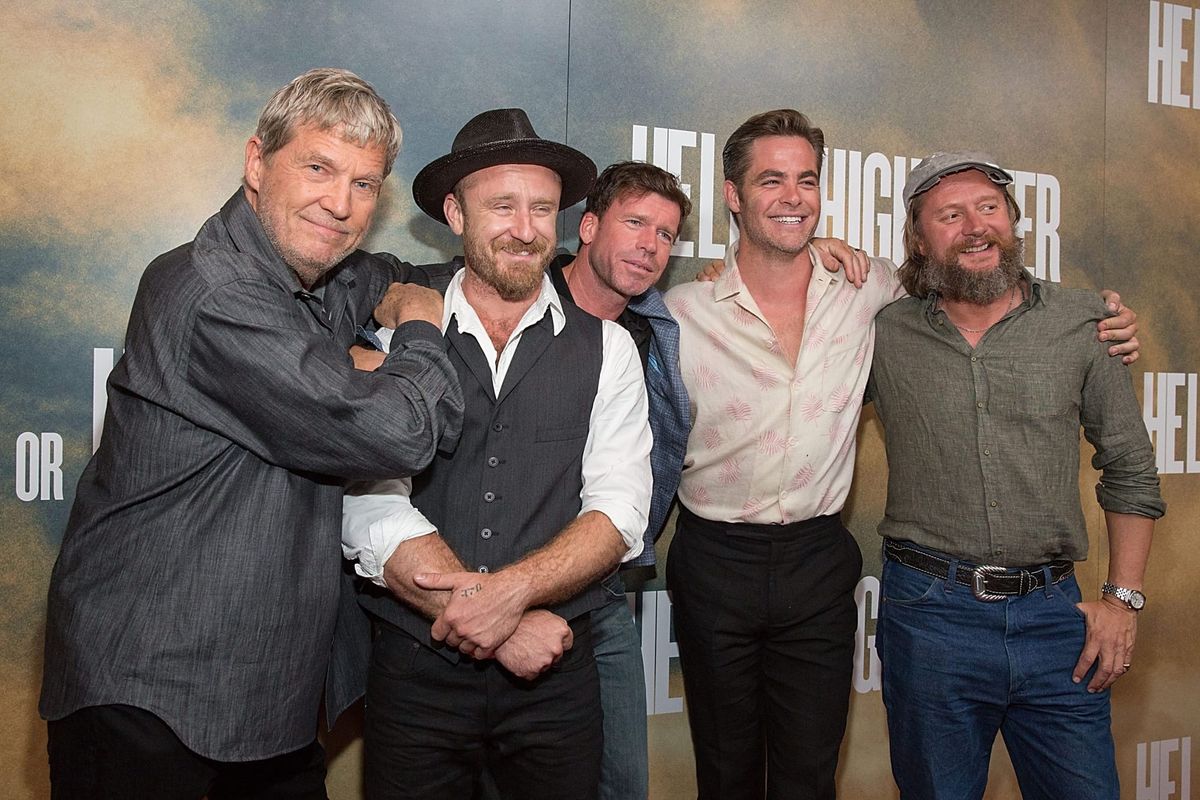
The West Texas neo-western is about two brothers, Toby and Tanner Howard (Chris Pine and Ben Foster), who rob Texas Midlands Bank branches. Toby, a divorced father of two, is the brains of the operation. He’s the quiet stoic one, and he devises the plan to save his mother’s ranch after she dies. If Texas Midlands Bank doesn’t receive $40,000, the property goes into foreclosure, but there’s more to it than just the loss of a piece of land and his mother’s memory. Black gold has been discovered in the soil. The scheme, if executed without any hiccups, is a smart one. Stealing from the bank that’s responsible for bringing stress into your life and handing that money right back to them? That’s a beautiful way to stick it to the man. More importantly, the Fosters have an opportunity to never go hungry — or need for anything — another day of their lives.
But of course, there are a couple of setbacks. Tanner is the hot-head ex-con brother, who acts on impulse. And if there are robbers, there’s gotta be cops too. Texas Rangers Marcus Hamilton (Jeff Bridges) and his partner Alberto Parker (Gil Birmingham) are on the hunt waiting for the brothers to make a mistake. On the surface, it’s a simple story told many times before. The film has the very bones of what makes a western great, down to its handsome leading man and climactic shootouts. There’s no high-minded deconstruction of the genre here, but the script, penned by Fort Worth-raised screenwriter Taylor Sheridan (“Sicario,” “Yellowstone,” “Landman”), opts for perfecting well-worn tropes. He built a world dominated by economic anxieties, the vestiges of a crumbling empire all around. Obviously, this is the crux of the entire plot, but it’s also found in the subtle things you’ll miss if you catch yourself doom-scrolling, like billboard signs advertising debt relief passing by in establishing shots. (Editor’s Note: Bridges worked with the real life sheriff of McLennan County, Parnell McNamara, to prepare for the role of a Texas lawman, as our editor-in-chief Olivia Messer reported in January 2017 for The Daily Beast. At least according to McNamara, that’s one of the reasons that Bridges’ character felt so realistic down to the details of his .45-caliber automatic weapon, Dodge pickup truck, and creased jeans: “He wanted to get everything right.”)
Another thing that strikes me is Hamilton and Parker’s relationship as partners is a brotherhood bound by the badge. Hamilton represents an archetype of whiteness. Parker, who is Mexican and Native American, is the source of constant racist jokes by way of Hamilton. His jest does not absolve the fact that he is a racist person, but he is the most common type of racist, or at least the traditional one we’ve seen for most of our lives. Broadly speaking, he does not see people of color as his equal, and he does not like Mexicans, although he may love a singular Mexican. In his mind, this is cover for the evil within. He may not see himself as a racist because he loves his partner, but the truth is, he’s a racist man with a badge.
At the film’s end, after all the bloodshed and spent shell casings, Hamilton and Toby meet face-to-face at the Howard ranch. Their chat considers if it was all worth it, if winning was the only thing that mattered at the expense of human values and morality. In the background, oil gets pumped from the land. Toby looks a now-retired Hamilton square in the eye and says, “I've been poor my whole life, like a disease passing from generation to generation. But not my boys, not anymore.”