A Dripping Springs Artist Talks Serendipity, Love of the Craft, and the ‘Fire in Her Belly’

On a recent Friday morning, I drove my daughter and four of her classmates from their school in central Austin to Dripping Springs for a seventh grade field trip.
Three rows of girls yell-sang Olivia Rodrigo as I contemplated my life choices.
Fridays are supposed to be my writing day. Two years ago, I quit practicing law to focus on writing and editing. And still, with two children and a million commitments, preserving time to write was a challenge. I was supposed to be ruthless, especially on Fridays. But the art teacher had looked particularly desperate when she asked if I could chaperone. And how much longer did I have to listen in on my daughter’s singalongs? So here I was piloting a minivan full of tweens instead of moving words around in search of a perfect sentence — the solitary, time-consuming activity that brought me so much joy.
We turned onto Nutty Brown Road to the tune of “Love Is Embarrassing.” The day was overcast, and the scrubby fields on either side of the road were yellow and brown. A few feet past a faded UVALDE STRONG sign on the side of the road, I saw the bright red gate I was looking for. I entered the code and drove over a cattle guard into a dirt parking lot. The studio beyond belonged to Daryl Howard, an artist who has been making Japanese woodblock prints for 50 years.
The girls, suddenly demure, filed into a bright, high-ceilinged room and sat down in two rows of folding chairs.
At the front of the room, a woman in charcoal gray joggers and a black T-shirt with a Japanese wave print stood with her hands clasped behind her back. I guessed that she was in her 70s, like my mother. She was compact, with a shock of purple hair behind a red bandana. Her arms looked muscular, her posture excellent. When she bowed to demonstrate how she greets every day by saying, “It’s a very good morning,” in Japanese, her back stayed at a perfect right angle with her hips. I felt a familiar charge of affection not unlike love at first sight.
Here was someone I could write about.
The first time Daryl went to Japan, she told the assembled girls and moms, she was 20 years old. It was the early ‘70s. The Vietnam War was ending, and the Air Force had sent Daryl’s husband to an airbase near Tokyo. They lived near the airstrip, where the ground shook constantly from little earthquakes and planes evacuating people from Saigon. Daryl, who had been teaching middle school art in Texas, got a job teaching art for a Department of Defense school. Every morning, she took a train from her apartment to the school on the military base, stopping along the way to buy two sweet potatoes from a man who baked them in hot rocks on the side of the road. The sweet potatoes warmed her hands in her pockets. By the time she arrived at school, they had cooled enough to eat.
I thought of the summer when I turned 21 and spent eight weeks studying Russian in an ancient town near the border with Estonia. I lived with a Russian girl and her Belorussian boyfriend.
On the weekends, my roommate’s mother brought fresh milk from the family’s dacha. The jar of milk sat out on the counter all week. In the mornings I skimmed a thick layer of cream from the top to add to my coffee. At the end of the week we used the remainder of the thickened milk to make tvorog, which was like cottage cheese but better. We ate tvorog with honey and tart yellow berries.
After my classes at the local university, I would walk to the center of the city, where I would sit on one of the stone benches that lined the cobblestone streets and pull out a black-and-white composition notebook. I filled several notebooks with my observations of Russian life that summer. When I got back to college in the U.S., I worked as a tutor in the campus writing center. I wrote incessantly, but I didn’t think of myself as a writer. Sometimes I wonder if there is another version of my life, one where I recognized in my twenties that writing was not just a skill on a resume but my one true purpose. After college, I tried a few writing-adjacent jobs, and then came law school and a family and all the things that make it hard for me to write today. If someone were to observe me for a week in my life now, they might conclude that my one true purpose was driving on MoPac.
I wanted to jump up and down in front of the rows of silent girls in Daryl’s studio. I wanted to wave my arms and shout: “Pay attention to the sweet potatoes! This woman is giving you a precious gift!”
***
In their first weeks in Japan, Daryl and her husband were invited to the general’s house. Daryl was a hippie with long hair and miniskirts at a military party. Fortunately, an American man at the party was excited to meet an artist. Claude Holeman, a civilian who’d lived in Japan for decades, invited Daryl and her husband to his house for dinner, where he showed her his extensive collection of ukiyo-e or “floating world” woodblock prints.
“I never looked back,” she said.
Claude introduced her to printmaking master Hodaka Yoshida, and Daryl convinced Yoshida to teach her. (Claude showed her how to bow deeply from the waist while holding out one hand with a rolled-up $100 bill.) By the time Daryl’s husband was transferred to Bergstrom Air Force Base three years later, she had fallen in love with Japan and the art of printmaking.
She cried on the plane back to Texas.
She studied printmaking at the University of Texas, where her professors criticized the technique she had learned in Japan, so she transformed a bedroom in her north Austin home into a studio and made her prints there.
She had found her life’s work.
Unlike me, Daryl continued to travel after her 20s. She visited Japan five times and spent time in many other parts of the world, learning, teaching, finding inspiration. But her art was rooted in central Texas. By 1987, her art was in 42 galleries. She had left a job teaching art in Eanes ISD, and her first marriage had ended in divorce.
Austin was getting crowded, and she needed someplace to put her animals: She had two horses and two longhorns.
Thinking “I’m outta here, man,” she entered into a contract to buy 10 acres in Santa Fe, New Mexico. That was when her realtor called to tell her about 20 acres in Dripping Springs. The house on the property was rundown, but it came with a horse facility. The first time she saw the land where she lives and works today, Daryl stood for a minute in front of the house, which was basically a roach pit, and then she walked down to Big Bear Creek and sat down on a rock.
“I am not leaving my Texas,” she thought. “This is home.”
Out of six potential buyers, the fact that the county bank that held the deed chose to take a chance on a divorced, female artist was evidence, to Daryl, that the ranch in Dripping Springs was her destiny. She moved a double-wide trailer onto the property, angering the neighbors. The art scene in Dripping Springs was no Santa Fe, but there was another divorced artist who lived nearby, and the two women sometimes took a bottle of wine down to Big Bear Creek. In 2014, after years of making her prints in a garage and using the trailer as her office, Daryl built the pristine metal and glass studio where we sat on that recent visit.
My eyes wandered from the vivid prints of blue water and luminous birch trees hanging on the walls to the cattle dozing in the shade beyond the floor-to-ceiling windows. This studio seemed like a perfect home for Daryl. Spare yet capacious, welcoming to visitors, but uncompromising in its aesthetic purpose.
***
Daryl invited the girls to stand up and crowd around a large steel and wood press. They awaited their job assignments in uncharacteristic silence. I hoped it signified awe. The white shelves and cabinets lining the studio looked custom-made, like Daryl had designed the space to her exact specifications. I looked down at my black ankle boots — they were half a size too big, but I’d been wearing them for a year. Daryl opened a cabinet to reveal a stack of wooden blocks, neatly labeled and numbered, for each print that she made. Some prints had six different blocks, each with its own intricate carving. Each block is inked and run through a press by hand until the image is assembled to Daryl’s satisfaction; some blocks have to be printed four times in order for the full depth of color to reveal itself.
“My life is in these cabinets!” she said, introducing the concept of keeping an inventory for tax purposes. (Another gift, my lawyer brain thought.)
When she squirted a dark blot onto the pristine surface of her shelves, I felt the moms on either side of me flinch. The water-based vegetable ink, Daryl explained, would not stain like Western dyes. Daryl supervised as the girls took turns brushing the ink on a carved woodblock with a special brush made of “Japanese pony belly hair.” Then she bent her purple head over the paper as she lined the edges to match the carved woodblock, a process called “registration.” The fit had to be perfect; if the paper was placed so much as a hair’s length off center, the colors wouldn’t print consistently and the design wouldn’t work.
“We don’t breathe when we do this,” Daryl said.
Perhaps we followed her instructions too literally, since a girl from my car got the hiccups. We walked outside so she could get her water bottle, and I hurried her back in. I didn’t want to miss anything.
Daryl had completed the registration and assigned the next task of guiding the block into the press to the smallest girl in the class, who looked hesitant.
“Do your work,” Daryl said.
I wondered if I was going to hear her voice the next time I sat down to write. The girl nudged the block, which was covered in a cottony thick piece of paper. Daryl’s adult assistant commanded the girls to stand back and leaned, shoulders first, into the spike of a giant wheel on the side of the press. We all watched as the block made its way slowly beneath the heavy weight and came out on the other side. The room was silent as Daryl uncovered the block, and when she smiled I saw the private joy that had nourished her love for this art for fifty years.
***
When I emailed Daryl to ask if I could come back to the studio to interview her, she agreed enthusiastically.
“I have had a ‘meant to be’ kind of life,” she wrote. “It continues.”
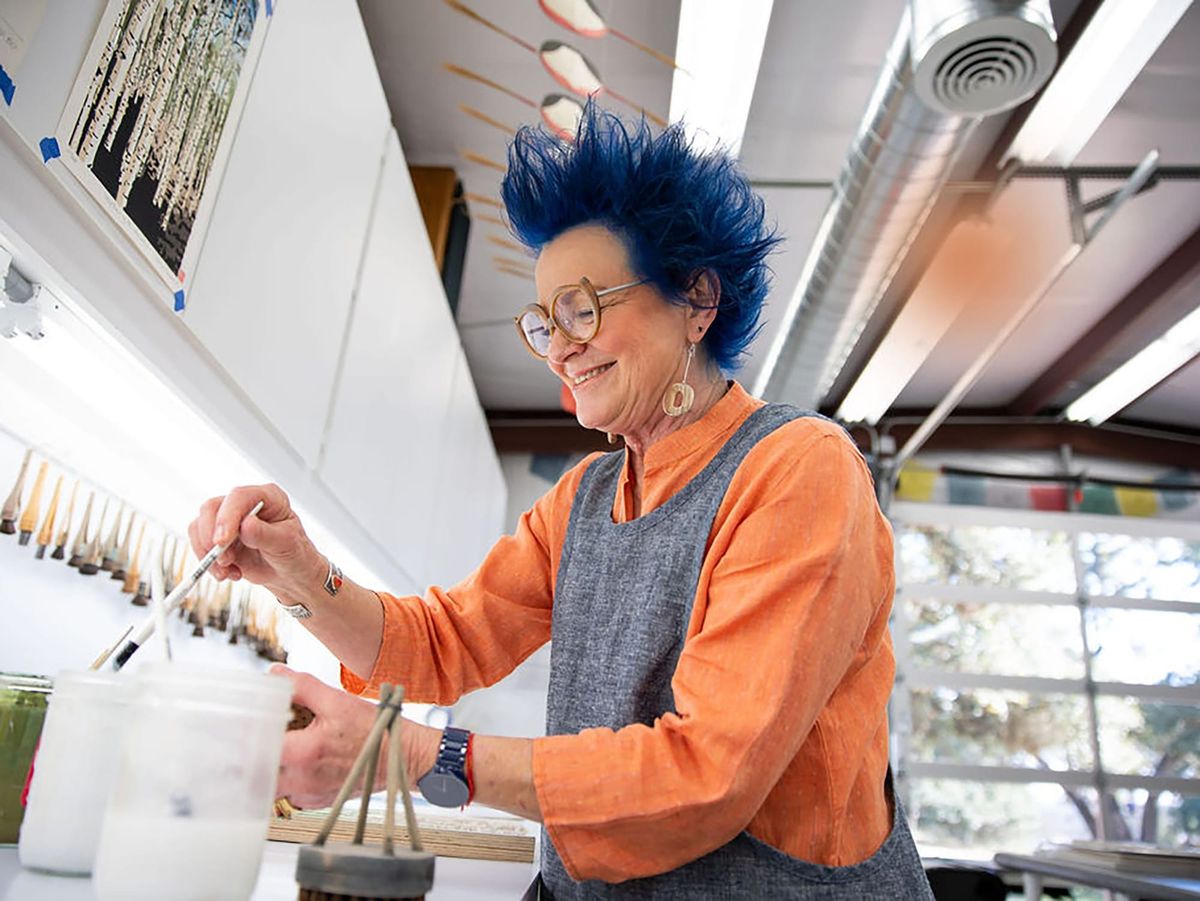
I drove back to Dripping Springs on a chilly morning in January, and we talked in the studio over mugs of hojicha tea. Her hair was blue. Her two dogs, whose Japanese names translate to Chopstick and Gentle Giant, tousled at our feet while we talked.
“Daryl Howard,” she tells me, “born in Del Rio and raised in Uvalde.”
She doesn’t drop into the third person often, but when she does it underlines her sense of wonder at the distances she has traveled.
Her father was Czech and her mother German-French. First-generation Americans, Daryl’s parents were hard-working, blue collar people. There was no art on the walls; Daryl doesn’t even remember being read to. But just across the border, a Mexican radio station blasted Wolfman Jack, the eccentric, gravelly-voiced rock and roll DJ that I knew from watching “American Graffiti” with my parents when I was young. Daryl was a baby in a crib when Wolfman was broadcasting.
She wonders if she caught his vibes.
At age two or three, she made her first work of art: an abstract design etched with a bobby pin on the painted metal headboard of a new bed, for which her reward was a spanking. She soon graduated to pastels, winning a blue ribbon in second grade for a drawing of Johnny Appleseed. Her father, a baker, delighted in her art. She majored in art at Sam Houston State University, where her mother insisted that she get a teaching degree. She graduated in three years because she wanted to get married to her first husband, the one who took her to Japan. “I’ve had this fortunate life,” she told me. “I got thrown into these situations. My fate, my karma, has brought me to these places, and I don’t even ask, I just keep going.”
It must have felt like magic to the girl from Del Rio to be transported to Japan, where the ground shook and men sold sweet potatoes by the side of the road. It must have felt like the hand of fate when she met Claude Holeman, a mentor well-connected enough to find her a Japanese teacher as well as clients and galleries back in the U.S.
Today, her woodblock prints are held in the Dawson Springs Museum and Art Center in Holeman’s Kentucky hometown, as well as the Blanton Museum of Art, the Nevada Institute for Contemporary Art in Las Vegas, the El Paso Museum of Art, and many other museums and institutions. Her work wins prizes in exhibits across the country. Last year, her print of Hamilton Pool was awarded first prize in Hope for Spring, an exhibit of local artists celebrating Texas water at the Neill-Cochran House Museum, where she will be a featured artist this summer, with an exhibit and printmaking workshop in June and a lecture about the history of Japanese woodblock prints in August. She is also a regular exhibitor at Austin’s annual Armadillo Christmas Bazaar.
When Daryl looks back on her path to becoming an artist, she sees a gleam in her timeline, like the seams of gold dust that she uses her breath to melt into some of her prints.
But I wondered: Did karma connect Daryl to the art that she was born to make? Or was the daughter of a stern Germanic mother and a father who worked for ButterKrust for 35 years the perfect person to devote herself to an exacting, ancient art?
And which was my meant-to-be life?
The life where I recognized my love of writing in my 20s and never looked back? Or the life I had, writing in the nooks and crannies of the family schedule, driving back and forth on the same highways, between errands and school pick-ups, in a cloud of ambivalence?
I wanted to know how she did it. How she held on to the love she’d discovered in Japan and brought it back to Texas. I asked about rituals. She mentioned the teapot that she used every morning, the tea that Holeman used to send her from Japan before she could buy it at Asahi Imports. But there was something more important she wanted to say.
“I have fire in my belly,” she said. “I have been gifted the ability to do this.” Daryl sees serendipity in everything. In the field trip, in this interview. “I just feel like this meant-to-be kind of thing,” she continues. “I am in an almost meditative state when I make my woodblock prints, when I draw, and when I’m developing them. It is so exciting. It is so fulfilling.”
Her art, she says, “gives me a reason to want to go on living.”
Driving over the cattle guard and through the red gate, I hoped that I had caught a little spark of Daryl’s fire.
Sometimes skipping a writing day ignites a flame. But nothing happens unless I show up to do the work. It helps to picture Daryl in her studio, holding her breath as she waits to see if the print will come out right.