This Texas Drag Queen Wants to Teach You How to Protest

Austin drag queen Brigitte Bandit knew she’d draw attention at the Texas Capitol last week. While speaking against Senate Bill 18 — which would withdraw state funding from any municipal library that hosts drag queen story hour events — she wore a Texas flag top with a white skirt listing the names of Texas pastors who have been accused or charged with sexual assault.
On the back, the skirt reads “Kids are safer at a drag storytime than at church.”
Bandit is no stranger to turning political theater into action. In 2023, she went viral for testifying in drag at the Texas Capitol against Senate Bill 12 and Senate Bill 1601, both of which targeted drag performers. Though SB 12 was passed into law, Bandit joined the ACLU in a lawsuit to block it from taking effect. The law, which sought to bar kids from drag shows, was later ruled unconstitutional.
Since then, the drag queen, whose signature look often includes a sky-high platinum blonde wig and a Dolly Parton-sized breastplate, has made public advocacy and activism as much a part of her job as brunch performances and themed tribute lip-syncs.
“I started to understand how a lot of politicians make it as difficult as possible to listen to their constituents,” she says, adding that even those who want to get involved don’t know where to start. “I wanted to make that information accessible and digestible to people in a way that didn’t feel defeating or devastating. I wanted to create something fun and engaging.”
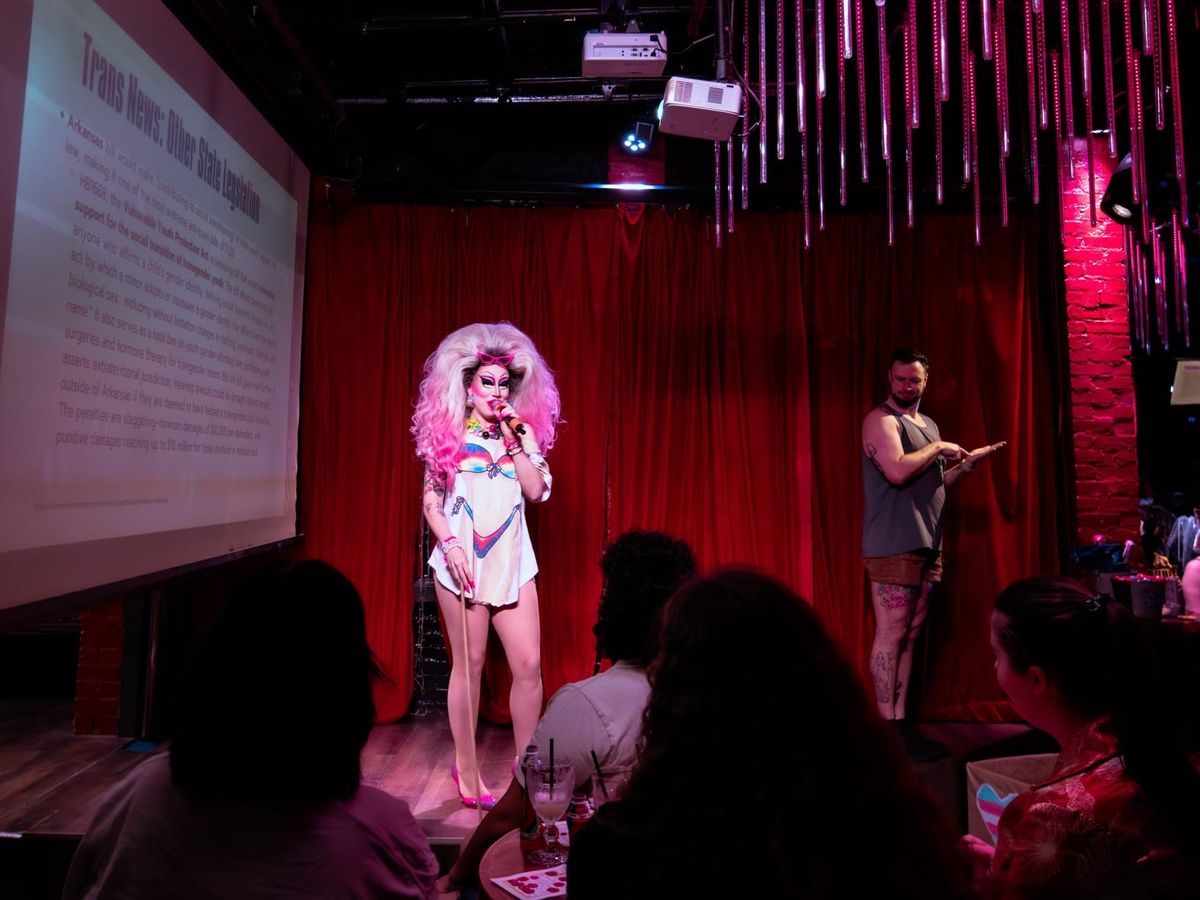
Thus, “LegiSLAYtion & Liberation” was born. Held every Tuesday at Oilcan Harry’s in Austin, the event begins with Bandit going over headlines in a game of “breaking news bingo,” before segueing into “Texas Tea & Policy,” to review proposed and concerning legislation.
These segments are followed by performances and presentations put on by other queens or local community organizations.
Previous guests have led talks on how to testify or drop a card at the Capitol, while others delivered presentations on disability rights, constitutional protections, and decolonization. Recently, Street Medics Austin taught a “stop the bleed” emergency medicine class.
Bandit spoke with The Barbed Wire about blending activism with drag, and LegiSLAYtion & Liberation, which continues through the end of the legislative session in June.
How has your drag changed since you first started? Is this what you imagined you’d be doing years ago?
BB: I actually didn’t get into drag until I was 26, around 2018. I think it took me a while to understand that somebody like me, who was born female, could be a drag queen. Once I figured that out, though, it was like hell yeah, sign me up. I’ve been doing that ever since, but no, I never imagined that I would be doing what I'm doing today, especially because we didn't have the volume of attacks on our community that we're seeing now.
When I started drag, it was just for fun. I had just gotten through a very abusive relationship, and kind of lost myself and all my confidence. I didn't know who I was, and drag kind of gave me that outlet to explore myself and to feel empowered again. I found a lot of strength through drag, and I also found community. I found people who really celebrated each other.
What inspired you to use drag as a form of political advocacy?
When we started seeing these attacks on drag queens and the queer community, I showed up to testify in drag, and I realized how much it really drew people’s attention to these issues. Bringing those two worlds together just kind of made sense. But also, from the very beginning, some of my first numbers were about reproductive rights and reproductive health care. So I guess I’ve always been a little political, but I didn't think I was going to end up suing the state of Texas with the ACLU. [Laughs]
You got a lot of attention when you spoke at the Capitol in 2023. What was that experience like?
It’s kind of crazy that the very first time I went to testify, it became worldwide news. I got a lot of love and attention, but I also got a lot of backlash from hate groups, to the point where I was doxxed online. I saw my information posted, and I just wanted to hide. I wanted to delete my socials, and I was nervous for my safety. But then I thought, You know what? That’s what they want me to do. If I do that, then they win. So instead, I blasted that post out into my followers and asked them to report it. It was reported so much that the [poster] lost their Facebook and Instagram. That really empowered me to not be silent. I realized it's not just me, I have a whole community supporting me. I have people who love me and who will fight for me too.
https://www.instagram.com/p/DJUbSWxNACi/?hl=en&img_index=1
Have you developed a strategy for the backlash now?
Now I really don't care. Whenever I see negative posts, I just clap back and try to poke holes in their logic and their stupidity.
When I’ve seen you clap back, a lot of your responses focus on the use of anti-LGBTQ legislation to distract from other issues affecting Texans, like the fact that we’ve led the nation in school shootings, or that we rank among the lowest states for school funding. What’s behind that strategy?
It’s because all of these issues are interconnected. The first time I went to testify at a hearing, I wore a dress that had the names of the children who died in Uvalde, and on the back I had, “Protect Texas Kids” and “Defend Our Kids,” which are the names of two anti-LGBTQ hate groups. I was purposely targeting them by using their language to address actual issues. I think I was just so angry because we had just had another mass shooting the weekend before they were hearing the anti-drag storytime bill, and on the same day, there were Neo Nazis outside a drag story time. I just thought, Fuck it, I’m going to make the biggest statement I can make. I called my mom to help me with that dress, and we both cried on the phone together. It was a really heavy thing to wear.
How does your experience as a female drag queen inform and shape the work you do?
At first, I was really hesitant to talk about being an AFAB queen. That’s why I wore the amount of makeup that I did. I didn’t want people to see me as a female drag queen, I wanted the illusion to be there and to play with gender a bit. So when I outed myself at the Capitol, I saw so many comments from women being like, Wait, I can do this too? At the same time, I was really frustrated as an AFAB drag performer when abortion restrictions were passed, and there was silence from the gay men in the community.
It was devastating for women and for people who give birth, and I was frustrated with the lack of solidarity I saw within the community. Because of that, it’s really important to me that even when a bill doesn’t necessarily target me, I still show up and fight back. I understand the importance of us standing together, and that an attack on any one of us affects all of us.
When it comes to Legislation & Liberation, what was your main goal with the event?
I just wanted to go through and talk about these things with everybody as straightforwardly as possible. Because as overwhelming as it is, you do eventually start to keep up with it and digest it. [Texas lawmakers and this administration] are trying to overwhelm us with all of these bills and executive orders, so let’s not let them. Let’s do this together and go through it point by point.
Texas Republicans filed a record number of bills targeting trans people this year. Why is it so important for people who aren’t trans to follow those bills and speak up against them?
I would say that the attacks on trans people affect other communities, too. Even anti-drag rhetoric is a way to attack trans people. But also, cis women are now being accused of being men in bathrooms, and things like restricting access to hormone blockers affect children who need them for other reasons. Anti-trans rhetoric is going to affect all of us, so it really is front and center for me to protect trans people.
SB-18 would restrict funding from libraries that put on drag queen story time events. What do you enjoy most about those events?
I’ve worked with kids in different capacities for years, and when I became a drag queen and was asked to do all-ages events, it was a no-brainer for me. But it was also funny, because the reason I was asked to do it was because no other queens wanted to. People try to make it seem like we get into drag to be around kids, when most drag queens don’t want that at all. [Laughs] When I did my first event with kids, they just loved it. I was dressed as Dolly Parton, and they treated me like a Disney princess. It was really sweet. They’re so funny and they really enjoy it so much, sometimes I have to hold back tears when I’m reading. I get to see the magic of drag through them in a different way.
https://www.instagram.com/p/DFQS3HopcAs/?hl=en
You said you never imagined being in this position when you started drag, what kind of future do you imagine for yourself now?
Honestly, I’m not sure where I’ll be in the future. I just want to keep showing up and see where that takes me. Maybe one day I can just do drag just for the sake of art, and just have fun again. That’s a dream of mine — where we can all feel celebrated and free. Is that going to happen in my lifetime? Who knows? But that’s the future I like to dream of.