Austin Firefighters Ring the Alarm Over $8.3M in Funding Cuts After Controversial Flood Response

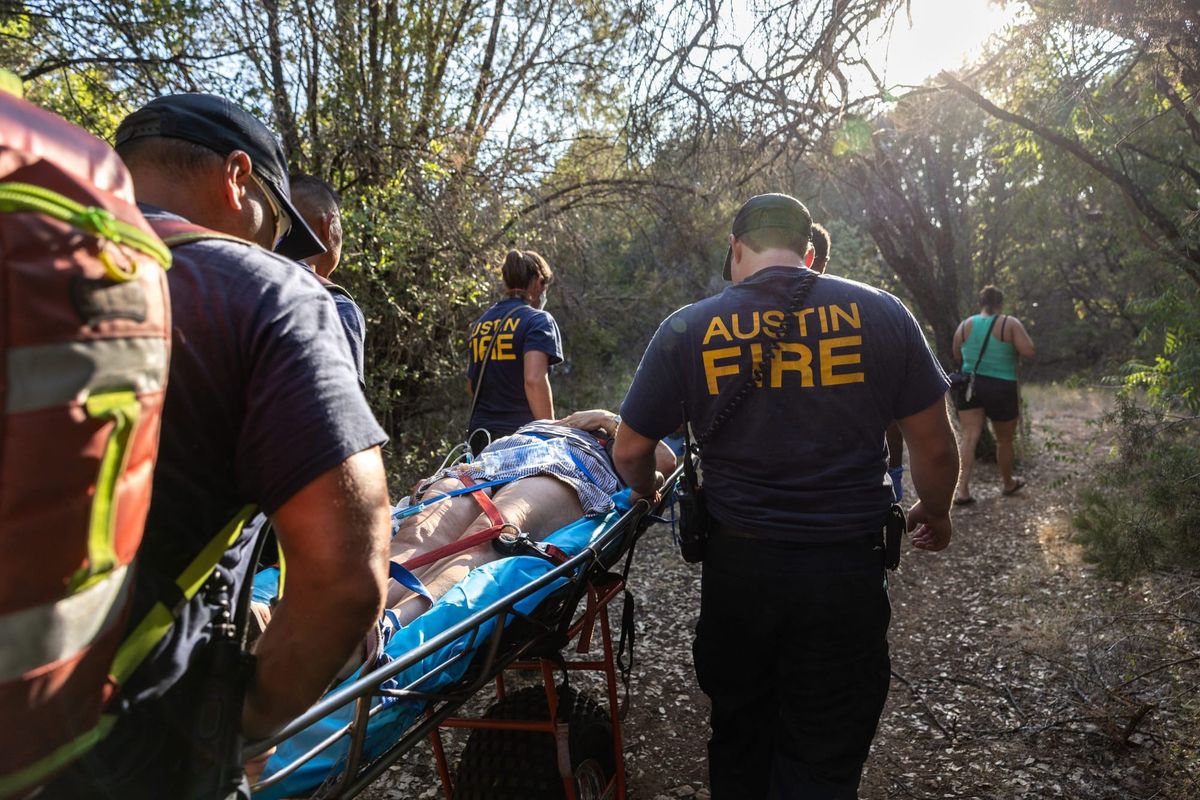
The Austin Fire Department is facing another blow after a chaotic two weeks.
Austin’s city manager released a proposed budget on Tuesday that includes a $8.3 million overtime funding cut for the Austin Fire Department as the Central Texas region is still reeling from catastrophic July 4 flooding that took at least 134 lives.
The announcement came days after 93% of Austin Firefighters Association members voted to approve a vote of “no confidence” in Austin Fire Chief Joel Baker. Baker had issued a nondeployment order that union leaders say prevented a better, early response to the epicenter of the floods.
The proposed cuts and infighting are happening at a critical time — President Donald Trump has plans to further downsize agencies that manage weather warnings and emergencies as experts warn of a greater likelihood of deadly weather events. The Austin Fire Department frequently serves as a critical lifeline to communities facing climate disasters in the capital and beyond — raising concerns about future disaster response in the region.
The City of Austin said in a statement that the reduction in sworn overtime is due to a planned restructure of the fire staffing model.
There’s a lot to unpack here. Let’s start with the Austin Fire Department's flood response.
What Was Austin’s Role in the July 4 Floods?
Located between flood-prone river valleys and hurricane territory, Austin has one of the best trained flood response and swiftwater rescue teams in the state, and regularly deploys crews to disasters. For example, in June 2024, Austin Fire Department deployed 10 crew members to parts of Texas that were expected to be hit by Tropical Storm Alberto. This is a relatively regular occurrence, given that smaller municipalities lack the budget to train and maintain substantial emergency response teams.
Bob Nicks, president of the Austin Firefighters Association, told The Barbed Wire that some personnel were contacted on July 2 and July 3 by the state task force that manages swiftwater response ahead of large-scale disaster events. Austin firefighters didn’t respond due to the standing order that suspended deployments through Oct. 1 due to budgetary reasons.
“The whole nature of emergency response is to anticipate problems and pre-deploy,” Nicks told The Barbed Wire. “So you have resources on scene when it happens, rather than reacting when it's already occurred, and then trying to get there eight hours behind.”
On July 4, as the flood waters were already raging, the Austin Fire Department deployed a team of three rescue swimmers, and further personnel were deployed in subsequent days.
Austin Firefighters Association’s Mutiny
On July 7, the Austin firefighters union published a Facebook post accusing Baker of delaying the deployment of swiftwater response teams for budgetary reasons. At the root of the issue is the aforementioned standing order from AFD leadership, which said deployments were suspended through Oct. 1.
“My frustration is that Chief Baker had a standing order to not deploy,” Nicks told The Barbed Wire. “We would have had our boat teams on site the afternoon of the third we had accepted the first request.”
“The fire chief, in my professional assessment … caused lives to be lost.”
On July 11, 93% of members cast a vote of no-confidence in Baker, with only 4% in opposition.
Baker said in a statement shared with multiple news outlets that Austin Fire Department had to “prioritize having sufficient resources in our own community” given the risk for flooding in Austin during that time, and that it did send three rescue swimmers and would continue to support the response to the floods in Central Texas.
Baker also said that the department deployed three rescue swimmers on July 4 to serve with the Texas Task Force 1 helicopter search and rescue team, and that eight more personnel were deployed on July 5 and 6.
Randell Nations, a retired Austin firefighter who was a swiftwater expert and trainer, told The Barbed Wire that teams that answer deployment requests are typically backfilled with people from other shifts. “The city of Austin is never, ever left uncovered,” Nations said.
“The type of flooding that came in less than an hour, to not have those assets there and pre-deployed,” Nations said, was “unbelievable.”
City leaders have criticized the union’s public denouncement as politicization of the disaster, and questioned the timing, which overlaps with the union’s final stretch of labor contract negotiations with the city. On July 8, Austin Mayor Kirk Watson issued a statement, saying “I'm very disappointed in Bob. In this awful time, he shouldn't be politicizing this horrible loss by making it part of budget negotiations and the collective bargaining with the union.”
But that’s not how Nations sees the situation.
“This is pure and simple mismanagement at the highest levels that in all the way up to the fire chief, the city manager and the Mayor of the City of Austin,” Nations told The Barbed Wire. “Some of the pushback we've gotten is people asking why are y'all doing this now, when this is all still going on?”
“Because we're still affected,” Nations added, “and because the city is coming out, making these statements, trying to cover their ass when they get some of the state's best first responders in house.”
Austin Fire Department’s Budget Woes
On July 15, Austin City Manager T.C. Broadnax announced the proposed 2026 city budget, which includes an $8.3 million cut to the Austin Fire Department overtime funding. In recent years, the department has exceeded its allocated overtime budgets, and this April the City of Austin projected a $33 million deficit for 2026.
The budget deficit is thanks to costs rising faster than revenue sources. One of the largest revenue sources, sales tax, has slowed amid inflation and economic uncertainty. Compounding the issue is the Trump administration’s delay or cancellation of federal grants and reimbursements.
The proposed cuts to firefighter overtime would almost certainly impact disaster deployments, even if Austin Fire is able to increase the number of personnel. Per a 2023 audit, “overtime expenditures go up when [Austin Fire Department] tackles these low frequency, high risk situations throughout the community and the region.”
The City of Austin said “the $8.3 million reduction in sworn overtime is due to a planned restructure of the fire staffing model,” in a statement from Kimberly Moore, a business process consultant with the city, to The Barbed Wire. The statement continues: “This restructure will ensure 24 personnel are available at the scene, which stays above the national standard of 17 personnel. This model will not impact the effectiveness and response of the Austin Fire Department"
What Do Cuts To Austin Fire Department Mean for Texans?
The timing of the proposed funding cuts — paired with proposed federal funding cuts to weather science and disaster response — raises significant questions regarding future disaster preparedness in Texas. Less resourcing for one of the largest fire departments in the state, at a time when climate disasters are increasing in frequency, bodes ill for smaller communities that have fewer resources.
“What you see in Texas is a whole bunch of overlapping teams in highly dense population areas like Houston or places like that,” said Chris Boyers, executive director of the National Association For Search And Rescue. “Then in places like Kerrville, with a low density population, you don't see many active members of teams.”
In parallel, hold ups in federal response to the flood, delays in federal funding applications for disaster relief, and the proposed elimination of the Federal Emergency Management Agency are leaving state lawmakers in fear about what could come next. Trump has said he wants states to do more to handle the cost of disasters, but few states, if any, are currently prepared to go it alone.
If federal funding for disaster response does dry up, as some have predicted, then states will likely have to rely on each other for support — creating new friction as states haggle over who should pay for what.
“Let’s say Kentucky calls FEMA and says we have a disaster here. And FEMA picks up the phone and makes a couple of phone calls and launches other state task forces to Kentucky. FEMA pays for it,” Boyers told The Barbed Wire. “If FEMA gets out of that business and gives it to the states, when Kentucky has a problem, what Kentucky is going to have to do is they're going to have to make a phone call to Tennessee and say will you send your task force?”
That same interstate problem applies within states as well, given that most states pay for a fraction of their overall disaster response budgets (the majority comes from federal support). If large municipalities like Austin are also facing budget squeezes, they may be less willing and able to lend resources to smaller surrounding communities in need.
“About 80% of fire departments in the United States are still volunteer departments,” Boyers said. “But typically the volunteer fire departments have a community budget of some sort to handle their insurance, sometimes their training, vehicle maintenance, some of their resourcing, if not their hours, and now that's going to go away. A lot of that came from FEMA.”
It is possible that the legislature could recognize this problem and utilize our substantial budget surplus to ameliorate these issues, at least within the state of Texas. Gov. Greg Abbott recently announced a special legislative session with a large number of priorities, including: flood warning systems, flood emergency communications, relief funding for floods, and natural disaster prevention and recovery.
Whether the state legislature will go far enough is ultimately the question. Texas is already behind other states when it comes to disaster prevention legislation.
“California has a legislation for search and rescue, giving it to the county sheriffs,” Boyer said. “And there are 58 counties in California that do that. But when you go to the 200 plus counties in Texas, there is no legislation. There's nothing that says the sheriff has to have a search and rescue team.”
The Barbed Wire’s Senior Editor Leslie Rangel contributed to this report.
An earlier version of this story incorrectly stated the budget cut figure, that number has been corrected.