The Free Speech Crisis for Black Americans Is Worse Than You Think
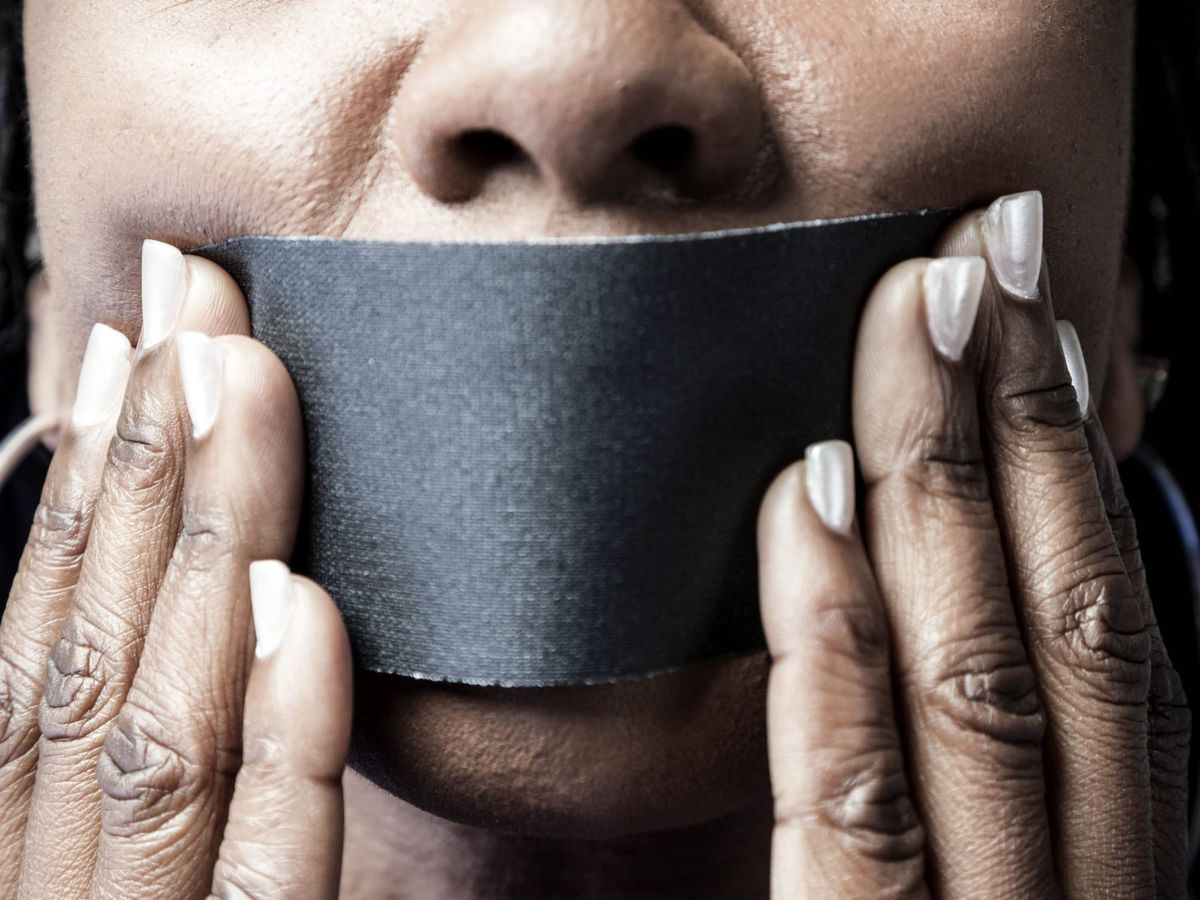
America, we have a problem.
In the weeks since the assassination of conservative political activist Charlie Kirk, historically Black colleges and universities have experienced terroristic threats, Black students have been expelled or withdrawn for expressing their first amendment rights, and prominent Black journalists have been fired for social media posts.
That’s a big news story, and one that I set out to tell for The Barbed Wire. In its infancy, the story was about how HBCUs should not be held accountable for Kirk’s death. Except I struggled to get anyone to talk.
Now, it’s an essay about how — and why — that initial piece never came to pass. Because a failed first attempt led me to another big story: In all my years of journalism, I've never seen so much fear from subject matter experts.
Since President Donald Trump took office, his administration has restricted Associated Press access to the Oval Office, threatened to revoke foreigners’ entry to the United States because of their commentary on Kirk, and withheld funding from higher education institutions because of their alleged “antisemitism and ideological indoctrination.” Despite positioning himself as a champion of free speech, Trump has reignited a war on not only freedom of speech, but academic freedom as well, with many left in fear of backlash and retaliation.
More than 50% of American voters are pessimistic about freedom of speech being protected, according to a Quinnipiac University poll released on Wednesday. Almost 80% of those respondents said the nation is in a political crisis.
Jimmy Kimmel’s return to his late-night show on ABC this week has dominated much of the conversation. Kimmel was suspended after Brendan Carr, the chair of the Federal Communications Commission, urged broadcasters to stop airing the show, saying they were “running the possibility of fines or licensed revocation from the FCC.”
When he returned to the screen on Tuesday night, Kimmel encouraged the American public to be mindful of the privileges of living in a country with free speech.
He described the actions taken against his show by the FCC, along with Nexstar Media Group and Sinclair Broadcasting Group (which together own more than 300 TV stations across the country), as “un-American” and “dangerous.” He made a triumphant return to air, and his Wednesday night monologue got stellar ratings and has racked up more than 20 million views on YouTube. But Nexstar and Sinclair both refused to air the late night show on their respective affiliate television stations throughout the U.S.
Kimmel has garnered the support of several Republican senators, such as Mitch McConnell, Rand Paul, and Ted Cruz, who warned fellow conservatives that continued actions by the Trump administration against free speech could result in future retaliation by Democrats in the event they regain control of the White House: “They will silence us, they will use this power, and they will use it ruthlessly.”
But, there is already a group of Americans that are actively being silenced over fears of professional and institutional retaliation.
They are worried about the future of their careers.
They are afraid of their words being used against them.
In the first 20 hours after Kirk’s assassinations, multiple HBCUs were placed on lockdown, which led me to reach out to Black professors at both HBCUs and predominantly white institutions to inquire about conversations being held on campus about safety.
That week, I reached out to numerous experts in the fields of capitalism and politics, Black women’s history and political violence, race and political ideology, race and democracy, and civil rights law. Only one responded; after talking on the phone, she agreed to let me use one quote about the fear of reprisals.
That professor, author, and expert on racial politics who teaches at a public university in Texas told The Barbed Wire: “We are very much in a conundrum right now. I'm very much in a personal conundrum about how I manage the rest of my career that I thought would be spent teaching and working with students for the rest of my life, and I am no longer sure that's going to happen.”
“What do you do? That’s the question I think everybody's asking right now,” the professor continued. “What do we do? The thing that's really sad about it is you wanna stay in the trenches with these kids as long as you possibly can, but you also want to get out before you drown. These kids deserve better.”
Devion Canty Jr., a former student at Texas State University, withdrew from the university after he received backlash for his behavior at an on-campus vigil for Kirk. Gov. Greg Abbott called for his immediate removal from the student body.
Camryn Giselle Booker, a former student at Texas Tech University, was arrested by university police and charged with simple assault after videos of her conduct at a wake for Kirk went viral online. Once news of her arrest went public, Abbott celebrated on social media: “This is what happened to the person who was mocking Charlie Kirk’s assassination at Texas Tech.
We don’t know the racial makeup of the more than 350 complaints filed against Texas teachers for alleged comments on the killing of Kirk — but I’d be willing to take a guess. Six school districts have already taken disciplinary measures against staff: Klein Independent School District fired a teacher, and Ector County Independent School District fired a part-time tutor and placed another employee on administrative leave, according to Texas Tribune.
“What started with lawmakers weaponizing their platforms against civil servants has morphed into a statewide directive to hunt down and fire educators for opinions shared on their personal social media accounts,” Zeph Capo, president of the Texas’ American Federation of Teachers union, told the Tribune.
It’s not just in academia and education, either: In Cleveland, Ohio, a Black fire chief was placed on paid leave over his social media posts, which included a political cartoon.
Meanwhile Karen Attiah, an award winning Washington Post editor and columnist, was fired from the publication because of her social media posts about Kirk. She and the Post’s labor union have filed grievances against her former employer. Her grievance states that “she should have been allowed to share her views on news events under the company’s labor agreement and social media policy.”
“The First Amendment is only as good as the people who decide to defend it, particularly journalism institutions that depend on that First Amendment,” Attiah said in a podcast interview with “What Next” at Slate. “I’m watching Jimmy, but I’m also still fighting my own case. There is still this climate of intimidation against media broadcasting networks, against anyone who criticizes, whether it’s Trump or Charlie Kirk’s legacy... That threat is still there, even though Kimmel is back.”
The Washington Post has expressed no plans to reinstate Attiah.
When I followed up with the one professor who agreed to speak with me off the record, they told me that they questioned whether or not it was a good idea to talk to the press.
That certainly doesn’t speak well for the current state of the country.
How are we supposed to write about free speech when people are scared to talk to journalists?
Are we not afraid of the precedent this creates for our constitutional rights?
Thomas Alter, a former associate professor of history at Texas State University, was dismissed from teaching at the public university after a complaint was filed against him over his participation at a virtual socialist conference. He’s suing — and has inspired protests.
Alter’s firing should scare you.
Mark Zoran, a former head in the College of Arts and Sciences at Texas A&M University, and Emily Johansen, a former English department head at Texas A&M University, were fired over classroom discussions of gender and sexuality.
Their terminations should be of great concern to you.
Whether you agree with the actions of the current presidential administration, the fear of retaliation, and the censorship birthed from it, is dangerous to all Americans, but especially those who are not represented in the demographics of the current White House.
The truth of the matter is that freedom of speech has never been a constant for those who are not born white and male in the United States. Black Americans have always had to exude a God-like aura of civility and patience in order to get their point across, in the midst of intense violence by the state and the government.
The majority of banned books are by Black authors — a University of Colorado Boulder study found that authors of color were 4.5 times more likely to be banned than white authors.
But, who cares? Where is the uproar? Where is the concern? I grow weary of hearing that Black Americans are the canaries in the coal mine. There are more dead canaries than coal at this point.
The lack of empathy for Black voices, like Attiah’s — but also the students, teachers, professors, and first responders who haven’t been vindicated like Kimmel — is the clearest and coldest indicator of what’s to come. And what is here.
There are no birds left to sing, just a clear and cold silence in the air and the spirit of submission.