Your Local Ballot Actually Matters More Than the Presidential One

Early voting is underway for the Nov. 4 election, and you may be asking yourself, what’s the point?
Don’t worry, you’re in good company. Texans love to gripe about property taxes, potholes, and school funding, but when it’s time to vote for the people who actually fix (or ignore) those things, most folks suddenly remember they’ve got laundry to do.
Sure, we show up for the flashy stuff: presidents, senators, maybe governors if the attack ads are spicy enough. But the elections that decide your water rates, your kid’s school, and whether your street gets paved? Crickets.
Jon Taylor, chair of the political science department at the University of Texas at San Antonio, tries to hammer that point home to his students.
Unlike federal elections, those “at the state and local level — particularly the local level — often have far more direct impact on citizens’ lives,” he told The Barbed Wire.
“From taxes to infrastructure to education to water to public safety to quality of life, these elections’ potential for immediacy regularly ignites great passion and usually end up suffering from low voter turnout anyway,” he said.
Brandon Rottinghaus, a political science professor at the University of Houston, put it even more directly.
“Decisions made at the local level affect people’s day-to-day lives,” he told The Barbed Wire. “Local officials set policy on education, policing and public safety, water supply and drainage, local taxes, and road maintenance.”
“These policies are often more influential on life than federal decisions,” he added.
And yet, almost no one shows up.
Oklahoma City just approved a $2.7 billion bond package for civic improvements — the largest in its history. Sounds like a big deal, right? Less than nine percent of voters bothered to participate, Taylor said.
Texas isn’t much better. Taylor said off-year elections for state constitutional amendments typically draw fewer than 10 percent of registered voters. Even hot mayoral races in big cities rarely crack 20 percent, he said. (Austin’s an exception — it moved its mayoral elections to even-numbered years, and turnout shot up to around 51% in 2024, he said.)
But that apathy has a silver lining: It gives even more power to those who do vote.
“A voter’s vote carries more weight in local elections because turnout tends to be smaller … so each individual vote has a bigger influence on the outcome,” Rottinghaus said.
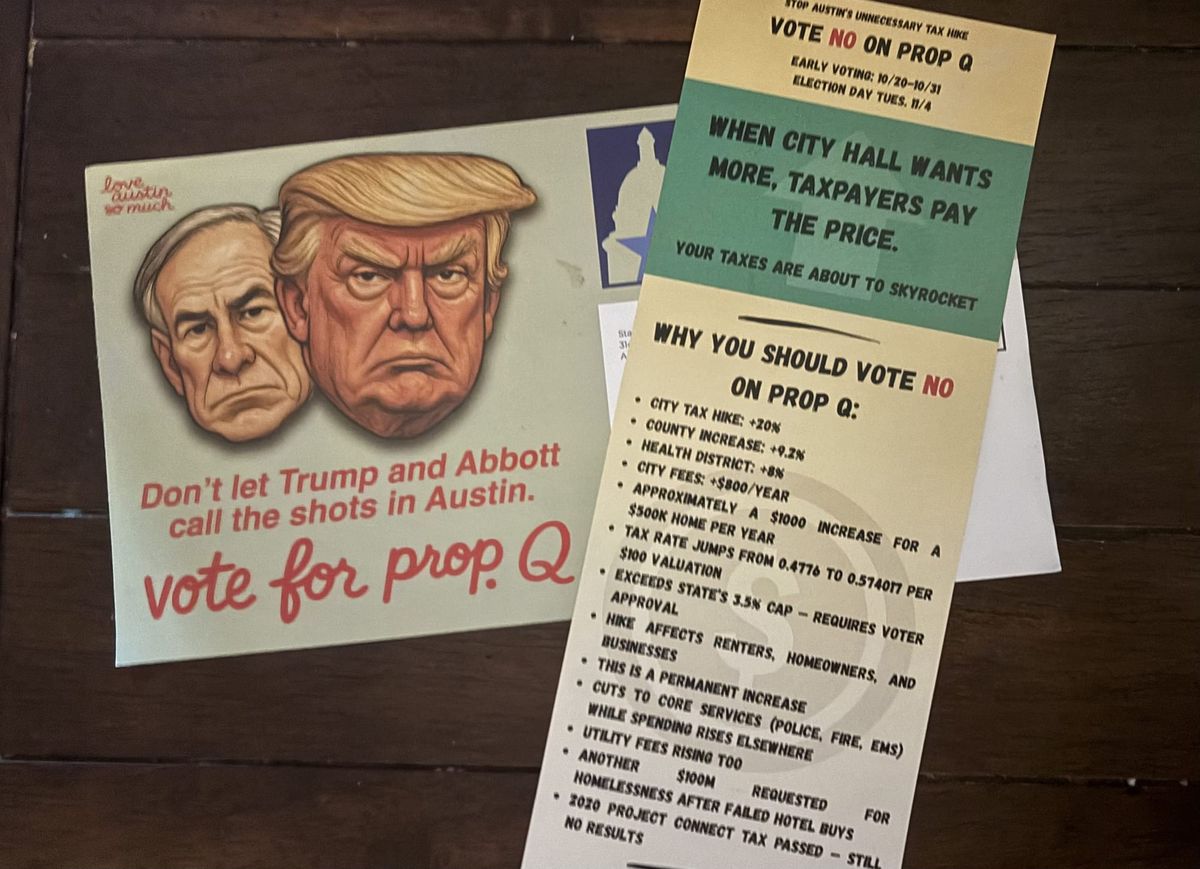
And it’s not like this year’s ballot is boring. There’s plenty for Texans to weigh in on. In Austin, Proposition Q would raise the city’s property tax rate by 20 percent to maintain basic city services. San Antonio voters are considering two proposals — Propositions A and B — that would increase the hotel and car rental taxes to fund a new Coliseum Complex and Spurs arena.
Meanwhile, Houston and Tarrant County are holding special elections to fill vacant seats in Congress and the state Senate.
Statewide, there are 17 proposed state constitutional amendments and dozens of local measures on the table this fall — representing billions of dollars and major policy choices.
When I asked Taylor if this election feels any different, he said there are a few shifts worth watching.
“I definitely see a few differences this time,” he said. “Austin asking for a tax increase to fund municipal services is definitely one where tax cuts and tax caps by the Legislature have starved local governments.”
In Austin, the aforementioned Proposition Q would raise the city’s property tax rate by 20 percent to maintain basic city services. The $110 million increase would cover both existing needs, like fire department overtime and low-income housing assistance, and new initiatives, including expanded mental health programs, park maintenance, wildfire prevention, and a more than doubling of the Homeless Strategy Office budget.
That measure has generated some backlash, though, as various anti-tax groups have been railing against the increase.
(Case in point: As I was writing this story, I got an anti-Prop Q text. It urged me to vote no, saying, “Austin is already too unaffordable for so many.”)
And early anecdotal evidence doesn’t look good for the measure. CBS Austin reporter Vinny Martorano interviewed in-line voters on the first day of early voting on Monday.
“Everyone I’ve spoken with is voting no,” he wrote on X.
Meanwhile in San Antonio, North East ISD is holding an election for a whopping $495 million bond proposal.
Taylor said that is a response to “state property tax cuts and the budget fight between Abbott and the Legislature in 2023 that led to budget shortfalls and (staff cuts) in a lot of school districts across the state.”
Rottinghaus agreed that the local level is where the state’s biggest political fights now play out.
“In particular for Texas, school boards and municipal officials are all elected locally, so battles over budgeting, curriculum, and bond proposals are all on local ballots,” he said.
And local elections are often about more than potholes and property taxes — they’re a way for voters to push back against state overreach.
“State laws in Texas often seek to limit the power of cities and counties,” Rottinghaus said. “When voters vote locally, they can express their willingness to embrace those limits or to resist those changes.”
Similarly, when local officials are up for reelection, voters have the chance to deliver a verdict.
“Holding local leaders accountable lets voters reward good governance or punish mismanagement,” Rottinghaus said.
So that’s why state and local elections matter. The bad news is that most people don’t care.
Taylor predicts turnout will once again be dismal — somewhere between 8 and 15 percent. For context, he said, the last time Texas broke 20 percent turnout in an off-year amendment election was way back in 1991 — the year voters created the state lottery.
Taylor’s advice? Stop treating local elections like the junior varsity game.
“Given that, on occasion, it literally comes down to a handful or even one vote, your vote really matters in local elections,” he said.
So yeah — your local vote doesn’t just count. It’s where the real power is, hiding in plain sight.