Healthcare for Trans Veterans Was Already Bad, And Under Trump It’s Getting Worse
Under policies adopted last year, the VA now refuses to support newly transitioned veterans. Even accessing routine healthcare can be a challenge.

Holden will never forget the discomfort he felt on his second visit to a Veterans Affairs’ endocrinologist for gender-affirming care.
It was spring of 2020, and the COVID-19 pandemic was raging across the globe. The army vet was masked up in a tiny, stuffy exam room, when his endocrinologist asked if she could invite medical students to join them. At first he refused, but he said his medical provider “guilted” him into agreeing:
“She closed the door, and (said) ‘this is kind of like for the benefit of future trans people coming in, these students are going to become doctors here, etc.”
Two medical students entered the room and began a hands-on examination of Holden, including asking him to remove his face mask so they could study the growth of facial hair, and requesting that he remove his shirt to show his scars from chest masculinization top surgery. (The Barbed Wire agreed to use only Holden’s last name to protect his privacy.)
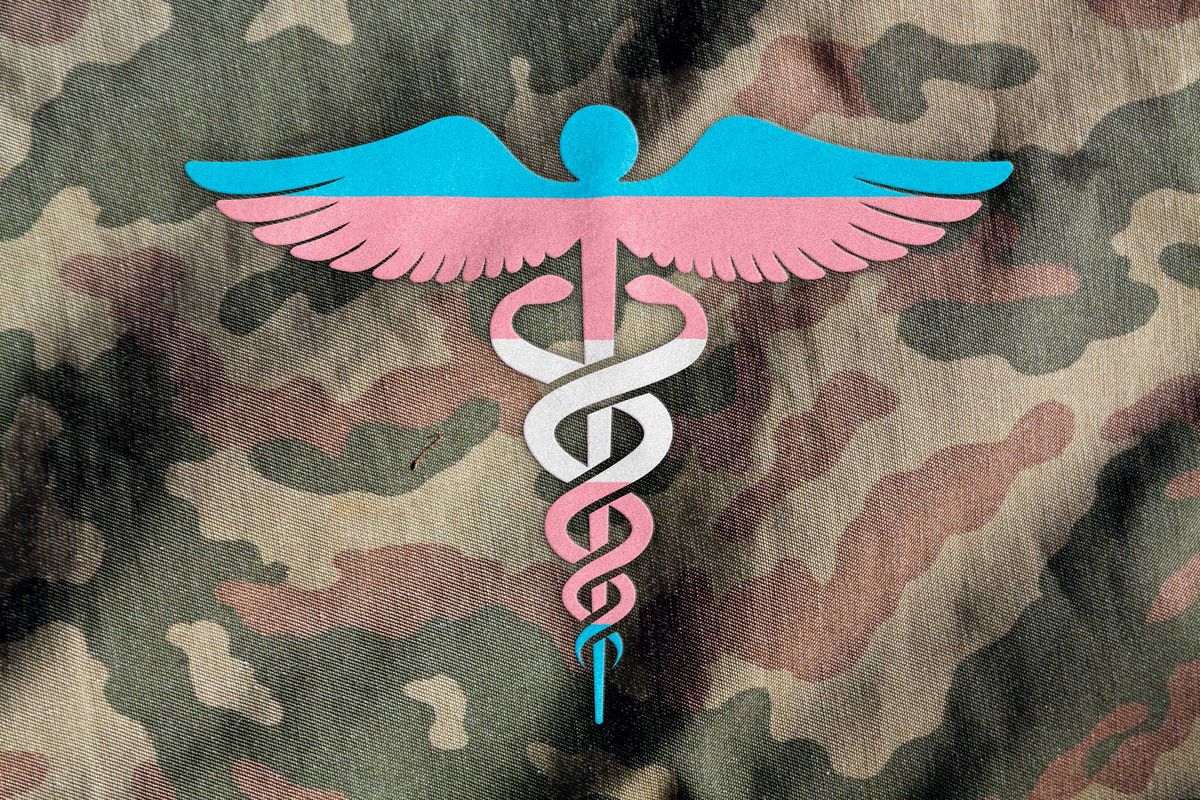
As illustrated by Holden’s experience, accessing healthcare has long been fraught with challenges for transgender veterans, even before President Donald Trump’s second administration when the VA used to offer a wide-array of gender-affirming care services. Supportive practitioners exist within the system, but so do numerous roadblocks. And today, newly transitioned veterans are excluded entirely.

Holden, who served in the military from 2012 until 2019, began transitioning soon after his contract with the army ended. But before he could be referred to an endocrinologist, the first practitioner he approached in the VA told him (incorrectly) that he’d need to travel from Phoenix, Arizona, where he lived at the time, to Boston, Massachusetts, in order to receive gender-affirming care. He only made progress after demanding a new primary care physician.
Holden was stationed at Ft. Hood, then moved to Austin as a veteran in 2023, and he still receives his testosterone prescription through the VA. He’s among a dwindling number of trans veterans who can access hormone-replacement therapy through the system. In March 2025, the VA announced it would “phase out treatment for gender dysphoria,” although it continues to offer care to those who transitioned before the change was announced, or who are already receiving hormones in the military when they separate from service.
The move was made amid attempts to ban transgender servicemembers from the military by Secretary of Defense Pete Hegseth, and nationwide attacks on gender-affirming healthcare, driven by the American right-wing.
At the same time, a recent court decision has brought renewed attention on trans people in the military: Earlier this month, the U.S. Court of Appeals for Washington, D.C. ruled that banning existing transgender servicemembers was unconstitutional, although the decision allowed the military to continue its ban on new enlistment by trans people. The U.S. has promised to appeal the decision.
The ongoing court cases over the ban have left servicemembers like Kara Corcoran, executive director of Sparta Pride in limbo.
“I'm still an active duty infantry officer,” she told The Barbed Wire. “I haven't been allowed to go to work in a year.”
Sparta Pride is a D.C. nonprofit that supports transgender servicemembers, veterans, and their families through political advocacy, peer support and emergency grants. She explained that the Department of Defense has transformed what used to be the pathway to accessing care into the reason to deny service, for troops and vets alike.
“Per the policy, you're supposed to get a letter from within the (Department of Defense), from a DOD doctor to say you have gender dysphoria.”
This is in keeping with the World Professional Association for Transgender Health’s standards for gender-affirming healthcare, which requires diagnosis and treatment by a mental health professional as part of best practices for trans patients. Although still the traditional approach, some providers have moved to an informed consent model, which allows trans people more agency to make their own medical decisions without a formal diagnosis from a psychiatrist.
Regardless, under the VA’s previous healthcare policies, a diagnosis of gender-dysphoria opened doors for people like Holden. Although gender-affirming surgeries were not available, trans vets and servicemembers used to be able to access vocal training, support groups and a variety of devices such as prosthesis and chest binders, in addition to hormone-replacement therapy. All of those programs are either gone, or increasingly difficult to access for those who remain in treatment.
Now, Corcoran continued, the diagnosis of gender dysphoria is used to pathologize trans folks as mentally ill, who are then told their illness makes them unfit to serve in the military, and unworthy of treatment that directly addresses their needs.
“They said we had to get (the diagnosis), that it was just for insurance … and now that’s the thing they’re using to ban us,” Corcoran said.
Corcoran pushed back against the idea that gender dysphoria itself had prevented her from serving her country. “We’ve seen that getting the treatment you need allows you to optimize your performance as a servicemember.”
Holden agreed about the benefits of taking testosterone on his well-being and ability to function. “I am a totally different person,” he told The Barbed Wire. “I'm not angry anymore; I've been more optimistic now than I was pre-transition.”
For transgender veterans before the ban, or those who, like Holden, are still allowed to keep their existing care, Corcoran suggested the quality of treatment available varied greatly from provider to provider, and depended a great deal on where they’re located. Major urban areas tend to have more providers who are up-to-date on the latest, best practices for treating trans folks. In addition, turnover within the VA health system can be extremely high, so there’s no guarantee of keeping a supportive provider once you find them, as Teván Perez, an Austin Air Force veteran, discovered after beginning his transition.
“I have been through four psychiatrists at the VA at this point since 2021 and the first few were very against me starting testosterone,” Perez told The Barbed Wire.
After seeing previous providers, Perez was afraid that testosterone would interact with his psychiatric medications. His fourth psychiatrist explained that there were no contraindications; his previous providers had simply not been supportive of his transition. It was only then that Perez felt confident seeking out hormone replacement therapy. However, he recently found out his psychiatrist would be leaving the VA. “I had him for about two years, and so… I had him for the longest out of all the previous psychiatrists.”
Similarly, Holden recently found out that his primary care physician had moved on when he struggled to refill his testosterone prescription. After days of silence, he finally reached the nurse who had worked with his previous doctor who explained that she’d left the VA. He ended up going weeks without his T.
“I’ve got to be honest with you, I couldn't even function,” Holden recalled, describing intense brain fog. “I was just kind of in a cloud … for at least a week of those two weeks.”
Holden still hadn’t seen his new provider when we spoke and, although they sent him a refill on his testosterone, his prescription had changed without explanation: he now takes his hormone injection once every two weeks versus every week, and at a higher dosage than before.
Although he knows he can get his T from an outside source – Perez, who is a friend of his, receives his testosterone from Austin’s nonprofit ASHWell Clinic – Holden said he’s holding onto his VA-based prescription out of a stubborn optimism.
“I want to give them the benefit of the doubt, (but) I feel like the political climate isn’t helping me,” he said. “After this prescription is completely depleted, if I haven't had any face time with this primary care doctor, I'm probably just going to go ahead and switch.”
The erratic treatment they receive as transmasculine veterans navigating the VA healthcare system has led both Holden and Perez to frequently seek care outside of the VA, even for something that would otherwise have been covered. Holden paid out-of-pocket for his hysterectomy, after hearing horror stories of transmen’s mistreatment by VA gynecologists. He described previous visits to the gynecologist, where he overheard nurses arguing with each other over who would be forced to examine him. Negative experiences were frequent, even when he had his supportive primary care physician.
“The last interaction we had, she had sent me to go get an ultrasound …The ultrasound tech was not comfortable giving me an ultrasound, and at first was somewhat unsure … and took one look at me and (said) ‘are we sure that this is what we're looking for? I don't think you have a uterus,’ (and I said) ‘oh, it's in there, you'll find it.’”

Get all our queer Texas coverage direct to your inbox with the Big & Bright newsletter.
The VA declined to comment on this story, and directed The Barbed Wire to a press release about their decision to end trans healthcare. The press release, which dishonestly conflates sex and gender and fails to understand that even sex is not binary, claims that the VA is diverting funds from gender-affirming care to "help severely injured VA beneficiaries — such as paralyzed Veterans and amputees — regain their independence." Aside from the fact that some severely injured VA beneficiaries are trans themselves and gender-affirming care is part of what helps them heal and thrive, the VA already helps severely injured veterans as part of its core mission. It is one of the most visible things the agency does.
Corcoran suggested the ban on trans healthcare is the first step towards eliminating care for the LGBTQ+ community as a whole.
“This is not formal policy yet, but a narrative to erase the LGBTQIA+ community from the VA. We have seen this pattern of behavior from this administration before, and it is a mechanism to force the LGBTQIA+ community to seek care elsewhere. This is not how we take care of our American patriots."
For Perez, who served as a medic during his time in the Air Force, it’s especially disheartening to see the current state of healthcare under the VA. Even when he was stationed in conservative West Texas, he knew there were patients at his clinic who could access services that have since disappeared.
“I was the person checking you in for your appointment, taking your vitals, asking what you're there for, and … between 2016 and 2021 we had had multiple patients who were also active duty that were trans and … they were able to access hormone replacement therapy.”
He continued, “It's really infuriating now that …even if there are good people working at the VA–because I know that there are– they no longer even have the option to care for their patients in a way that they should be able to.”
Holden struggles with knowing he served his country in order to defend what he thought were well-established rights to bodily autonomy, even putting up with intense harassment as an assigned-female-at-birth servicemember, only to transition to civilian life and see attacks on trans healthcare and the end of Roe v. Wade.
“It's kind of like, ‘what did I do it for? What did I do it for?’