Why Doesn’t Texas Have High-Speed Rail? Will We Ever?

If Texas is anything, it’s big. Drive around the state, like most of us do, and it takes forever to get anywhere — it’s even become a point of pride. We laugh at East Coasters who complain about three and four-hour drives, which are a lunch trip for us.
But, despite our bravado, the fact is that it’s 2025, and we’re still mostly driving around in cars, just like our parents and grandparents did.
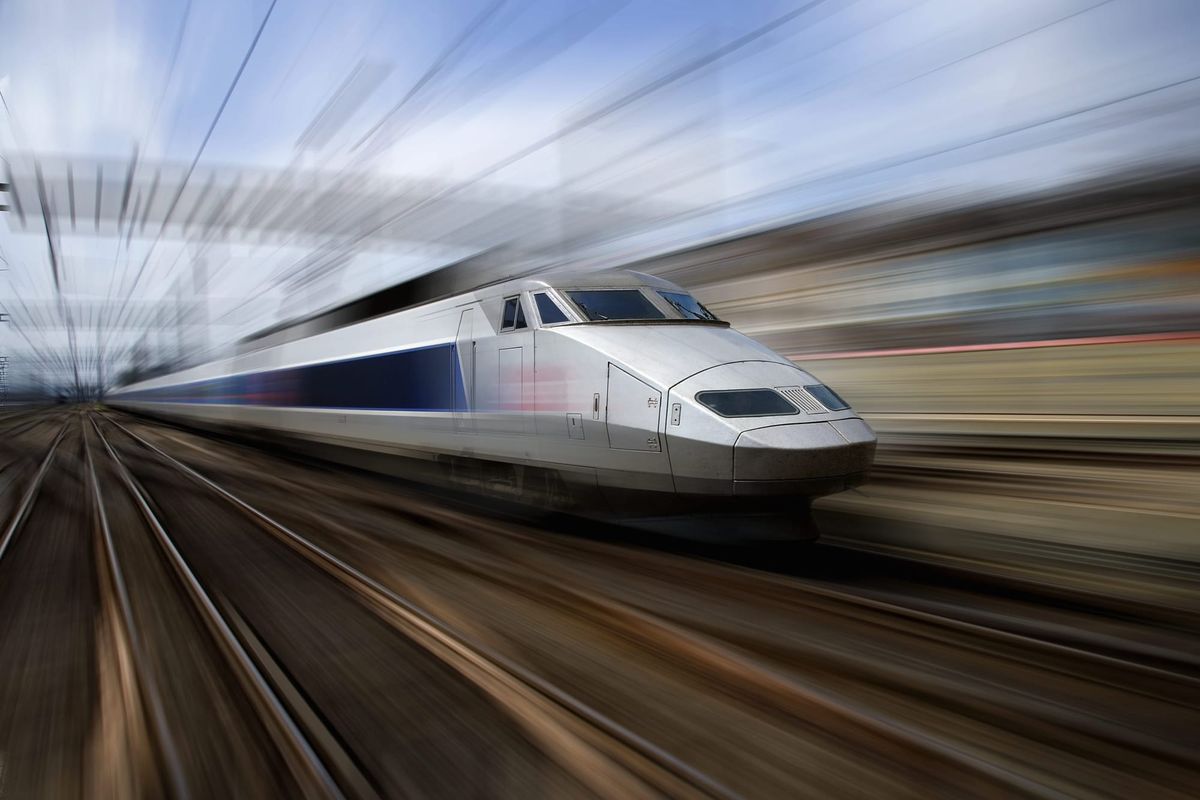
While we may look hungrily at countries like Japan and China, with their futuristic bullet trains, the question remains: Why doesn’t Texas have something like that? Or something even in the same galaxy?
In November, Texas state Rep. John Bucy, a Democrat from Austin, proposed legislation to develop a high-speed rail line connecting Dallas, Austin, and San Antonio along the Interstate 35 corridor. Bucy introduced two bills: one requiring the Texas Department of Transportation to establish partnerships for planning the rail and another enabling state highway funds for transit projects.
Bucy told KERA News he’s heard widespread support from constituents and advocates since pre-filing the bills.
“The calls are non-stop, from constituents, from county commissioners, from elected officials that are just excited about this idea,” he said.
But with all due respect to Bucy, his bill is probably going nowhere. (Such is the life of Democratic bills in Texas, and such has been the case for all other high-speed rail legislation in our state history.)
The answer to why Texas doesn’t have high-speed rail is complicated — a confluence of political, economic, and cultural factors. Entrenched lobbying interests, high costs, and a deeply ingrained car culture have stymied efforts to develop rail infrastructure. But as Texas continues to grow, the demand for sustainable and efficient transportation solutions will only grow.
Of course, high-speed rail would also affect competitors in the transportation industry, so interested parties have made their positions pretty clear — both through public arguments and through lobbying.
Let’s talk about Southwest Airlines.
In the 1990s, Southwest Airlines actively opposed the development of a high-speed rail line between Dallas and Houston, which would have been expanded to Austin and San Antonio, Chron.com reported. The airline feared losing passengers to the proposed rail system, which targeted the same short-haul market that Southwest relied on. The rail system, Texas TGV, planned to use trains capable of travelling 200 miles per hour but failed due to financing challenges and opposition from influential figures, many of whom were moved by Southwest’s lobbying.
Southwest argued publicly that its concern was about preventing taxpayer-funded bailouts for the project. However, industry analyses suggested the airline’s motivation was protecting its market share. Predictions indicated the rail system could divert 60% of local air passengers, potentially forcing Southwest to increase fares or cut routes.
“In the past in Texas, when high speed rail has come up as a possibility, airlines have pushed back against this, fearing competition,” Chandra Bhat, a University of Texas professor of engineering, told The Barbed Wire. “And, with their clout, they have successfully thwarted high speed rail possibilities by using their lobbying influence in the state legislature.”
Others who study this issue agree.
“There are multiple powerful lobbies who benefit from the status quo,” Tara Goddard, an associate professor with Texas A&M’s Department of Landscape Architecture and Urban Planning, told The Barbed Wire.
Lobbying groups have worked for decades to maintain the status quo of highway construction and air travel, which benefits a range of industries, Goddard said.
These include firms directly involved in building highways, as well as those in the oil, gas, and automotive sectors, all of which gain from continued investment in road infrastructure and short-haul flights. These groups oppose rail development, particularly high-speed rail, as it would challenge their established interests, she said. Such ongoing resistance has played a significant role in limiting the advancement of alternative transportation options like rail.
“Oil, gas, and automotive companies all benefit from the status quo, too, and no doubt lobby against rail, both formally and informally,” Goddard added.
In Texas, cheap land and fuel, along with heavy subsidies for driving and parking, reduce the pressure to develop local rail systems, she said. This creates less public demand for rail, as people don’t pay the true costs of driving. Additionally, with a significant portion of the federal transportation budget allocated to highways, securing funding for rail development is challenging. Even with recent infrastructure improvements, shifting resources away from highways often feels like a loss to many.
“We heavily subsidize driving and parking for all of us, so individuals also don't have incentive to demand rail,” Goddard said.
Still, rail projects have always floated around the periphery of Texas politics.
Most famously, there’s the Texas Central high-speed rail project between Dallas and Houston. Proposed in 2009, it aimed to reduce the 3.5-hour car commute to a 90-minute train ride using Japan’s high-speed rail technology, capable of speeds exceeding 200 miles per hour with more than 1,300 passengers per train.
But the project has had a bumpy road, sputtering amid leadership and land acquisition challenges.
Amtrak revived the project in 2023, highlighting its suitability due to Texas’ flat terrain and the connection between two major metropolitan areas.
But, despite Amtrak taking the lead, the project is still very much up in the air. In November, Amtrak senior vice president Andy Byford said officials are still determining how to fund the project, which has yet to receive federal approval, the Texas Tribune reported.
High-speed rail offers numerous advantages over conventional transportation like cars and planes, particularly for short to medium-distance trips in Texas, Bhat said. It has a higher capacity, operates at speeds over 200 miles per hour, and is generally safer, with less environmental impact as it runs on electricity.
Compared to air travel, it’s more fuel-efficient, quieter, and unaffected by weather conditions, he said. Plus, Texas' growing metro areas make it an ideal region for rail, because the distance between cities is well-suited for high-speed rail’s 1.5-hour travel time.
But that doesn’t mean a project like Texas Central will actually happen. Because there has always been pushback to rail from Texas politicians.
A big reason is that many of the state’s most powerful leaders, including Gov. Greg Abbott, get a lot of money from people who build highways.
In 2022, the Texas Tribune reported that J. Doug Pitcock, CEO of Williams Brothers Construction, is among Abbott's largest donors, contributing a total of $4.3 million. Since 2020, Pitcock's firm has been awarded $1.9 billion in contracts from the Texas Department of Transportation.
Similarly, John R. Weisman, owner of Hunter Industries, has donated $1 million to Abbott, with his company securing $464 million in TxDOT highway contracts over the past three years. Collectively, these two firms accounted for 13% of all TxDOT highway work during that time.
As the Tribune noted, such contracts are awarded through competitive bidding, but Abbott appoints the members of the state transportation commission responsible for approving TxDOT contracts.
Meanwhile on a federal level, the general contracting industry — which includes public works, industrial and commercial construction companies, as well as building associations — gives tens of millions in donations every election cycle. The vast majority, 76%, of that money goes to Republicans, according to the Center for Responsive Politics’ OpenSecrets database, which tracks political donations.
“These companies are frequent recipients of contracts for federal infrastructure and transportation projects and no stranger to the world of money in politics,” the site states.
Other big Republican donors, like the oil billionaire Charles Koch, have fought rail projects around the country for years, ranging from a light rail project in Phoenix to public transit projects in Little Rock, Ark., southeast Michigan; central Utah; and Tennessee.
And the Koch-backed Super PAC Americans For Prosperity has for years had a big presence in Texas, backing Republicans in various Congressional races, state House campaigns, as well as supporting U.S. Sen. John Cornyn’s re-election bid in 2020.
So it should come as no surprise that Texas Republicans regularly bash rail.
In 2023, two Texas Republican congressmen blasted proposed federal funding for the proposed Texas Central rail service.
U.S. Congressmen Jake Ellzey, R-Texas, and Michael McCaul, R-Austin, wrote in a letter to the Federal Railroad Administration that, “Since 2009, when the project was first proposed, Texas Central has secured very few parcels of property and is attempting to acquire private property using eminent domain. It will exclusively run a type of train manufactured only in Japan using a unique track that is incompatible with any existing system in the United States.
“At its core, this project is intended to take land from American citizens and put it under the control of a Japanese company, which is itself subsidized using money from U.S. taxpayers,” they added.
And on the state level, while Bucy’s bill isn’t likely to pass, two Texas legislators have gone a step further and filed bills aiming to stymie rail projects ahead of the upcoming legislative session. State Rep. Brian Harrison’s House Bill 663 seeks to block private companies, like Texas Central, from using eminent domain to acquire land for high-speed rail.
State Rep. Cody Harris’s House Bill 1402 would prohibit public funding for planning, construction, maintenance, or oversight of private high-speed rail projects, including altering roadways.
For his part, Abbott has been on both sides of the rail issue. He initially supported the Texas Central rail project, citing its benefits, such as reducing congestion on Interstate 45 and cutting greenhouse gas emissions. However, he retracted his support after backlash from his conservative base, raising concerns about property rights and the project's dependence on Japanese investment.
And while opposing politicians are quick to point out the shortcomings of high-speed rail, even rail’s proponents admit that there are downsides.
Bhat, the University of Texas professor, said that infrastructure can be expensive — up to 10 times the cost of building highways — and requires land acquisition, which has caused delays.
Environmental litigation and landowner disputes can prolong the process. Ticket prices may also be high, potentially exceeding the cost of driving or flying, especially with the rise of electric vehicles, he said.
Additionally, emerging travel technologies like self-driving cars could compete with rail travel by offering lower costs and more flexible travel options, reducing its appeal, Bhat said. Still, high-speed rail could lead to more dispersed populations, new jobs, and economic growth in Texas, he added.
“This is because employers can set up offices, and production plants, too, at less-expensive non-urban locations along the corridor and still have employees commute,” Bhat told The Barbed Wire.
At the end of the day, proponents like Goddard contend that rail in Texas could make life better in ways that we can't imagine. Goddard fell in love with Germany’s regional rail system during a visit in 2022. The system was effective, even though the area she was staying in wasn’t heavily urbanized. But that can be hard for Texans to even envision — because we’ve had a car-centric system for so long.
“The regional rail makes it possible for there to be small towns surrounded by farmland and forest, but they all have a rail station, so people can travel to other towns for shopping, work, etc,” she said. “It is still very convenient and relatively inexpensive to travel around.”
In the abstract, riding the train might sound inconvenient compared to driving “even though our choices are actually more limited by being stuck only with driving,” she said.
“I wish more people could experience (high speed rail), and realize that we could have nice things here in Texas, we deserve it, and it actually wouldn't require massive sacrifice of our quality of life.”