She Thought Her Daughter Was Faking Sick. Then She Found Out Her Elementary School Was Built on a Drilling Waste Site.


EXCLUSIVE
If anyone had told Joey Giminiani what was under his house, he never would've bought it.
On April 23, Giminiani took off work at the electric utility and joined a Zoom meeting from the home he had sunk his life savings into. He watched as the residential developers on the call insisted on two things.
First, that no matter what anyone said, the site was safe. And second, that no one ever had any reason to tell him what lay beneath it.
Giminiani had been bracing for these test results for weeks. If they came back inconclusive, he told me last month, there would be an uproar. If they came back contaminated, it would force the state to test every lot in the development.
Instead, he tuned in that Thursday, along with 25 other homeowners from the hundreds in the neighborhood, to hear the developer arguing there had never been a problem — or as he put it, trying to “sweep things under the rug.” Bret Pedigo, a partner at Terra Manna Homes, opened by telling residents that Silo Mills in Johnson County was “a place to call home, to raise your families,” that it was perfectly safe — and that it was being “attacked or terrorized by irresponsible media stories.”
Reader, he was talking about us.
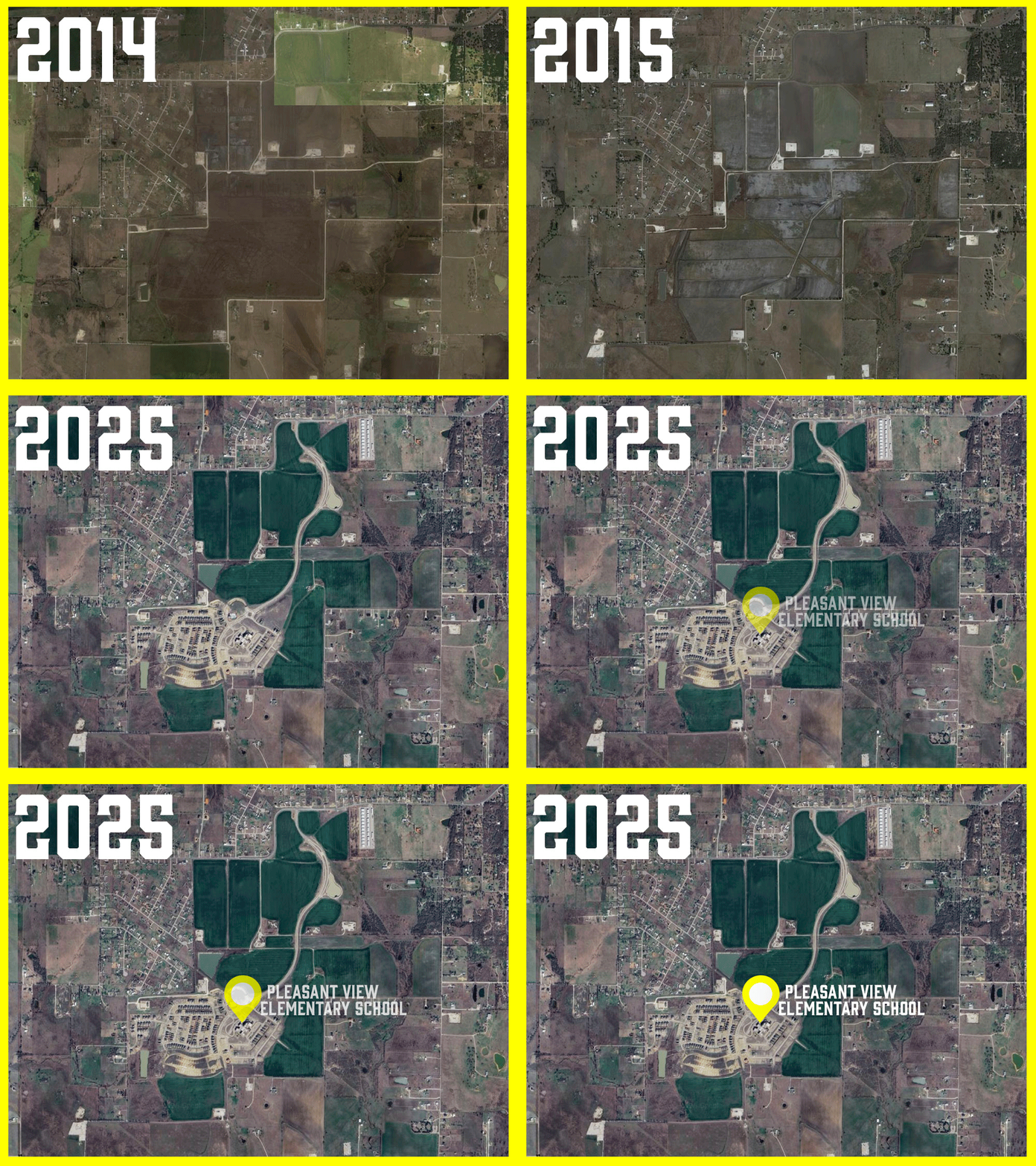
In February, The Barbed Wire and the Texas Observer published investigations that found Silo Mills had been built on a former landfarm — a site where solid, often toxic waste from oil and gas drilling had been spread on the land and left to break down. A whistleblower who had worked the site, Lee Oldham, told us he had personally helped bury radioactive drilling waste there.
We also reported that Silo Mills was one piece of a much larger problem: an estimated 20 to 60 million tons of drilling waste from the fracking boom that had been buried, plowed under, or dumped in municipal landfills around Dallas-Fort Worth, a region now in the middle of rapid suburbanization.
Silo Mills was exceptional, however, in a couple of ways. First, that a whistleblower with knowledge of the site had come forward to tell the public of what he had done there. Second, there were the kids: As part of the deal to develop the property, Terra Manna donated land to the local school district, which built Pleasant View Elementary on the same ground. So our story caused an uproar. In the weeks that followed our investigation, the Texas Attorney General's Office began looking into the development. The Texas Railroad Commission visited the site. And Pleasant View parents, some of whose children had health concerns they attributed to the waste buried under 500 elementary school students, pressed Pleasant View administrators for answers.
Meanwhile, the superintendent, hoping to reassure parents, released the environmental records the district had relied on when the school was built. Which only made things worse: Parents reading the records realized they showed a walkabout-and-paperwork inspection — not soil or chemical testing of the site itself. (As we’ll get to, the developers would later argue the site had been tested back when it operated as a waste disposal site, but their records, they claim, have been lost.)
The developers were rattled by our reporting too. “When the first article came out, it certainly caused a lot of stress and concern here,” Jeffrey Harper, an attorney representing Terra Manna and Prophet Equity, told me. “Did we misunderstand here? Why are people making these claims? Who the heck is Lee Oldham?”
Late last month, the Silo Mills developers came before the residents who had bought the houses they built to argue that all of the concerns had been overblown — a product of bad-faith journalism. The testing the developers cited to make this case was substantial. According to Harper and a recording of the Zoom meeting I later reviewed, UES Professional Solutions — the firm hired to do the testing — had audited the original mud-farm records in Austin, cross-referencing them against the property to confirm the historical permitting and test data checked out and didn’t have gaps.
The developers say this 2010s-era testing of the active oil and gas waste disposal site was exhaustive, though they have not released hard copies of either the testing or the methods they used. They told residents, and us, that last month’s testing involved drilling more than 60 holes around the school and community buildings. These boreholes went down 15 feet, and then every foot of every hole was sampled for a variety of common oilfield contaminants — radiation, toxic oil-cousins like benzene and toluene, and heavy metals like arsenic.
The result: 137 core samples and roughly 1,996 individual data points. Company representatives said that results for every contaminant they looked at came back below regulatory limits for the primary human-health exposure pathways — skin contact, ingestion, and inhalation.
UES is a reputable company, and Eurofins — which tested the samples — is a reputable lab.
But the methodology that the company shared with us revealed significant holes. For one, there is a long list of cancer-causing compounds common in oilfield waste that the developers didn’t test for: polycyclic aromatic hydrocarbons like benzopyrene, which can cause skin cancer; the metal nickel, which can cause breathing problems and lung cancer; and PFAS, the “forever chemicals” that wreck the endocrine system. These chemicals stick around in soil, don't break down well in landfarms, and have led to major lawsuits.
Perhaps most importantly, per Pedigo’s statements on the Zoom call, UES had sampled the school grounds, the common areas, and around the amenity center — but not the soil under or directly around the houses where families actually lived.
Despite these holes, Terra Manna and its financier, Prophet Equity, told The Barbed Wire they had spent more than $1 million on follow-up testing — and insisted no more was needed. Harper said UES had expressed “100 percent certainty” that the site was clean of radiation. “A granite countertop has more radiation than this land,” he said of Silo Mills. The testers, he added, had “reiterated everything that we knew and thought, which was that there is no way any radioactive materials ever made it to this farm.” Harper said UES had also told the company there was “no point doing any further testing out there.”
Such absolute language is unusual in environmental science, where empirical findings tend to come with caveats.
Johnson County Detective Dana Ames, who led the county's investigation into PFAS dumping that had killed 80-plus cattle on nearby farmland, said she would be testing the Silo Mills site herself, including for PFAS. Ames told The Barbed Wire she could not comment on the developer's results because the company had not given her their data or methodology. The county's investigation, she said, was ongoing.
‘She’s a Completely Different Kid’
Many residents weren't convinced by the developers’ assurances that all was well. In the weeks after our story ran, a half-dozen parents responded to a survey I posted online with health concerns about themselves and their children — symptoms they said appeared during the school year and cleared up during breaks. We followed up with these parents to get more information about their stories and to verify their identities; The Barbed Wire granted them anonymity because of concerns about backlash in a community that has polarized around the issue.
One mother told us she had long ago begun making her kids shower off after coming home from school and that she felt sick when at events on the premises. Another said her daughter's constant dizziness and bad headaches after school had led her to suspect the girl was making things up — until she read our reporting.
Still another described how, in the months before our story came out, her family had tried detoxes, parasite cleanses, and mold remediation to address their continual symptoms.
“I'm so tired of having to keep my kids at home because they don't feel well, and then getting in trouble with the school because of absences,” she said. Two families told us that the symptoms disappeared during holiday breaks. “Over summer,” one mother wrote, “she's a completely different kid than the school year.”
One mother who lived next to Silo Mills reported in a Facebook post that when the wind blew south, a foul “rotten” odor filled her house.
What caused the symptoms and smells hasn't been established. But the pattern the families describe appears consistent with something tied to the school property and Silo Mills at large, considering that symptoms showed up during the academic year and cleared up during breaks, when children weren't on the premises. (Pleasant View takes children from surrounding communities, not just Silo Mills.)
The complaints echoed older ones about the site, dating back to 2018 — before the development existed. That year, neighbor Sue Beaton told Texas state environmental regulators — in records reviewed by The Barbed Wire — that fumes from the mud farm, by then decommissioned, had stripped the paint from her house and her car, left a foul odor in her pool, and that dying animals, which she assumed came from the site, kept ending up on her property.
‘You Didn’t Do the Proper Testing’
The developers said they had always known the site underneath Silo Mills was safe. They used to own it. Why would anybody dispute that they knew what was buried there?
Before it financed the construction of Silo Mills, Prophet Equity owned a controlling share in a gas drilling company and in a drilling fluids company. That drilling company sent its waste to Joshua Land Farm LLC — a company owned, per state records, by Prophet Equity founder and managing partner Ross Gatlin, who scowled, camera-on, through the Zoom town hall last month.
In other words, the companies generating the waste, receiving it, and building homes on top of it were all controlled by or partnered with the same private-equity firm.
The site had been farmland before it was a land farm. After the DFW-area oil and gas boom largely ended and the landfarm was decommissioned, Prophet had tried to convert the property into a wastewater treatment plant; when that effort fell through, the company turned to housing.
Lee Oldham was the source whose testimony first revealed what was under Silo Mills — both in our previous story and to Dana Ames, the Johnson County detective. Oldham, 52, was a former landfarm worker who had spread and buried drilling waste at what locals called the Joshua Mud Farm during the Barnett Shale fracking boom of the early 2010s. He believes he was poisoned by radiation there — something the company now argues its post-publication tests have proven impossible. When Pleasant View Elementary opened on the site, he came forward with claims that the dust he inhaled during his time at the landfarm had severely degraded the bones in his jaw and neck, a known side effect of radium exposure.
Harper disputed parts of Oldham's timeline. “I'm confident that we have multiple people in charge of the property, and confident he was not working on our land at that time,” he told me. The company, Harper said, had been in contact with former landfarm employees who could dispute Oldham's account, though he did not provide their names.
But the developers did not consult with Oldham when they did their testing, and none of these employees have brought their concerns about him to law enforcement. Ames told me she would welcome the chance to interview anyone who had worked the site, but that the developer had not provided that information to her and none of those alleged witnesses had come forward. (A Facebook post from one man claiming to be an employee said the truckloads were radioactive; another former worker wrote on Oldham’s page after our story published that her colleagues at the landfarm had experienced “odd cancers & birth defects passing to the younger generations.”)
Swipes at the whistleblower aside, Harper’s main point was this: Exhaustive testing before construction of the new development on a former waste site had been unnecessary because Joshua Land Farm LLC had run such a rigorous intake operation. The dump site was fenced, monitored by cameras, and patrolled by security personnel. At the gate, every incoming truck was inspected. The staff, Harper said, had been trained to assess the loads by smell — “it doesn't take a genius,” he said he’d been told, to tell the difference between water- and oil-based drilling muds. Trucks that smelled wrong were turned around. The rest were sent on to a testing pad, where a technician ran samples against chemical strips.
But what, exactly, that technician had been testing for, Harper could not say. The one substance she could swear she had checked for, he said, was petroleum — the company's main concern was making sure no one was sneaking in oil-based drilling mud, which is regulated more stringently. Beyond that: “The short answer is, she just wasn't [sure],” Harper said.
The records of what had been tested at the landfarm were also gone. “I can't give you the documentation for what we did back then, because we don't have it,” Harper said. “When the company closed down, that was put in storage for, I think, seven years, and we looked for it to see if we still had it. And we just don't.”
And as with the UES testing, there was one category of pollutant the company had never tested for at all: radioactive heavy metals, which Harper said the site wasn’t licensed to receive. PFAS — forever chemicals — also went unchecked.
“Other than avoiding oil, I don't think that they were making any particular test,” Harper said. The company had since done its own radiation testing, post-publication, and concluded nothing was there — proof, they argue, that their controls when it was a landfarm had worked. But during its operating years, was there ever actual testing for radiation in the trucks dumping at the landfarm? Harper was unequivocal: “There was not.”
The testing the company did perform before construction — the results the Godley Independent School District superintendent released, to widespread frustration — was what’s called a Phase I environmental assessment, which isn’t really testing at all. Instead, an assessor walks the property, reviews the available records, and writes a report. The hands-on work — drilling cores, sampling soil, testing groundwater — is a separate process. At Silo Mills no one broke ground to test the former landfarm between the time it was closed and the time the homes were built, or before Pleasant View Elementary opened on the same ground.
The Phase I report TBK Environmental had written for the site flagged this issue directly: The lack of surface-level toxic waste, the inspectors wrote, did not prove that nothing was there. The only way to know for sure, they wrote, was through “soil and groundwater testing and/or excavation.”
The company, Harper told me, didn't feel the need to do soil testing before Silo Mills was built because of the stringent testing the Railroad Commission had required to run the site and to decommission it. But that decommissioning testing, like last month's UES work, had the same blind spots — which included no testing for PFAS.
Of these, PFAS are a particular concern, both due to their carcinogenic and estrogen-disrupting impacts and presence in oilfield waste. A 2021 report by Physicians for Social Responsibility found that PFAS — the same forever chemicals Detective Ames was now testing for — had been used in hydraulic fracturing in more than 1,200 oil and gas wells since 2012.
The figure is almost certainly an undercount, since testing for the chemicals is expensive and access to wells is hard to come by. The developer's testing at Silo Mills had not covered them.
For Giminiani, the lack of proactive soil testing on a known oilfield waste disposal site was the thing that didn't add up. “It's incredible,” he told me. “You're gonna invest millions and millions of dollars into a property and then not go the full route?”
Another homeowner, Clayton Boley, had pulled the Phase I report and read it himself. The records were “pretty spotty,” he told The Barbed Wire.
“You didn't do the proper testing,” Boley said, of Prophet Equity and Terra Manna. “You just rolled the dice.”
“They've only ever answered the questions they've been asked,” he added.
Blake Scott of Waste Analytics, an industry veteran who runs the site Wellfacts to help homeowners untangle whether their property hosts old oil-and-gas infrastructure, said that even if the developers could ultimately prove a site like Silo Mills was safe, they had already taken from homeowners something critical: the right to choose whether to buy a property built on oilfield waste.
“Just because they decided it was okay, and the state decided these were the standards to close the facility — well, I get to make my own choice for my family over whether I think that's okay.”
Someone buying a used car, he added, “gets a Carfax report. But you don't tell me about this being spread on the site of a home I'm gonna live in?”
For their part, the developers have held the line on the argument that no one ever needed to disclose any of this to residents in the first place — though Harper was at pains to argue that it was the real estate agents, not his clients, whose responsibility it would have been, had it been anyone’s.
At the online town hall on April 23, a homeowner who was listing her property asked Pedigo — the partner at Terra Manna Homes who gave the presentation — whether she had to disclose the site's waste history to a future buyer. Pedigo's answer:
“This is a very subjective matter and each homeowner can decide what they want to do with this information — whether you want to disclose it or not.”
But, he said, “it's kind of like if you didn't have a hole in your roof, you wouldn't go around saying you don't have a hole in your roof. There's nothing to disclose.”
Giminiani called the answer “a non-answer” — “mob boss advice.” He added, “But of course he isn't going to say that dumping anything from the oilfield onto the ground isn't a good idea.”
Harper, the attorney, made a different case: If you start disclosing a site’s history, where does it all end? He argued, effectively, that all development in rural Texas carried with it a long history and a buried risk of toxins.
Before it was a landfarm, he explained, a property like Silo Mills “has been ranchland, and before that it was being used to grow wheat, and before that it was being used as a landfarm. The question is how far you choose to go back.” Each of those uses came, like a landfarm, with its own potential residue of poisonous petrochemicals — fertilizers, pesticides, herbicides for the ranch and the wheat, drilling waste for the landfarm. It was, Harper contended, “difficult to know what to disclose.”
The developers, Harper argued, had revealed “what they felt was relevant based on all the information at their disposal.”
The legal picture, however, is more contested than Pedigo's “nothing to disclose” suggests.
Texas Real Estate Commission disclosure forms list specific fields for hazardous waste and former landfill sites. Real estate attorneys familiar with the area told The Barbed Wire they would advise their clients to disclose, even where the law's requirements are unsettled. Texas law also requires sellers to disclose deaths caused by a defect in a property — and Boley, one of the homeowners, argues the same principle applies to a home knowingly built on oilfield waste, however benign it may prove to be.
If he ever sells his house, Boley said, “Morally and ethically I still have to disclose. There are still people that don't trust those reports and don't want anything to do with those places.”
Asked about the residents’ frustration, Harper noted that the builder, not the firms he represents, was the entity in direct contact with buyers — while acknowledging that the underlying decision about what to disclose had been his clients’.
“If there is a thought by somebody that they would have liked to have known more,” Harper said, “I'm sorry that they feel that way.” He added: “I'm not disputing that somebody out there says, ‘Gee, I wish I'd known.’”
The question of what needs to be told to potential buyers is not academic, nor is it simply an exercise in where the fault lies. Silo Mills — and some of its residents — still have homes to sell.
In a complaint to the Texas Attorney General, Giminiani warned what could come as a result of Terra Manna and Prophet Equity’s failures to properly test the site before building there: If “prospective buyers become fearful that the site is contaminated,” the development “could stall or be abandoned altogether,” leaving current homeowners “unable to sell or refinance” and bearing “the financial burden of a partially completed or stigmatized development.”
Meanwhile, construction at Silo Mills has not stopped.
The builder is advertising the final lots in Phase 1 and pre-selling Phase 2 — which is being built, Oldham said, on the precise part of the property where he once helped bury the highest concentration of toxic drilling waste.
Homes are available, if you're in the market, for $339,990 to $584,990 apiece.