How Austin Became a Haven for ‘Bro Saviors’ Like Alex Jones and Elon Musk
(Editor’s note: This is an excerpt from Alex Hannaford’s book “Lost in Austin: The Evolution of an American City.” It’s an exploration of the profound movements that have shaped Austin — charting the shifts within its vibrant music scene, the impact of rapid urbanization, and the challenges of gentrification — ultimately questioning what Austin’s transformation signals for the future of American cities. Hannaford’s book was released on Tuesday, Oct. 1. This excerpt has been minorly edited for style and context.)
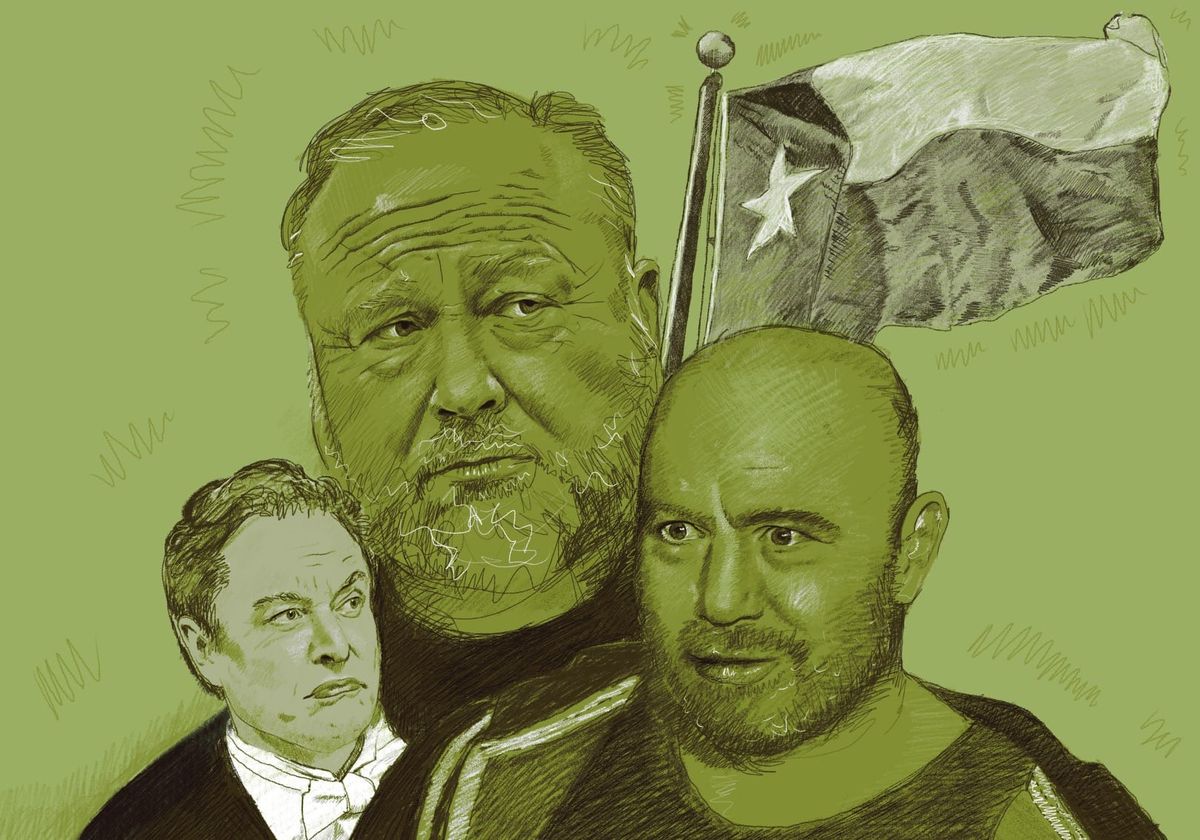
Alex Jones is Austin’s most famous conspiracy theorist.
In 1999, Jones launched Infowars, a website devoted to his elaborate, conspiratorial diatribes and fake news. Soon, I’d notice Infowars stickers plastered all over town—on mailboxes and streetlights, along Austin’s hike-and-bike trails, and on the walls of public bathrooms. Some of what Jones said on his show was fairly innocuous, amusing even; other monologues were clearly intentionally provocative and offensive: we were experiencing a “New World Order” overseen by an ancient cabal of evil elites (an anti-Semitic trope); Lady Gaga’s Super Bowl halftime show was in fact a satanic ritual; when the U.S. government wasn’t controlling the weather with radioactive isotopes it was secretively adding to jet fuel, it was attempting to turn kids gay with a chemical lining that it put in juice boxes. Jones also believed the U.S. government was involved in the 1995 Oklahoma City bombing and that 9/11 was an inside job. I interviewed him for a story I was writing about the anniversary of the Waco Siege — the fifty-one-day standoff between FBI agents and members of the Branch Davidian religious sect that took place in 1993 in Waco, Texas, one hundred miles north of Austin — which ended when, according to the FBI, the Davidians burned the compound to the ground. In all, seventy-five men, women, and children died. Waco had made a massive impression on Jones, then a high school senior in Austin, inspiring him to launch his career on public access television. In the aftermath, he had spearheaded a campaign to rebuild the Branch Davidian church.
***
Austin has a reputation for being open-minded and hosting a variety of alternative viewpoints, and Jones’s presence might have, initially at least, contributed to the city’s diverse landscape of ideas, even if some of those ideas were considered fringe or extreme by some. But while Austin may be swimming in free speech, in an unmoderated ocean where you can pretty much say and think whatever you want, you’ll sooner or later end up with the bad thrown in with the good. Alex Jones’s Infowars was ripe for the internet age, and in the early 2000s, his star began to rise among a growing legion of conspiracy buffs. With the birth of Facebook in 2004 and Twitter a few years later, he amassed an astonishing number of followers. By the time those social networks permanently suspended both Infowars and Alex Jones (Twitter in 2018, Facebook a year later), he had nearly four million followers across his accounts. As one writer friend in Austin told me: “Austin has this openness — which means it’s also open to crazies. And we live side by side with them. But in the 1980s, Alex Jones was a clown. I didn’t think he’d be sharing a stage with the president in a few years.”
Long before he courted Donald Trump, though, he had become an inspiration to other antigovernment extremists. In April 2009, a 22-year-old man shot and killed three police officers in Pittsburgh who were responding to a domestic dispute. Richard Poplawski, who reporters said had posted on Jones’s Infowars website, believed a secret cabal of Jews ran the United States and that U.S. troops were about to confiscate guns from ordinary Americans like him. Then in 2012, two weeks before Christmas, 20-year-old Adam Lanza woke up, shot his mother in the head four times while she lay in bed, then drove five miles to Sandy Hook Elementary School in Newtown, Connecticut, where he shot and killed twenty young children and six staff members before turning the gun on himself.
***
He predicted that then president Barack Obama would use the Sandy Hook shooting to call for more gun control. But pretty soon he started to say something far more troubling: that the Sandy Hook massacre had been staged, that the victims were “crisis actors,” and that, actually, it was a false flag operation and no one at all had died that day. Jones had gone from a circus sideshow to something far more sinister.
A few years later, in the run-up to the 2016 presidential election, Jones helped promote a Far Right conspiracy theory that became known as “Pizzagate.” Days before the election, James Alefantis, the owner of a Washington, D.C., pizzeria, discovered that his Instagram account was being bombarded with comments calling him a pedophile. Weeks earlier WikiLeaks had released a tranche of emails from Hillary Clinton’s campaign chair, John Podesta. In one of those messages, Alefantis had discussed with Podesta a possible fundraiser at his pizzeria, Comet Ping Pong; in another, Podesta had specific “cheese pizza.” Meanwhile, somewhere buried deep within the endless threads that constitute right-wing internet message boards, somebody had given birth to an intricate conspiracy: anonymous users convinced themselves that “cheese pizza” was code for “child pornography” and indulged a fantasy that Comet Ping Pong was ground zero of a huge Democratic Party child sex ring. At the same time, it was easy to laugh off Pizzagate as the fanatical rantings of a tiny minority of unhinged Infowars fans. But shortly after the election, a 28-year-old warehouse worker from North Carolina left his home at sunrise and began the 350-mile journey to the nation’s capital. Edgar Maddison Welch pulled up outside Comet Ping Pong, then walked inside with a revolver and a loaded AR-15 assault rifle and opened fire. Incredibly, nobody was hurt or killed, and Welch was eventually sentenced to four years in prison, but it proved that words mattered. During an appearance on Infowars a year before he became president, Trump told Jones, “Your reputation is amazing. I will not let you down.” In response, Jones said 90% of his audience supported Trump’s candidacy. With the election of Trump, Alex Jones became emboldened. It was a match made in hell.
***
The parents of Sandy Hook victims eventually took him to court, contending that his public proclamations that the shooting was staged compounded their distress. In 2022, the courts ordered him to pay just under $1.5 billion to those families for spreading conspiracy theories that resulted in harassment. One of Austin’s most famous exports was now persona non grata. But was it too late? Was the city tainted by association? Austin’s penchant for unfettered free expression had allowed Jones to grow his platform, and its tolerance for his reactionary politics had come home to roost. In a way, Austin was always the perfect home for him—the capital of a state whose top politicians regularly threatened secession from the Union, even if only to score political points and reinforce its uniquely independent status. Jones was among those interviewed by the U.S. House select committee investigating the January 6, 2021 attack on the Capitol in Washington, D.C., as he had played a major role in promoting the “Stop the Steal” conspiracy that held Trump had in fact won the presidential election and not Joe Biden.
***
Just as my wife and I were leaving Austin, the podcast host Joe Rogan closed on a $14.4 million, eleven-thousand-square-foot mansion in the city and moved in with his wife and two daughters. The beefy, balding fiftysomething was already insanely famous when he decided to make the move from California to Texas in search of, in his words, “a little bit more freedom,” and he’d settled on a Tuscan-style McMansion with Hill Country views, a swimming pool, and a giant wine cellar. Rogan had made his name as an MMA commentator and stand-up comedian before launching a podcast that had become, by the time he got to Austin, the biggest in the U.S. and one of the most popular on the planet. As far as his politics were concerned, Rogan would fit right in. Cable channel Newsmax named him one of the hundred most influential libertarians in America. On his podcast, he’d interviewed Elon Musk, during which the Tesla founder smoked a blunt, unsheathed a samurai sword, and indulged Rogan in rambling conversations about how governments should regulate artificial intelligence and how to revolutionize transportation. Rogan had also described Austin’s Alex Jones as “the most misunderstood guy on the planet,” regularly talked enthusiastically about guns, and used the n-word on multiple occasions. He had courted controversial, right-wing figures, embarked on anti-trans rants, and laughed as one of his guests bragged about giving women comedians stage time in exchange for sexual favors.
***
Along with Austin’s vast, change-everything technology boom came the Dave Aspreys and Tim Ferrisses of the world, “bro saviors” possessed with an astounding self-belief that if you’re a dot-com millionaire, you also happen to have the God-given ability to save the human race. Austin was now the place to be for these world-changing wannabes.
Massively successful tech entrepreneurs appeared, to me at least, to possess a unique brand of arrogance — that by making millions (or billions) in their chosen field, they now had the nous to solve world hunger or help humans live forever. They didn’t feel they needed to bankroll people who knew what they were doing, though; they thought they knew what to do themselves. At the time of writing, the most listened-to episodes from Joe Rogan’s podcast featured, in fourth place, Alex Jones; in third place, Edward Snowden; in second, a joint appearance between Area 51 conspiracy theorist Bob Lazar and ufologist Jeremy Corbell; and, in first place, Elon Musk.
Musk had already been running SpaceX for almost two decades; the company, which sent astronauts to the International Space Station, now had its sights set on Mars. He had already started the Boring Company to create underground city transit systems and Neuralink to implant devices in the brain to treat disease (and to further “human enhancement”). By the time he chose to move his company Tesla to Austin in 2021, Musk had become equally, if not more, famous for his controversial tweets; he was a divisive figure who seemed to take pleasure in being a contrarian, even if it cost him financially. He seemed like the perfect bedfellow for Rogan. Tesla had announced it was moving its corporate headquarters to Texas in the fall of 2020.
***
While he maintained he’s never looked to buy a house in Austin, reports said Musk moved into a luxurious waterfront estate on the banks of the Colorado River beneath Mount Bonnell that belonged to billionaire friend Ken Howery, a cofounder of PayPal.
The Barbed Wire Author Q&A
What was the most shocking thing you learned about Austin while writing this book?
I think the thing that shocked me the most was finding out the legacy of the 1928 City Plan. This was a plan commissioned by the city to deal with a growing Austin's street layout, zoning, parks, etc. But it also suggested establishing what it termed a “negro district” east of present-day I-35. To help achieve this, the plan suggested denying services like refuse collection, running water, etc. to neighborhoods where Black people lived elsewhere in the city. Years later it was those Black neighborhoods east of I-35 that had to deal with the toxic fumes of heavy industry due to lack of zoning regulation there, and — now — mass gentrification. I go into this all in detail in the book, but it’s unforgivable.
You wrote that Alex Jones and his specific ideology prospered here, in part, because of Austin’s openness to new and strange, at times unhinged, ideas. Do you think his presence demonstrably changed our media landscape — and in what ways?
In my book, I write that in the ‘90s, Austin’s local public access television was inhabited by people “fronting a seemingly endless number of bizarre, weird, or religious shows,” and that one of the hosts was Alex Jones. I’d guess that before that, the only large conspiracy theory that made the news in Austin was centered around the JFK assassination. Jones changed everything. And while, for years, he really was just an oddball sideshow in Austin — someone who gave Austinites a bit of a giggle — by the early 2000s, his messages had started to resonate with more and more people. Unfettered free speech has its consequences — it can amplify hate speech and misinformation. And I think both of those things have gotten out of control.
You named a handful of other tech and podcast folks who’ve moved their homes and businesses to Austin, including Elon Musk and Joe Rogan. Do you think there’s a straight line from Jones’s ascension to Austin becoming a “bro savior” haven? What’s your understanding of that connection?
I think there are a number of reasons Texas attracts people like that — and it’s not just due to the state’s love of free speech (although you only have to listen to Republican politicians there to understand they really don’t care who they offend.) For Musk, I’m sure it was no state income tax. For Rogan it was, in his words “a little bit more freedom” — which I’m sure is shorthand for he felt he’d have more of a receptive audience for his more controversial bullshit. But certainly Alex Jones and the success he had building his empire of misinformation and controversy must have persuaded a lot of like-minded people that Austin was the perfect place to set up shop.
In your opinion, what makes Austin continue to be such a sanctuary for this subsect of conspiracy-theory-driven, biohacking, God-complex tech billionaires?
In addition to no state income tax, freedom to say what you like AND own as many guns as you want, together with Alex Jones’s proof-of-concept, they’re also sold on this idea that Austin is America’s coolest city that enjoys great weather, cheap living, great food, and is a cultural music Mecca. I’m not quite sure what they think once they settle in and find out that maybe one of these things is still true: the food is good, if expensive. But then, they can afford it.
What was your reaction to the recent revelation that Elon Musk secretly funneled hundreds of thousands of dollars to make “pedophile fliers” and attack ads in an unsuccessful attempt to remove Travis County District Attorney José Garza from office?
I have a friend who owns a Tesla and has recently added a sticker to its rear window that reads: “I bought this before we knew Elon was crazy.” Today, I’m not surprised at all that Musk did this.