Latino Men Put Machismo First When They Voted For Trump. Latinas Are Angry.

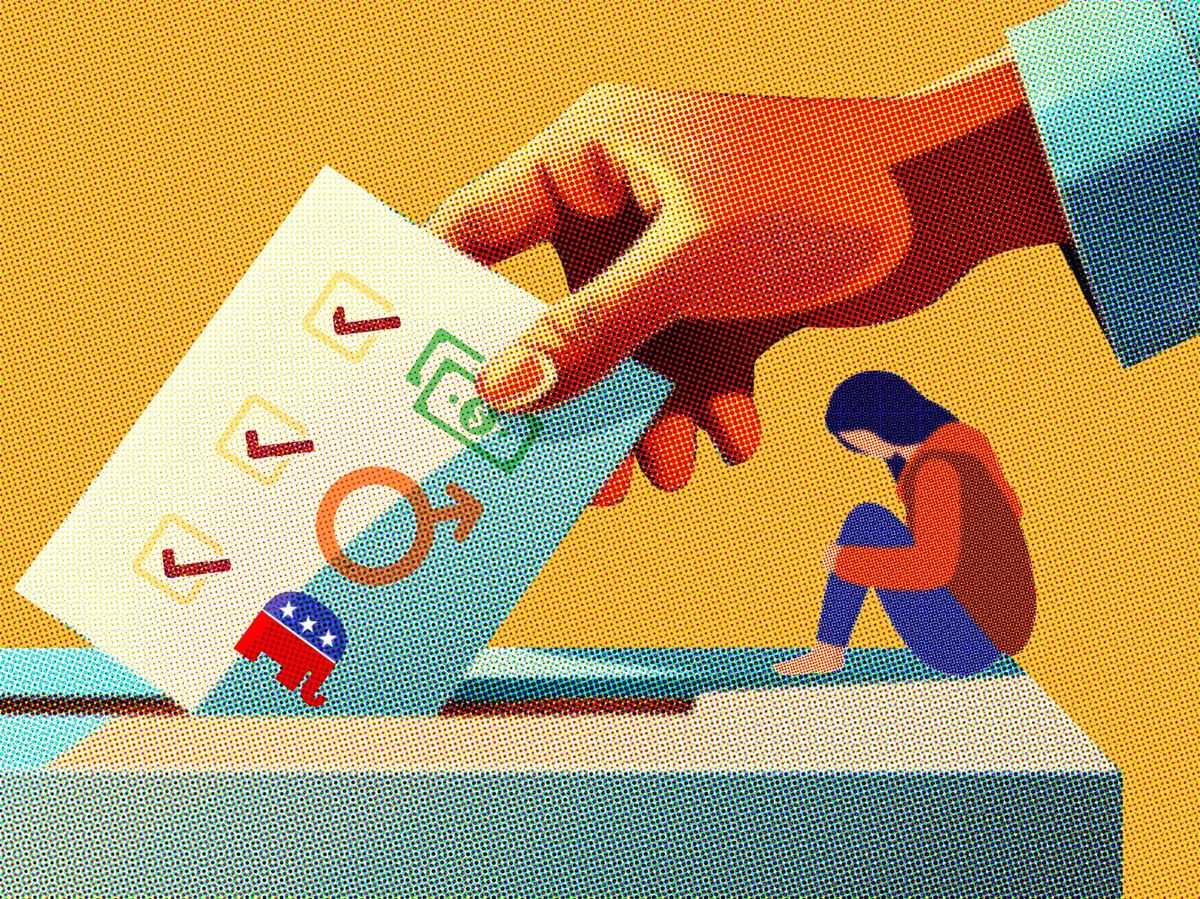
Days after election night, I still have Latina women in my DMs telling me they’re shocked but not surprised the men they love voted for President-Elect Donald Trump. They’re very angry about it. “They want a better economy,” one friend told me. “Lots of Chicanos, especially,” another friend said. “They have a good-paying job, and all of a sudden they are middle-class Trumpers,” still another said. “They forgot that their mothers crossed the river to get here and their dads were deported three times.”
And, more sharply: “Shout out to the ‘anchor babies’ that voted for Trump. F*ck them,” one of my best friends told me over text. “I’m angry and heartbroken.”
“It’s really disheartening. It’s like your own people sometimes, it’s your own people and I feel so beat up and betrayed by my own kind,” another told me.
Political analysts and (mostly white) journalists have since pored over exit polls like NBC’s that show 55% of Latino men voted for Trump — pushing the total among Hispanic voters to 45%, a record high for a Republican candidate. In Texas, 64% of Latino men that were polled voted for Trump (although The Barbed Wire’s Cat Cardenas makes a compelling argument to why that number may be flawed). As headlines proclaimed Trump the unexpected victor of Latino voters, I saw a different analysis in my community that noted it was the men that Trump won, not the women (60% voted for Vice President Kamala Harris). That portion was not, actually, a surprise — as was made clear by the conversations I was having with Latinas in my life about our collective dismay.
Many Latino Trump supporters have said they voted for the former president because they believe he will improve the economy. And, to be sure, economic concerns were a dominant issue that swayed the election. But saying it’s all about the economy is reductive, and to some of us, feels insulting. The women I spoke with are single mothers, have multiple children, student loans, mortgages, wives, businesses and all want a better economy, too. Latinas in my life know that the economy is not the full story.
Latinos are not a monolith. And some facets, including some of the men in our lives, aren’t immune to appeals for traditional gender roles. They may not all have cheered when Trump implied Harris wasn’t intelligent enough to become president. But they may have agreed the White House is no place for a woman, let alone a Black one.
If you dig slightly deeper, it’s clear. A 31-year-old small business owner from Belton, north of Austin, told the Associated Press that he wanted tax cuts. He was not surprised Latino men in his generation voted for Trump. “I am a blue-collar worker, so tax breaks for small businesses are ideal for what I do,” Brian Leija told the AP. In interviews with the Austin American-Statesman, Latino men (both registered voters and nonvoting undocumented immigrants who shared their political opinions) said the draw was the economy but also social policy. One man said he was alarmed by nonbinary gender education in schools and Democrats’ focus on access to abortion.
Like segments of straight white men (and women) — who say they voted on the economy but also weren’t turned off by a candidate found liable for sexual assault and defamation — Latinos have their own deeply embedded misogyny, an aggressive reflection of masculinity and a desperate grasping to white proximity to assert the dominance.
“Es el pinche machismo!” one of my friends said. “It’s the damn machismo!”
We collectively talked about how machismo is woven into our cultures. And how it informs views on dominance — namely, that dominance is an admirable trait — along with the ways machismo contributes to violence and discrimination against both women and the LGBTQIA+ community. We talked about how machismo goes hand-in-hand with the idea of the “American Dream,” to come to this country and be accepted at all costs. Sometimes that means forgetting where you came from. We spoke about our close family and (sometimes former) friends who desperately grasp at the illusion of assimilation at the expense of erasing their indigenous roots. Some have been clinging onto that “French ancestor” or the “Grandma who came from Spain” or the “uncle with the green eyes.”
***
So what is machismo?
Journalist Ixa Sotelo describes it as “a social construction of masculinity common across Latin American and Spanish culture that maps out how men should engage with their gender based on virility, courage, strength, and power.” The Spanish word macho means “having a strong or exaggerated sense of power or the right to dominate.”
Machismo may have roots in the Christian colonization of Latin America. And certainly involves a Biblical worldview.
I first learned about machismo when I was a little girl.
“Donde esta la cena, mujer?” my male family members would say. It means “where’s my dinner, woman?” in Spanish. My aunts would laugh it off or sometimes hit back with a sarcastic remark if they were brave enough, but most of the time they would grin and bear it.
I could see the exhaustion in my aunts’ faces. Their eyes were red from waking up at 4 a.m. to clean the house, make breakfast, take the kids to school, come back home, start cooking for lunch, clean again, do laundry, go pick up the kids, visit the bodega or mercado for dinner ingredients, and then do it all over the next day. Some of them managed to have jobs outside the home. Their hands were calloused hand-washing laundry late at night on a washboard — some of them didn’t have a washing machine — and then hanging it up to dry.
I can see the same veils of machismo very thinly and aesthetically layered over the pretty trad wife videos touting servitude to husbands that are a topic of endless debate on social media. Meanwhile, I know what it looks like when women don’t have the right or luxury to choose to spend their time baking the perfect pie or making tortillas and buñuelos from scratch.
Growing up, I visited Mexico during my summers, where I witnessed many women who had no equity or control over their own lives. There was no choice on when to rest, take a day off, pick what they wanted for dinner, what city they wanted to live in, take birth control, or even use tampons versus pads. One of my aunts had to wear heels every day because my uncle liked it. They had to do as their husbands said because it was “lo que Dios manda,” or “what God orders.”
Even as a child, the men in my family tried to train me to always have my dad’s plate ready in service to him, or to remind me that the men had to eat before the women. Our place was always in the kitchen to “chismear,” meaning to gossip, and to clean. It felt weird. My mom and I would swap awkward looks about it, but we were women (and guests), so we would oblige.
Looking back, it eerily echoes the countless comments Trump has made about women doing dishes. Or the time he told Howard Stern, “I like kids. I mean, I won’t do anything to take care of them. I’ll supply funds and she’ll take care of the kids.” Same goes for his close proximity to JD Vance, our soon-to-be vice president, whose harmful rhetoric about women who don’t have children helped spur refrains from his staunch supporters like “your body, my choice” and “get back to the kitchen.”
***
At its worst, machismo and its vein of aggressive dominance normalize and even glorify violence toward women and those who aren’t straight, cisgendered males. It’s the idea of “putting women in their place.”
Studies show that 23.4% of Latina females experience intimate partner violence in their lifetime, and 48% of Latinas report an increase after they immigrated to the United States.
That’s true for my family.
My mom has memories of her father coming home to beat her mom. After the beatings, my mom tells me that my grandmother would clean her bloody face and fix dinner. For her, it was a normal part of life. My dad, too, grew up with intimate partner violence as a child. He would show me scars where he’d been beaten by people who were supposed to care for him. My aunts whispered about intimate violence in their marriages and sometimes about cheating husbands. At one point, my sisters, mom, and I were homeless and living in a shelter for survivors of intimate partner violence. All of us experienced the worst of machismo.
Watching the exit polls, and seeing the increase in Latino men who voted for Trump, wasn’t a surprise to me. It was an actualization of a complicated and ugly history that Latinos don’t want to talk about. It’s no wonder many men find refuge in the Trump camp, where calls to point a rifle at Republican former congresswoman Liz Cheney’s face are not just tolerated — but welcomed and celebrated.
That language is obviously triggering to survivors of intimate partner violence and sexual violence, who recognize it as part of an abusive pattern. For those who’ve never experienced abuse, the power and control wheel is a tool that shows tactics abusive partners use to keep survivors in a relationship. Among them are minimizing, denying, blaming, and asserting male privilege.
Veteran journalist Bob Woodward wrote in his book “Fear: Trump in the White House” about Trump’s approach to the accusations of sexual misconduct against him. “You’ve got to deny, deny, deny, and push back on these women,” Woodward wrote. “You’ve got to be strong. You’ve got to be aggressive. You’ve got to push back hard. You’ve got to deny anything that’s said about you. Never admit.”
That response aligns with a term coined by Jennifer J. Freyd, professor emeritus of psychology at the University of Oregon: DARVO. It stands for “Deny, Attack, and Reverse Victim and Offender.” DARVO “aids in understanding how perpetrators are able to enforce victims’ silence through the mechanism of self-blame,” Freyd found in a 2017 study.
There’s evidence to show that Trump’s behavior, rhetoric, and policies have had a chilling effect on women reporting intimate partner and sexual violence.
During the last Trump presidency, advocates warned that Latinas were less likely to report intimate partner violence because of a fear of death, family separation, or worry that something would happen to their partner. In 2018, the New York Times found a 38-year-old woman from Houston didn’t report that her husband punched her at six months pregnant — which caused her to lose her baby — for those exact reasons. “With the laws now, a lot of women like me are too afraid to come forward,” she told the Times.
And it keeps coming.
This week, Trump appointed Florida-based U.S. Rep. Matt Gaetz to be the next attorney general of the United States — even though he’s been at the center of allegations ranging from sexual misconduct to the trafficking of underage children. Gaetz denies the allegations and has not been charged. The Department of Justice ended a sex trafficking investigation last year; a House Ethics Committee investigative report has not been released. Still, even some Republicans called the decision an “absolute gut punch.”
***
There’s another side to being a strong Latino man.
The morning after the election, I spoke to my husband, who’s a first-generation son of immigrants from Michoacan, Mexico.
We talked about what trying to conceive might look like under a different type of Republican Party — not that the GOP has ever been great at recognizing women’s bodily autonomy. But the world was different before Trump ensured that Roe v. Wade was overturned.
“Maybe we should look at freezing eggs, in case we have issues in this place,” my husband said, his voice trembling.
The weekend before, we’d watched “Zurawski v Texas,” a documentary detailing some of the stories of Texas women who nearly died because of the state’s strict abortion laws. “You think it’s your pregnancy, but it’s not your pregnancy, it’s the state’s pregnancy,” Amanda Zurawski said in the film. My sister’s terrifying experience with miscarriage was fresh on our minds. “I’m bleeding uncontrollably, I can’t stop it, and no one can help me because everyone’s afraid of what will happen,” she told me last month. She had two miscarriages after Texas’ strict abortion bans began, and the terrifying experience shook her faith in Trump.
After the election, my husband told me: “I love you so much, I’d die trying to save you.”
In him, I witnessed a brave man who carries his family with honor. It left me, and other women in my life, asking: Is a lower interest rate really worth voting against my rights, your wife’s rights, your sister’s rights, or your daughter’s rights?
A lot of Latino/a/x voters are staying quiet — or preaching about “not getting lost in division” and “being kind to one another.” But who is that mindset really for?
It’s not about which political party you picked: Trump could have stayed a Democrat. This is about placing power in the hands of a convicted felon and abuser who is absolutely willing to take away women’s rights. He’s proud of it.
As the writer Robert Jones Jr. said in 2015: “We can disagree and still love each other unless your disagreement is rooted in my oppression and denial of my humanity and right to exist.”
It seems history likes to repeat itself.