How Selena Called Me Home to Texas
I have a secret to admit.
I’m not a Texas native.
Luckily, I’m not a Californian who moved to the Lone Star State. I’m a Nebraskan who fell in love with the Dallas Fort-Worth area. But my introduction to Texas was not the metroplex. Nor was it Southern Methodist University, where I attended college.
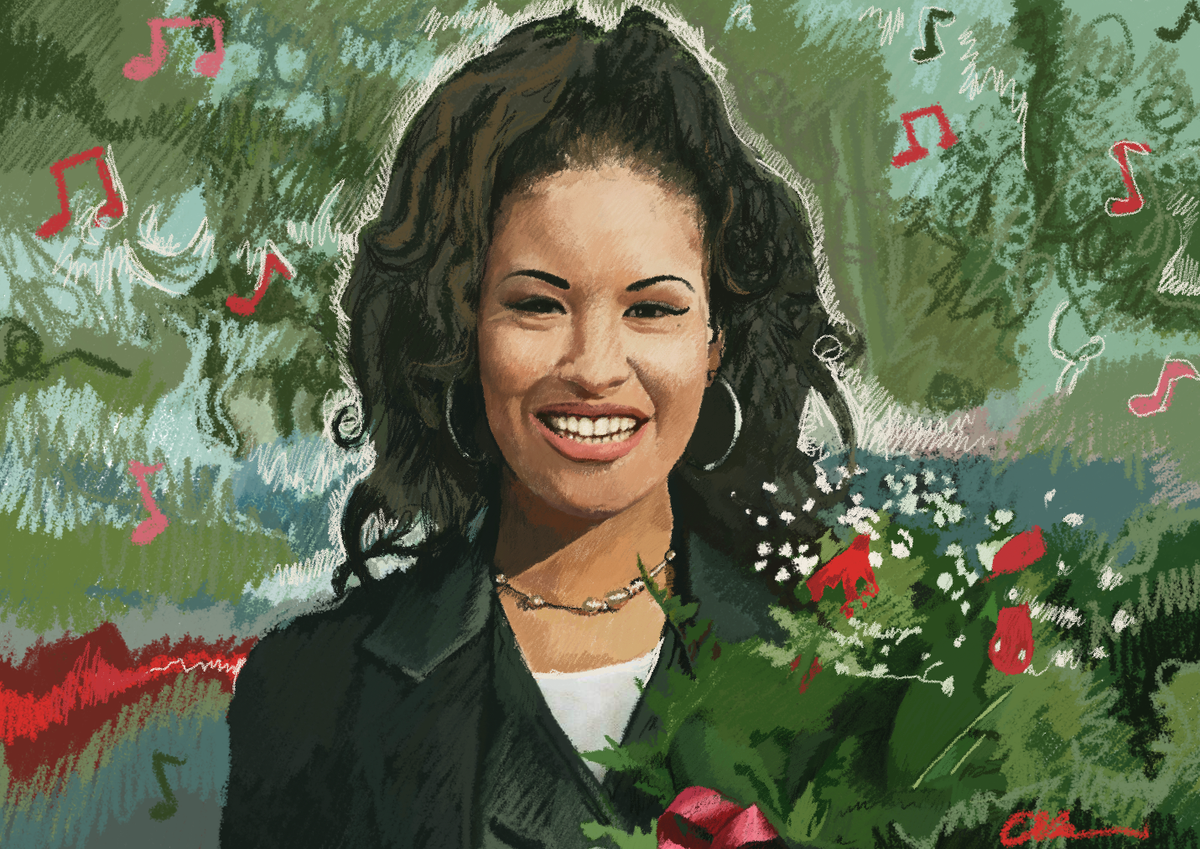
It was Selena Quintanilla.
Selena was born in Lake Jackson, Texas in 1971. Her music blended Tejano, pop, and cumbia styles. She sang in Spanish and won her first Grammy in 1994 for best Mexican/Mexican-American album. If you think you’ve never heard her music before, you are either living under a rock or blatantly wrong.
The songs “Bidi Bidi Bom Bom” and “Como la Flor” are so ingrained into my earlier childhood memories that I can’t even remember when I first heard them. Instead, I see flashes of dance routines my 7-year-old friends and I made up to the contagious cumbia beats.
Our teacher in Nebraska — about 1,000 miles away from the birthplace of Selena’s music — would take out a radio and play a Tejano station during recess. I’d mix the hip-swaying dance moves I saw on MTV’s “Total Request Live” with my dad’s Salsa steps. I grew up pretending I knew the Spanish lyrics despite not learning the language until my late 20s.
Growing up Black in a predominantly white city of less than 70,000 people, Selena meant something to me. She and her music were a tie to a state and Tejano culture I eventually called home. She was a bridge to multiculturalism that I didn’t completely understand until I was much older.
I was born a few months before Selena’s murder in 1995 when she was just 23, but I didn’t know her life had ended tragically until I saw the 1997 biopic on TV years later. In elementary school, I spent weeks transfixed by the iconic sparkling purple bodysuit Jennifer Lopez wore in the movie. I was also shocked and confused by the fact that her killer was Yolanda Saldívar, the president of her fan club. The movie was added to the National Film Registry at the Library of Congress in 2021 after a successful campaign by U.S. Rep. Joaquin Castro.
Decades after her death, Selena still has a hold on Texans — natives and transplants alike.
Each year, on April 16, fans gather on her birthday, visiting memorials, murals, and statues from Corpus Christi (where there’s a Selena Museum) to El Paso. In Texas, it’s known as Selena Day.
She would have been 55 this year.
Selena’s legacy transcends genders, languages, and cultures. Her fans are everywhere because the emotion and danceability of her music speaks to the human experience. On Reddit, users still sound off about the moments they discovered her: A pawnshop at 13, when the 1997 movie came out on VHS rental, a music video on Univision viewed from Portugal. Students sketch drawings of her in class at school and read commemorative editions of her widower Chris Pérez’s book, called “To Selena, With Love.” They post photos of visits to her murals in Los Angeles and share tattoos of Selena’s face on their calves.
Seeing people share their own memories makes me feel like part of a community connected by Tejano music. Now that I’m a Texan transplant, her music makes me feel like I’m a Dune bluebonnet. While not originally from Texas, the flower and I have made it our home. Selena reminds me of my dad, who taught me I can embrace and appreciate other cultures despite them not being my own.
Through the years, Selena stayed with me. She became a litmus test for dating in Texas. On a bad date in Dallas, the man I was interested in did not recognize “Bidi Bidi Bom Bom,” and I laughed about it with my girlfriends afterwards. If the person I was seeing didn’t know her music? They weren’t right for me.
Selena herself taught me that it was ok to love and relate to a culture not your own. I witnessed her embrace Black music and culture, and as Vanessa Angélica Villarreal said in Harper’s Bazaar, “Selena’s life cannot be portrayed without Blackness.” Her primary influences for both her music and her iconic performance styling were Michael and Janet Jackson, Mariah Carey, Jody Watley, and Whitney Houston.
One of her most iconic performances was the 1995 Houston Livestock Show and Rodeo at the Astrodome, which broke the venue’s attendance record and drew nearly 67,000 fans inside the stadium. Selena opened with a disco medley of songs by predominantly Black artists.
In the 1990s, Houston was a frequent tour stop for Selena. And Houston, the city with the largest Black population in Texas, remembers. Thirty years after that performance, Texas Southern University’s Ocean of Soul marching band performed “Como La Flor.”
On a spring break trip in college my roommate and I went to the Katy Livestock Show and Rodeo, and my ears perked up when I heard La Carcacha playing as we sat on a bench watching men get bucked from horses.
As a Black woman who grew up hundreds of miles away from Texas, her music still feels like a childhood summer. When I listen to her, I feel like that 7-year-old girl impatiently waiting for my life to begin.
Today, as the world tries to silo each of our cultures into their own lanes, I turn on Selena’s music and think about the lessons she taught us: To embrace each other and elevate and celebrate our cultures. That you can love other cultures and still be authentic to the space you were raised in. Selena embraced her heritage, even as she was influenced by Black artists. She had mainstream appeal in the 90s and was unapologetically Mexican-American.
And that might be why Black fans still resonate with her music. A young Beyoncé got the chance to meet Selena in 1993 and went on to say in 2007 how much the Tejano star influenced her. Wyclef Jean has sampled her music in performances, Frank Ocean reflected on Selena’s death in his “Blonde” album, and Keke Palmer has performed renditions of “Amor Prohibido.”
And that’s just a few famous Black fans.
“Listen—Black folks love Selena for a REASON,” wrote mspackyetti on Threads “We understand, even if we don’t understand, you know?”
“Selena is at least as popular as Jesus,” H. Drew Blackburn wrote for The Barbed Wire in October 2024.
About eight months ago, as the school year began in Fort Worth, the principal of Kirkpatrick Middle School performed “Como La Flor.” Between verses, he was intermittently shouting “welcome back!” — all while dressed in bright purple.
“And this is what we mean when we say Black people don’t play about Selena,” read a caption of the video posted to Reddit.
On the 30th anniversary of her posthumous album “Dreaming of You,” writer Jonathan Apollo reflected on what it means to be a Black and gay fan of Selena’s — listening to her on first dates, pushing her cassette into a Walkman at the age of 13, witnessing little girls fawn over her at anniversary screenings of the biopic.
Selena, he wrote, helped “me make sense of my identity and further appreciate the Black culture that occasionally shunned me.”
Now, as I listen to Selena I understand more. Not just because the language barrier has been lifted. I’ve had my heart race from — crushes (like in “Bidi Bidi Bom Bom”) to heartbreak (like in “Como La Flor”).
Selena will always be with me. Whether it’s at the rodeo, dancing with friends, or listening to her as I run errands. Like a bluebonnet, she’s uniquely Texan.
And for a little Black girl finding her home, she was so much more.
Editor’s Note: The Barbed Wire is in the midst of our spring fundraising campaign. Good journalism isn’t free. Thanks to everyone who has donated so far — it funds what we do. If you haven’t donated yet, you can become a member for as little as $4 a month, or make a one-time gift.