What Can Texans Learn from Zohran Mamdani’s Political Earthquake? More Than You’d Think.

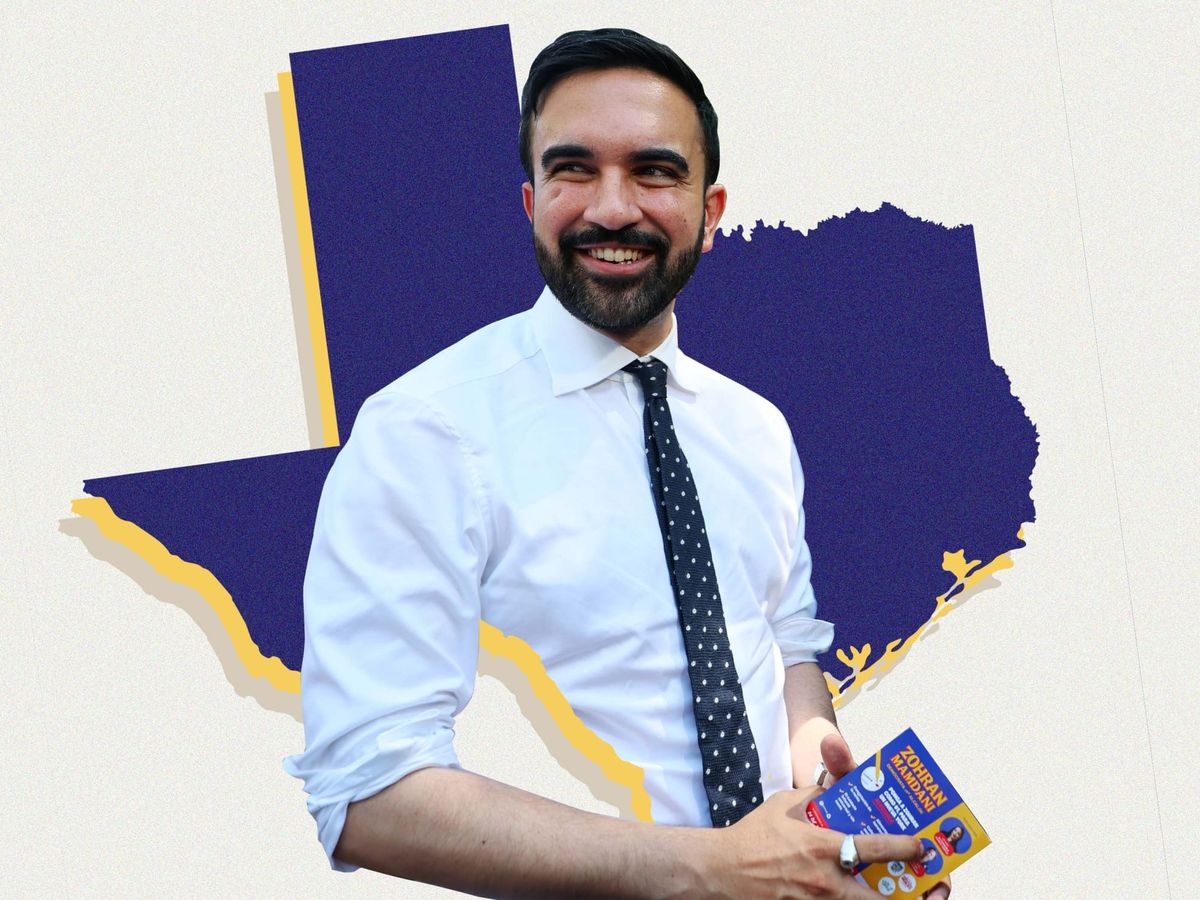
Unless you’ve been living under a rock for the past week, you know that a young democratic socialist just swept away establishment opposition in the New York City mayoral Democratic primary election.
Zohran Mamdani, a 33-year-old state assemblyman in New York defied polling odds — and conventional wisdom — in a blowout victory that sent shockwaves through the political system.
New York City ain’t Texas, but there are many reasons Texans should pay close attention to the outcome of the Democratic mayoral primary election there. Working Texans face many of the same issues that galvanized voters toward Mamdani: housing affordability, cost of childcare, and food insecurity to name a few. Not only are Texas’ current public officials spending their time and energy outlawing reproductive healthcare and (attempting to, anyway) THC — they’re doing so while seemingly ignoring kitchen-table issues.
What if a Texas politician embraced tangible policies to help the everyday citizen — and not the billionaires who have been bankrolling the far-right arm of the Texas Republican Party?
Mamdani ran a joyful, volunteer-driven campaign with an economic platform focused on cost-of-living issues impacting working class voters: rent freezes on rent-stabilized apartments, public investments in housing, publicly owned grocery stores, free child care and bus fare, and more. His victorious campaign — which overcame a massive gap in name-recognition, spurious accusations of antisemitism, anti-Muslim bigotry, and well-funded outside opposition — was labeled by one Democratic strategist as “the biggest upset in modern New York City history.”
With the support of a massive field operation and tens of thousands of volunteers from the New York City chapter of the Democratic Socialists of America, Mamdani sailed to first-ballot victory in a ranked choice election through a coalition of young people, working families, and voters across racial demographics.
Now, Mamdani is preparing to square off against embattled incumbent Mayor Eric Adams, who previously ran as a Democrat but is now running in the general election as an Independent. He announced his party switch the day after the Department of Justice moved to dismiss his contentious federal corruption case, arguing that continuing the case would interfere with Adams’ ability to govern and threaten “federal immigration initiatives and policies.”
“I think the lesson is young people are motivated if they're turned on by a candidate and turned on by public policy that really speaks to them,” Kathleen Thompson, the executive director of Progress Texas, told The Barbed Wire. “And in Texas, the economic messaging is the same. Whether you're in Houston or Dallas or San Antonio, it's so expensive. The last time Texas raised the minimum wage was 2009 and it's $7.25 an hour. That’s a joke.”
Much has been made of what Mamdani’s victory means for Democrats nationally, and for the establishment types who were shocked by Mamdani’s win. It exposed a growing divide within the Democratic party and the broader commentariat. Some, like Senate minority leader Chuck Schumer, praised Mamdani after his win, while others like Senator Kirsten Gillibrand have distanced themselves and refused to say who they would endorse in the general election — leaving open the possibility of supporting a mayoral candidate who is not the Democratic nominee.
And with the Democratic Party facing record lows in favorability polls, open revolt from youth activists, and a nagging reputation as a gerontocracy whose members die in office at inopportune times, voters are seeking a new path forward — something that candidates like Mamdani are eager to offer through an unabashedly leftwing populist policy platform and slogans like “we can demand what we deserve.” The same applies in Texas, where the majority of residents disapprove of the current state government, think the country is going in the wrong direction, and hold historically low favorability regarding the state Democratic Party.
The effect of Mamdani’s victory over his main opponent in the Democratic primary, former New York Governor and alleged serial sexual harasser Andrew Cuomo, has been nothing short of a political earthquake. Responses from the right are Islamophobic, apoplectic, and apparently aimed at making Mamdani an example of how the Democratic Party has become a tool of far-left Marxists. President Donald Trump, for example, described Mamdani as a “100% Communist Lunatic.”
Reactions from liberal commentators are more chastened and nuanced, reflecting their uncertain footing on the shifting political ground underneath them. Days before the election, The Atlantic, a bastion of liberal journalism, criticised Mamdani’s platform as “magical realism” that didn’t hold up to scrutiny. After the election, the magazine conceded that “Zohran Mamdani’s success might give the party a few ideas about how to move forward—to a point.”
Some centrist Democrats, like American economist and former United States Secretary of the Treasury Larry Summers, have asserted that Mamdani's victory is actually a sort of poison pill. Summers argued in a recent interview that Mamdani becoming the next mayor of New York City would cause “massive outmigration” from the city, and a consequent “great gift” for the economies of Florida and Texas.
This type of rhetoric has already been deployed by at least one conservative politician in Texas, former Democrat-turned-Republican Dallas Mayor Eric Johnson, who took to social media to draw a contrast between New York City and Dallas.
“Dear Concerned New York City Resident or Business Owner: Don’t panic! Just move to Dallas, where we strongly support our police, value our partners in the business community, embrace free markets, shun excessive regulation, and protect the American Dream!” Johnson wrote.
Democratic politicians in Texas, including centrists, would be wise to sidestep this trap, which will only serve the interests of Republican lawmakers who have a stranglehold on statewide politics. Instead, they should seriously consider what made Mamdani’s campaign so attractive to the voters, whose decision made the blowout result of the primary election such a shock.
Mamdani deployed a highly energetic, volunteer-driven campaign and leaned hard into social media, directly engaging with his audience and voters. To Thompson of Progress Texas’ point, younger voters — often dismissed as unreliable — played a significant role in Mamdani’s victory. An analysis by Gothamist found that nearly half of early voters were younger than 45, and Mamdani showed strength in neighborhoods with the highest concentration of young voters.
Thompson at least believes Mamdani’s success could be replicated in the Lone Star State.
“I think a Texan who runs on economic values and fairness and equality for all could do well in our major cities, but also our rural areas,” Thompson said. “There are a lot of folks in rural Texas who rely on minimum wage jobs, who rely on their neighborhood public schools to lift them out of poverty.”
Consider the potential impacts of Trump’s so-called One Big Beautiful Bill, which if passed would cut billions from SNAP and Medicare — programs that feed food insecure Texans and provide healthcare to underpaid working families. Forty-six Texas House Democrats recently sent a letter to Senators John Cornyn and Ted Cruz demanding they reject the bill. Given that Mamdani won in a state where the ruling party isn’t supporting policy that will take food and medical care out of the hands of their constituents, it stands to reason that candidates who channel outrage around those issues could do well in Texas.
Of course, we know what’s not working in Texas — on either side of the aisle. The Republicans have maintained a stranglehold on statewide politics for decades, while Democrats have struggled to win outside of safe districts and major urban municipal elections. Without changes in the statehouse, things will get worse for working Texans. But without changes to how Democrats campaign, there’s little hope for any change in Austin.
There’s plenty of room for fresh blood and new tactics, but what this would look like in Texas is yet to be seen. Any Texan candidate seeking to adapt Mamdani’s template would have to take into account Texas’ radically differing transportation infrastructure, housing density, and statewide political climate.
Aspiring Mamdani copycats don’t have to describe themselves as democratic socialists in order to channel the same populist energy that enabled Mamdani’s unexpected victory, even if more people — particularly the young — are open to socialism than ever before, in spite of attempts at a new Red Scare. One could also argue that the word “socialism” may be too fraught to try employing in Texas, even if that would erase Texas’ rich history of homegrown socialist agitation and the small but extant number of socialist organizations across the state whose grassroots support could be leveraged. But what they must do — both for the sake of good politics and for long-term success — is extricate themselves from the uber-wealthy who have been lately bankrolling Texas Republicans.
“I’m hoping that in 2026 and in 2025 for the primaries, we see more people running who see what happened in New York as a motivation to run on issues that are common moral threads of economics that cross racial demographic, age demographic, and regional demographic lines,” Thompson said.
“Democrats shouldn't be afraid of public policy that works for the working class,” she added. “They should embrace it.”