If You Don’t Already Know Heman Sweatt’s Name, It’s Time to Learn It

This fall semester is my first time teaching college history. Incidentally, it also marks the 75th anniversary of the first time Black students were admitted into formerly segregated colleges and universities in this nation.
As a Black adjunct professor, one of my goals is to teach younger generations how long ago events impact the lives of real people. These aren’t just abstract narratives from our textbooks. Last week, for example, we studied the Reconstruction era and its bittersweet advances. To make this history personal, I asked my students to think of an ancestor, if known, and trace that person’s life through each passing decade. It has become a remarkable exercise in demonstrating how laws and policies shape not only society, but also people.
Our people.
Weeks ago, when the editors at The Barbed Wire asked me to write a piece about the landmark Sweatt v. Painter U.S. Supreme Court ruling — which in 1950 held that the University of Texas Law School must enroll Heman M. Sweatt and other Black students for the first time, paving the way for the end of lawful segregation at all levels four years later — I didn’t realize how personal it would get.
Despite regularly showing my students how profoundly historical events have shaped our lives, I worried this pivotal point in American history would be a challenge to do justice precisely because of its impact and complexity.
Then I started the research.
I began the way I always do — by combing through as many books and articles as I could find. While reading “Before Brown: Heman Marion Sweatt, Thurgood Marshall, and the Long Road to Justice,” by Gary Lavergne, one line caught my attention: “To ensure local input, William J. Durham, a Black attorney from Sherman, was retained as Texas’s resident counsel.” The name was instantly familiar.
I had grown up hearing about Durham because of the 1930 lynching of George Hughes that took place in my North Texas hometown, Sherman. I knew this story intimately, having been for years surrounded by descendants of George Hughes, the Black man whose lynching scarred my tiny town and shaped the trajectory of men like Durham.
I had always assumed Durham’s work was confined to local lawsuits that plagued Grayson County afterwards, but here he was, his name mentioned beside the likes of giants like Thurgood Marshall and Heman Sweatt and their legal fight that was carried to the U.S. Supreme Court.
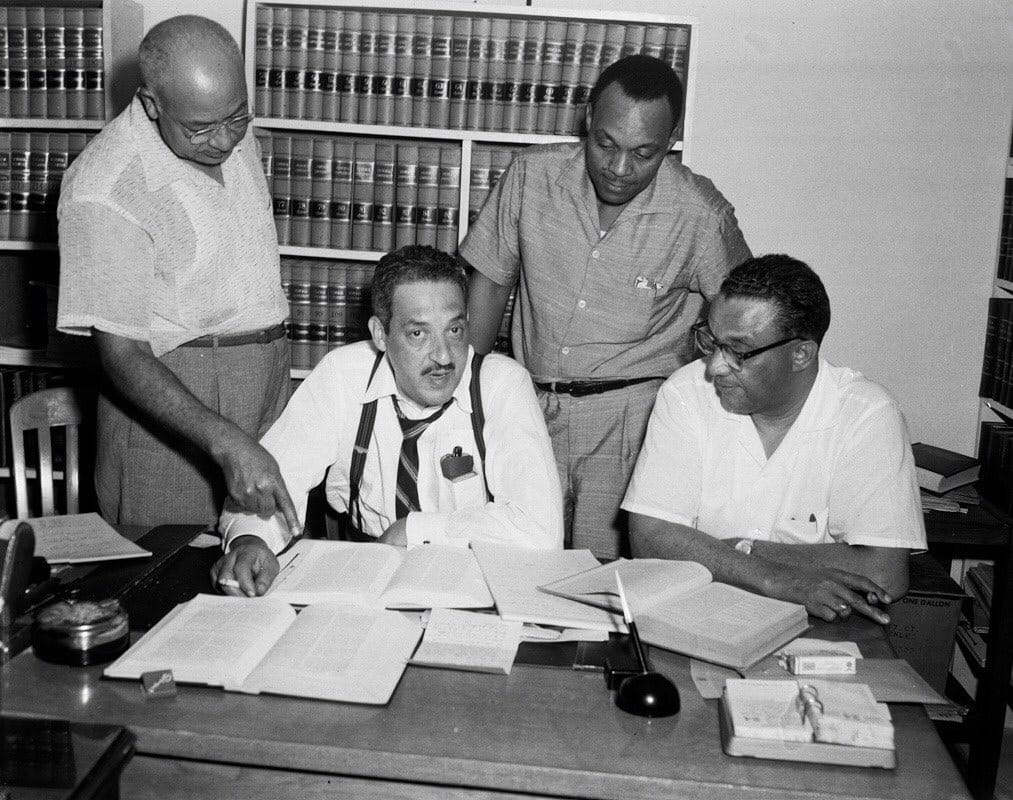
Durham was a leading Black Texan civil rights lawyer who, with Marshall and James M. Nabrit Jr. and the Legal Defense Fund of the NAACP, waged a long and arduous legal battle to change the course of history.
As an historian, I already knew that Sweatt v. Painter was not just a victory for Black Texans — it was the first step towards desegregating America.
Excited about this connection, I called my cousin Kenji, whose paternal family descends from Durham, to share what I had just found. It was a Friday night in Texas, so of course he was at a high school football game and promised to call me later. The next day, we spoke at length about his great grandfather William’s legacy — and for the first time, I began to see just how interconnected these stories are.
“We all grew up knowing my great grandfather, William Durham, played an important role in Texas civil rights history, but I don’t think most people today, even my family, really understands the weight of what he and Heman Sweatt carried,” Kenji Griffin Walton, my cousin and Durham’s great-grandson, told The Barbed Wire in a phone interview.
The Weight of What They Carried
As a young boy, Heman Marian Sweat — known to family and friends as “Bill” — was surrounded by heroes in the Civil Rights movement.
Born in December 1912, he idolized his father, James Leonard Sweatt, who was a founding member of the Houston Chapter of the National Advancement for the Association Colored People. Bill grew up watching him hold strategy sessions in his living room.
According to the University of Texas, Bill’s barber was Richard Grovey from Grovey v. Townsend, and his dentist was Lonnie E. Smith from Smith v. Allwright — both U.S. Supreme Court cases helped end all-white voting primaries in Texas. The Sweatt family’s neighborhood was also integrated, which was unusual for the time period in Houston, and Bill has said his father stressed that each of his kids would be educated academically. But he also taught them history at home: Bill considered his father a historian.
Bill swiftly followed in his parents’ footsteps. He graduated from Wiley College in 1934 and became an educator in Cleburne, where he taught and then served as the grade school’s acting principal in 1936. He entered medical school and matriculated in biology at the University of Michigan in 1937.
After his second semester, Bill left Ann Arbor and returned to Houston, where he married his high school sweetheart, Constantine Mitchell, in 1940. In his late twenties and early thirties, Bill was friends with legendary civil rights activists like Lulu B. White, who was president of Houston’s local chapter of the NAACP. The pair worked together during voter-registration drives in the early 1940s and raised funds for impending lawsuits their organization would help fund for members. He also sometimes wrote columns for the Black newspaper, the Houston Informer. Around this time, Bill became a postal worker and continued challenging discriminatory practices as he stepped into the role of secretary of the National Alliance of Postal Employees. An attorney helped document that discrimination, and the process piqued Bill’s interest in the law.
According to the Texas State Historical Association, it was William J. Durham — my cousin’s great grandfather — who advised Bill to apply to the University of Texas School of Law. However, Lavergne’s book contends that Lulu White had the idea and introduced the men. In either case, not only did Bill agree to seek admission, but he agreed to serve as the NAACP’s plaintiff if he was rejected on the basis of race.
But first, he had to apply.
In 1946, an NAACP delegation — including Bill and Lulu White — met with then-University of Texas President Theophilus Shickel Painter to debate the state’s segregationist policies. During that meeting, Bill presented his transcript and asked for admission to the law school. Painter, whose staff tried to persuade Bill to retract his application, told the state’s attorney general that Bill was qualified “save and except for the fact that he is a negro.”
Thus began a complex and contentious four-year legal battle, which involved multiple courts at various levels, as well as $2.5 million in legislative appropriations in a last-ditch attempt by the state to create and fund a two-room law school specifically for Black students.
Together, Thurgood Marshall, William Durham, the NAACP Legal Defense Fund, and the man from the third ward successfully sued the prestigious university. A case that was eventually heard in the U.S. Supreme Court. The long journey of testimonies and late-night strategy sessions in Durham’s family home in Sherman became one of the most groundbreaking cases in American history.
There in Durham’s modest two bedroom home on East Brockett Street, he selflessly turned his place of refuge into a planning ground for himself, Marshall, and the remaining lawyers who sacrificed their safety for the greater good.
Ada Anderson, an early Black graduate student at UT, said that her family and other community members in East Austin housed the Sweatts, but also the NAACP lawyers who couldn’t stay in local, segregated hotels. They wrote briefs at neighbors’ homes.
In 1949, Black students organized a mass registration protest in a show of support for Bill’s case.
The First Domino
Each of these interactions lead him to that fateful day — Sept. 19, 1950 — when he successfully registered for classes at the University of Texas Law School.
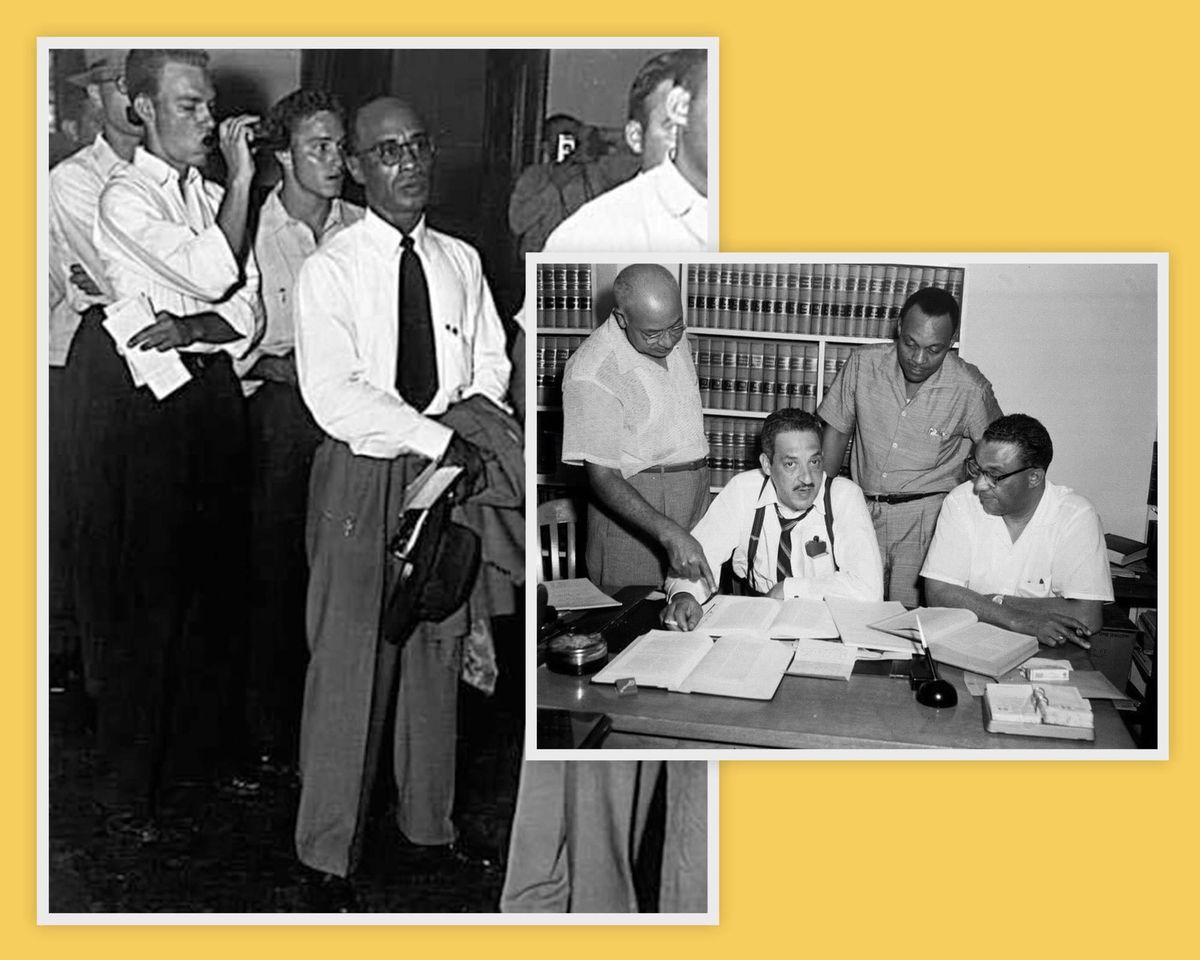
It was warmer than usual in the state capital, Texas was experiencing a severe drought. Despite the 93-degree heat, Bill stood in line with other incoming students wearing wool slacks and a crisp, starched white shirt fastened at the throat and secured with a necktie.
In a now iconic image by Austin photographer Neal Douglass for Life Magazine, 37-year-old Bill had removed his sports jacket and casually folded it over his left wrist, pens peeking from his breast pocket while gripping his fedora hat in the same hand.
In a now iconic photo, 37-year-old Bill had removed his sports jacket and casually folded it over his left wrist, pens peeking from his breast pocket while gripping his fedora hat in the same hand.
One can only wonder what emotions filled him that day. The weight of knowing that you had just played a pivotal role in kicking the sturdy legs out from beneath ol’ Jim Crow in a state that had, ironically, experienced its first racially motivated bombing just seven months prior. That had happened in South Dallas simply because white families didn’t want Black families moving into the neighborhood.
All these years later, the policy landscape for higher education in Texas is once again being shaken. In 2023, Gov. Greg Abbott signed Senate Bill 17 into law, which prohibits public institutions of higher education from engaging in diversity, equity, and inclusion activities as defined by the state. It’s hard to see these “anti-DEI” policies as anything other than a return to segregation.
And in fact, school segregation is surging 70 years after Brown v. Board of Education. The data shows gaps in public school funding, teacher shortages and fewer resources — all sharply divided by race.
On the surface, this legislature seeks to eradicate anything labeled as “DEI activities” such as programming and training designed to encourage inclusivity. Data reveals how short-sighted this eradication is: When diversity is intentionally fostered, corporations are substantially more profitable. If diversity, equity, and inclusion can have such a profound impact on corporate structures, imagine the benefits of championing diversity within our educational institutions.
The Sweatt v. Painter case was monumental for many reasons — like the first domino slammed onto the table of equality. The loud clack of that tile set others in motion. UT’s attempt to avoid integration by creating a separate law school — at first the Texas State University for Negroes, later renamed Texas Southern University — was quickly exposed as unequal, given the drastic differences between the schools’ resources. But that’s how the school began.
Bill’s case paved the way for many other exceptional Black students to enroll at UT’s graduate schools who then used their degrees to do more good, including William Astor Kirk, who began his studies at UT on the same day that Bill did. Kirk received his PhD in Government in August 1958 and then taught civic engagement to his students, leading the effort to integrate the Austin Public Library, the Methodist church, and facilities like Zilker Park and Barton Springs. The Supreme Court’s ruling became a blueprint for dismantling segregation nationwide. Without it, those later victories might have been delayed for years — if they happened at all.
But there are many lessons we can learn from Bill and his legal team, 75 years later. The rot of racism posing as meritocracy via “anti-DEI” initiatives is just one of the myriad — and relentless — ways that systemic biases get repackaged as normal. This isn’t specific to Texas or to education. The Trump administration’s curbing of federal diversity initiatives and cutting of essential jobs disproportionately affected Black women, according to multiple reports from ProPublica and The New York Times.
Earlier this month the U.S. Supreme Court rolled back restrictions on federal immigration enforcement tactics in California. Translation? Immigration experts say we’ve effectively legalized racial profiling.
These rollbacks in progress parallel laws and practices from the 1940s. In 1944, the U.S. Supreme Court ruled in the hardwon case of Smith v. Allwright that states must make voting in primary elections equally accessible to all races. Two years later, Bill was declined admission to UT Law in 1946. Ten years later, after Brown v. Board of Education, Texas Gov. Allan Shivers deployed state troopers to stop Black students from entering Mansfield High. Public schools in Mansfield, Texas weren't officially desegregated for another almost 10 years with the Civil Rights Act of 1964.
The Long Road to Justice
The fight never stopped, and today is no different. Let this serve as your wakeup call: This is the exact moment we should be strategizing.
“My father, Heman Marion Sweatt, seldom spoke to me about the landmark Supreme Court case that bears his name,” wrote Bill’s daughter, Dr. Hemella Sweatt, in Gary Lavergne’s book.
“Nor did he ever dwell on the price he paid so that all Americans could have access to institutions like The University of Texas Law School,” she added.
That silence echoes in the Durham family as well; he rarely spoke of his own sacrifices. When I interviewed Durham’s great-niece — the Honorable Judge MaryEllen Hicks — she recalled how her uncle inspired many other relatives to become successful entrepreneurs and lawyers.
“His legacy lives on,” Hicks said.
“I saw him, and he made me believe that I could be an attorney too,” Hicks continued, remembering his charm and kindness. “He had what you might call swagger! He was Obama before Obama!”
As a college student, her dream was to work for her famous uncle after graduating law school, but Durham died before she finished her degree. His absence didn’t stop her determination. If anything, it fueled her. Hicks was the first Black person and first woman to serve as a justice on the Texas Second Court of Appeals, according to the Black Women Lawyers Association of Tarrant County. She was also the first and only Black woman to serve as a state district judge in Fort Worth from 1983 to 1993, when she presided over the 231st State District Court, and she was the first-ever Black Probate Court Master in Tarrant County, beginning in 1983.
It’s clear that she carries the legacies of William Durham, Thurgood Marshall, and Heman “Bill” Sweatt, who are forever linked for their relentless fight for equality. Bill may have been the face of one of the nation’s most famous cases, but he never graduated from UT Law.
He risked everything and sacrificed even more.
The photographs from that September day in 1950 don’t show the toll it took — the exhaustion, both emotional and physical, that weighed heavily on Sweatt. The strain also fractured his first marriage, which ended in divorce shortly after the Supreme Court ruled in his favor.
By 1952 — after enduring racial harassment and threats at UT, according to the Texas State Historical Association — Sweatt left law school. But his actions had already changed the nation. He went on to earn a master’s degree in social work from Atlanta University in 1954, returned briefly to work with the NAACP, and he later built an extensive career with the National Urban League in Atlanta.
Sweatt also found love again, later marrying Katherine Gaffney and raising two daughters before his death in 1982. Because of him, and others named and unnamed who broke barriers, students across America now sit shoulder to shoulder in classrooms that once would have shut them out.
As the Supreme Court observed in his case, equality in education depends on more than facilities — it requires “those qualities which are incapable of objective measurement but which make for greatness in a law school… reputation of the faculty, position and influence of the alumni, standing in the community, traditions and prestige.”
“The criteria used by the court in the application of the separate but equal doctrine gave legal experts cause to believe that the doctrine was virtually dead,” according to the Texas State Historical Association. “It was clear from the opinion that a good-faith effort to supply equality of treatment without integration was insufficient; rather, it must be equality in fact.”
The dominoes that Sweatt tipped continue to fall, reshaping not only education, but the very meaning of equality.
And while I may be new to teaching, when I look at the varied faces of my students, I see them learning that the trajectory of their lives were shaped by the actions of their ancestors.
In the same way, our country can trace the turning point closer to equality back on that fateful September day.
Heman “Bill” Sweatt’s legacy stands as proof that the struggles of ordinary people, bolstered by the support of advocates and community, have always shaped the course of history — and will continue to do so long after we’re gone.