From Minneapolis to El Paso, Every City Is Now a Border City

I can’t stop thinking about Gustavo’s truck.
On a cold Monday morning this January, Gustavo Navos Morocho, 43, of Ecuador, and two relatives had been driving to a carpeting job in central Minnesota when federal immigration agents began to tail them. The officers pulled the men over, accused them of carrying fake identification papers and shackled their arms, legs, and feet before taking them away, he told me.
Gustavo said he had to abandon his truck on the side of the road. He slept with his feet still cuffed on the floor of a federal holding area in Minneapolis. His family members were shipped more than 1,300 miles south, from the snowy streets of the Twin Cities to a detention camp in the West Texas desert — to El Paso.
And so it goes. I can’t stop thinking about Gustavo’s truck, and I can’t stop thinking about how my hometown keeps coming up this way, sometimes in echoes, sometimes in a direct line that cuts through time and space, whether I am in Los Angeles, Chicago, Washington, D.C., or Minneapolis.
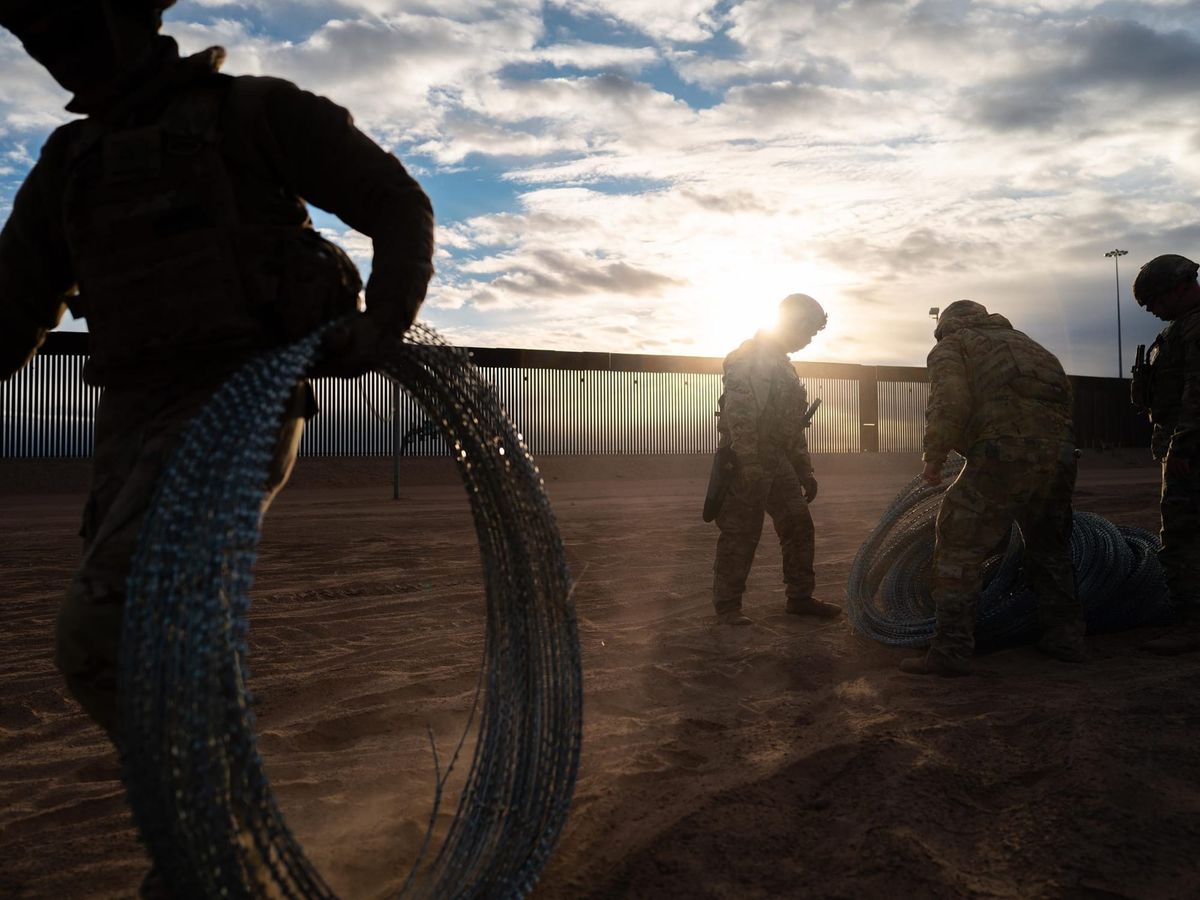
For more than a year now, immigration reporters like myself have been on the frontlines of the harshest deportation campaign this country has seen since World War II. We have covered raids and patrols by masked officers at courthouses, homes, and workplaces. We have reported on the fear and uncertainty spreading across Latino and Iranian and Somali and immigrant neighborhoods. We have tracked the militarization of major American cities.
The foundations for all these actions — the policies, the rhetoric, the treatment of migrants — were laid down long before, brick by brick, decade by decade in my hometown of El Paso.
Let me tell you a little bit about where I am from. El Paso sits at the farthest western tip of Texas, a place so far west that when I was younger it felt too isolated.
All I could dream about was getting out. It was only once I did that, I realized how special my city truly was: a place as much American as it is Mexican, as much Tejana and as it is Chihuahuense, a place that has allowed me to be all parts of myself, tanto de aquí como de allá.
But it was only much later, when I became a national political reporter for The Boston Globe, that I realized it was even more powerful than that. As El Paso became a backdrop to our nation’s immigration battles, I began to believe it held the key to understanding American identity. If only we can give the city the place it's due at the center — not the margins — of our story.
My book, “El Paso: Five Families and One Hundred Years of Blood, Migration, Race, and Memory,” out March 3, from Dutton, is a narrative history of our city, as told through the lives of the people who have crossed and shaped it, and in so doing, shaped the nation, too. The Chews, the Martinezes, the Holguins, the Rubios, and the Mura’ls. They trace Chinese, Mexican and indigenous Guatemalan roots. Some fled violence. Some sought opportunity. All have come and gone through the pass often described as “the Ellis Island of the Southwest,” a central crossroads for blue-collar workers, largely Mexican and Latino, who have been lured north by the promise of the American dream only to be cast out with every other nativist wave.
This past is personal. I started digging into it after the summer of 2019, when a white supremacist opened fire at a Walmart in downtown El Paso, decrying the “Hispanic invasion of Texas.” The massacre happened about three minutes from where I went to high school, and covering its aftermath was one of the toughest assignments I have ever had.
It was not a rupture in our history, but rather a continuation of a legacy.
Federal officials have defended their immigration enforcement actions in Minneapolis and other cities as necessary to capture criminals and rapists, arguing their dragnets are targeted at nabbing the worst of the worst.
“Let me send a message to anyone who thinks they can intimidate us. You will fail,” Todd Lyons, the acting head of Immigration and Customs Enforcement, told Congress in February, blaming elected officials and protesters for intensifying the rhetoric that he said endangered his officers.
But after he was pulled over in Minneapolis, Gustavo told me he believed the agents who stopped them on the road only did so because they looked Hispanic. (One of them even told him so, he insisted.) As they were chained up and waiting in the SUV, they could hear the officers high-fiving outside.
“‘Give me five! We got three!’” Gustavo recalled one shouting. “I couldn’t believe they would be delighting in someone else’s pain.”
I couldn’t help but remember that such attitudes and tactics are deeply rooted in operations long used against Mexicans and Hispanic residents on the border. In one example of that hostility toward migrants, Josiah Heyman, an anthropologist and border researcher who has studied the Border Patrol for more than three decades, was the first scholar to document why agents used the slur “tonks.” It was the sound the handle of their metal flashlight or baton made when it struck a migrant’s head.
Gustavo was released a day after his apprehension because it turned out he indeed had a valid visa given to victims of human trafficking willing to come forward and report their abusers to U.S. authorities.
More than a decade ago, Gustavo had crossed the border through Arizona with the help of coyotes, or smugglers, who took him hostage. They forced him to work in kitchens under duress and with little pay, he said.
Gustavo said those assailants often threatened him and other migrant men with weapons and sexually assaulted the women. It took him a while to come forward. He initially did not trust police to protect him from the people who had hurt him. He worried he would be deported. But in March 2023, after a long vetting process and investigation, he obtained his T visa.
A few days after his arrest, Gustavo was able to return to work, but he had not been able to recoup his visa from federal authorities nor his truck from the towing company. The truck was under his brother-in-law’s name, though he had spent three years of savings to purchase it.
The fine to retrieve it then stood at $1,000 and was getting higher every day.
That truck was his livelihood, he told me, his pedacito of the American dream. But when I asked him what he planned to do now, he took a deep breath.
“Don’t worry about me,” he said, “I’ve lived through worse.”
There’s plenty of that strength in El Paso, too.
Jazmine Ulloa’s new book, “El Paso: Five Families and One Hundred Years of Blood, Migration, Race, and Memory,” was published Tuesday. It is a narrative history of our city, as told through the lives of the people who have crossed and shaped it, and in so doing, shaped the nation.
Ulloa will be visiting Texas on her book tour, including the following stops:
3/9 EL PASO, El Paso Matters & El Paso Community Foundation at the Philanthropy Theater