More Than 1,000 Voters Were Turned Away Tuesday. ‘Total Chaos’ in Dallas Raises Alarms of Worsening Voter Suppression.

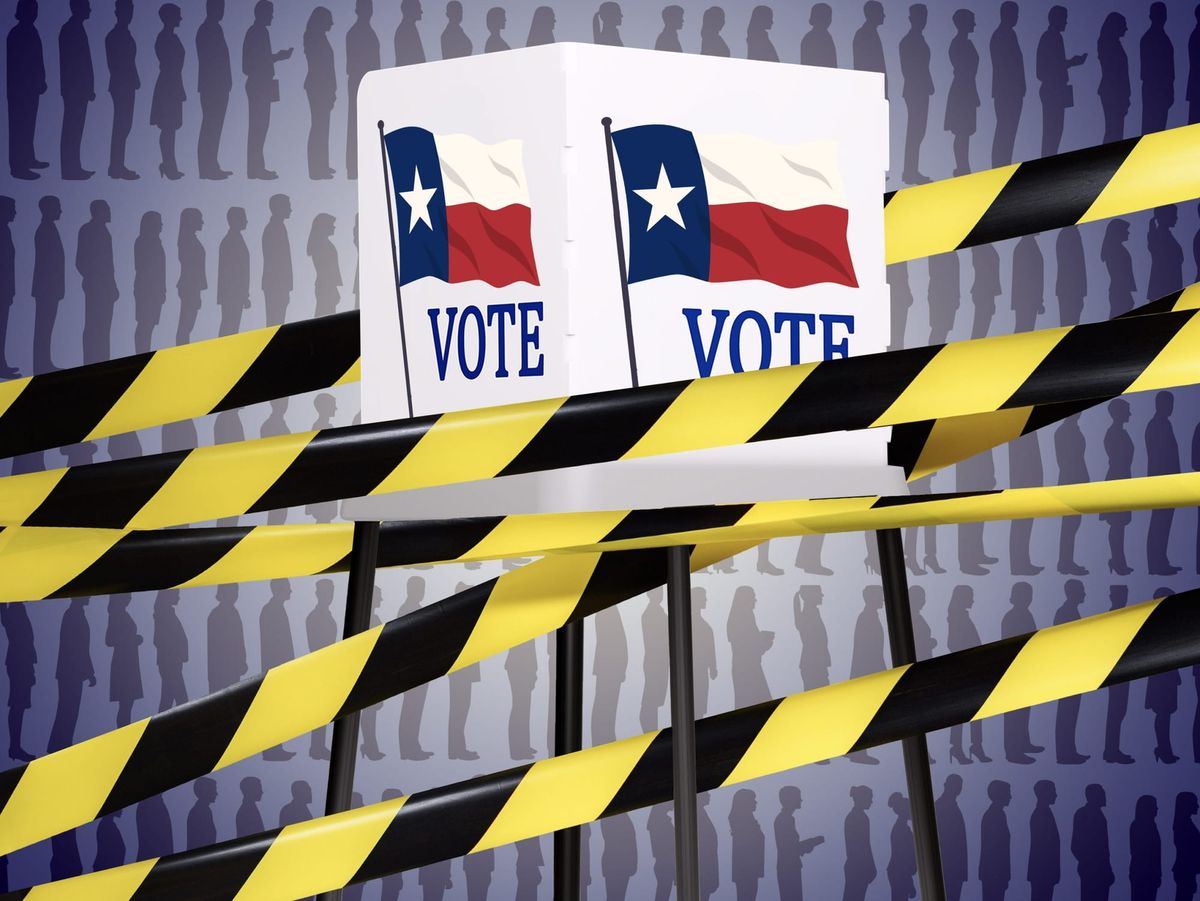
As if election nights weren't stressful enough, more than 1,000 voters were reportedly turned away from polling locations in Dallas on Tuesday.
That count — from Kardal Coleman, the chair of the Dallas County Democratic Party, via the New York Times — was only through the afternoon. By the evening it had devolved to “mass confusion,” a Dallas County judge said in an order extending voting by two hours. But before that time was up, the Texas Supreme Court put the extension on hold, and the Dallas Morning News reported that more voters were turned away.
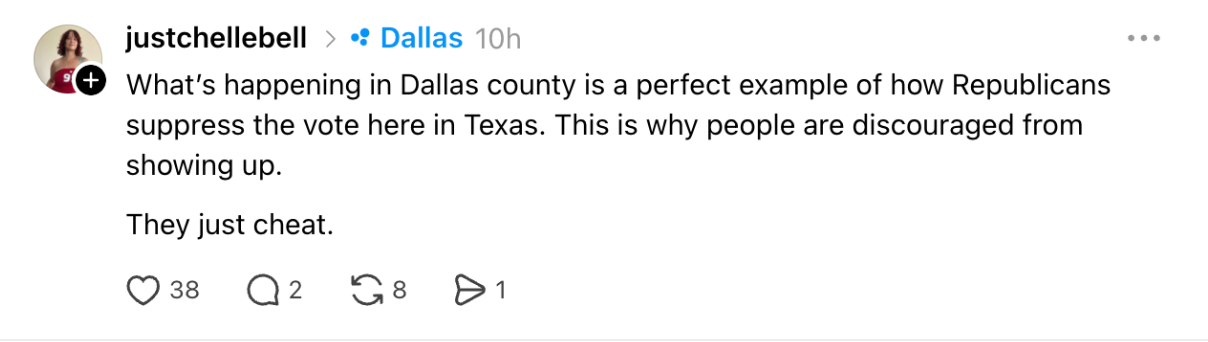
The chaos all stemmed from a change made by Republicans weeks ago — and is cause for alarm ahead of the general election in November.
I am a resident of Travis County. One of the many great things I get to enjoy as an Austinite is county-wide voting. I have the luxury of casting my ballot at the polling location of my choosing — whether it’s by my friend’s house, my H-E-B, or my wife’s office.
For years, residents of Williamson County and Dallas County have enjoyed that perk as well. That is, until the Republican parties there declined to participate in county-wide voting — meaning the Democratic county parties had to follow suit, according to state law. Residents could only vote at their assigned precinct polling place based on their address.
This caused the mass confusion the county judge noted on Election Day. Hundreds of voters who have, for years, cast their vote just like I have — wherever they wanted within the county — all of a sudden found themselves turned away from polling places. The Texas Democratic Party claimed that “hundreds” of voters were denied access to the polls.
The Dallas Free Press and Votebeat reported that 66-year-old Veronica Anderson walked 2.5 miles to the Martin Luther King Jr. Community Center to vote — before finding out she was at the wrong location and would need to cast her ballot at a different precinct she’d never heard of and didn’t know how to get to.
“Let's be clear about what happened here,” said Kendall Scudder, the chairman of the Texas Democratic Party, in a statement. “Both counties have spent a million dollars trying to get the word out about this change — a million dollars of taxpayer money that didn't need to be spent. Democrats pushed for a joint election. As it has been for eight years, It would have been cheaper, simpler, and more accessible for every voter in the county. Republicans said no.”
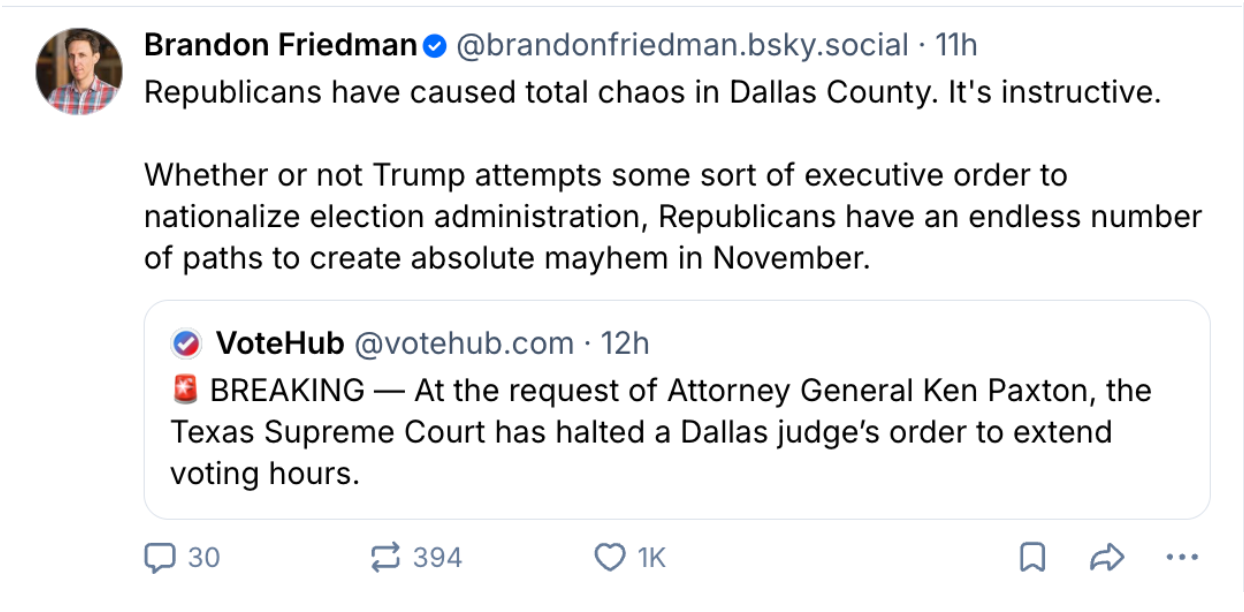
In addition, the Texas Secretary of State’s office didn’t receive an updated precinct map from Dallas County after the county’s precinct map was redrawn during the Texas GOP’s Trump-mandated gerrymandering spree this summer. Due to this oversight, the state’s votetexas.gov website directed some voters to the wrong polling location, according to a Dallas Morning News report.
The local Democratic party sued. For a moment, it looked like all had been settled — voting in the Democratic primary in Dallas and Williamson Counties was extended to 9 p.m., giving confused voters time to find their polling place and lawfully cast their vote.
Then as is so often the case in Texas these days, Attorney General Ken Paxton swooped in.
Paxton asked the Texas Supreme Court to block the lower court’s voting extension, and the Supreme Court agreed — kind of. The court mandated that polling locations in Dallas County set aside all votes cast by people who weren’t in line by 7 p.m., buying the court time to further mull over this decision.
On Wednesday, the Texas Supreme Court determined that votes cast by people in WIlliamson County between 7 and 10 p.m. would not be counted.
Luckily, for all of our sanity, it looks as if the post-7 p.m. votes cast in Dallas County aren’t enough to sway the election. Texas state Rep. James Talarico defeated U.S. Rep. Jasmine Crockett in the Democratic primary for U.S. Senate, by about 150,000, so even if every one of the “set aside” votes broke Rep. Crockett’s way, it isn’t enough to change the outcome. Crockett is from Dallas and has a stronghold there. She conceded the race and called for party unity, but told the New York Times that she was concerned her supporters could be reluctant to turn out in the general election, calling what happened in Dallas County voter suppression.
“The Democratic Party should absolutely prepare for the worst and get some things litigated right now,” Crockett said to the Times. “People will not turn out because of what’s happened, in my opinion, especially if no one fights for their votes to be counted.”
The precedent that this event set is chilling.
Paxton has an interest in the outcome of the race. He is headed to a May 26 runoff against U.S. Sen. John Cornyn after neither managed to clear 50% in the Republican primary. The winner will face Talarico in the general election. Establishment Republicans have been so concerned that a Paxton victory could open the door to a Democratic victory, they’ve funneled tens of millions into support for Cornyn, who many think has better odds of keeping the Senate seat in Republican hands.
Incidents like Tuesday's fiasco only intensify concerns over Republican voter suppression that could be coming in November.

As corny as it sounds, one of the best ways to protect your voting rights is to become as informed a voter as possible. Make sure you know your county’s rules for voting; help your friends understand the rules in their area and to cast their vote; don’t rely solely on state sources like votetexas.org and instead seek out resources published by your local county government (which will be running your election come November); and be sure to check that you’re registered to vote, and help your friends to do the same.
Then, vote for the candidates at every level who you believe will best protect your rights.
The overbearing workload required to correctly cast a ballot is a feature of the policy choices made by Texas Republicans, not a bug. Their hope is that, if they erect enough barriers to the ballot box, it will convince the “wrong” type of voters to simply give up.
In an election that looks like it could be a coin toss, that could decide the difference between Senator Talarico or Senator Paxton.
“I walked up here because I want to vote so, so bad,” Veronica Anderson, the 66-year-old woman who was turned away in Dallas after walking for miles, told reporters. The new barriers felt like “your self-esteem and everything is torn down.”
One thing is for sure: We all deserve a state government that is, at the very least, able to perform the basic functions of a democracy.