Why Do Texans Hate California So Much?

When the dystopian thriller, “Civil War,” came out earlier this year, there were a lot of skeptics who didn’t buy the premise.
Let me clarify. People weren’t dubious of the idea that the U.S. might be ripped apart (ok, ripped apart again) in a violent struggle. It was the fact that Texas and California were on the same side. Only in Hollywood, baby!
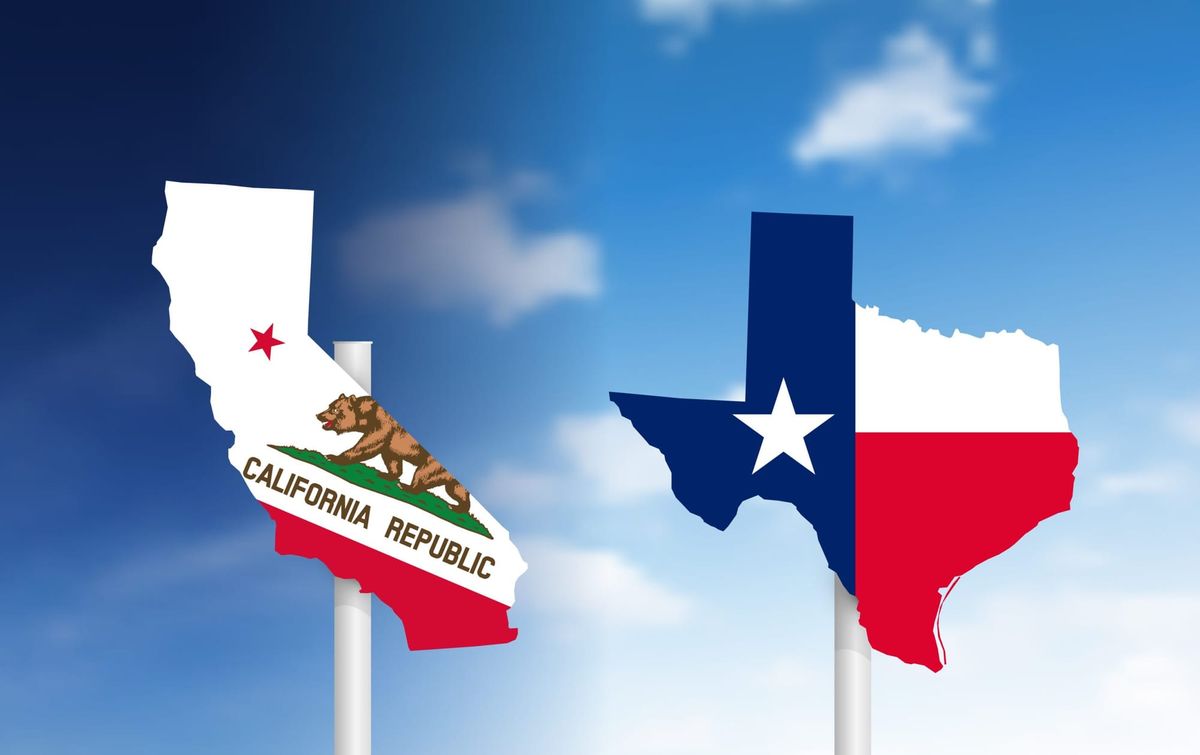
Of course, this is preposterous. The two states, as both will tell you, are diametrically opposed in nearly every conceivable way. We’re a red state; they’re blue. Texans want to be the biggest at everything, but California is more populous. It’s hard to imagine we’d team up to do anything, let alone overthrow the federal government.
And, at least in Texas, a narrative has developed — that Californians have deluged the Lone Star State, gentrifying us, and diluting our proudly held (sometimes extremely dumb, but shut up) identity.
Take Austin. If there’s one thing that topless Barton Springs hippies and Texas Capitol conservatives can agree on, it’s that Communists from the West Coast are driving up home prices, being rude in traffic, and ordering too many of those spooky self-driving vehicles. (You might be reading that last line thinking, wait, wouldn’t hippies be into Communism? But I assure you that, in Texas, a fair number of hippies are hardcore Rand Paul fans.)
How many Californians really are immigrating here, though? Is this just a tempest in a teapot?
Of the 668,000 people who moved to Texas in 2022, about 102,000 came from California, according to Texas Realtors’ 2024 Texas Relocation Report. Though, to be fair, we’re losing Texans the other way, too. About 42,000 traitors fled to California that same year, presumably to enjoy Satanic indulgences like affordable healthcare — and a coastline that doesn’t look like the chocolate river from Willy Wonka. (We wish.)
New arrivals from California “have been, fairly or unfairly, pilloried for decades by a self-appointed ruling class of ‘real’ Austinites who’ve been here for more than five years and/or know that it used to be called Town Lake,” said the guy who runs the Evil MoPac account on X, who this year was voted Best Online Personality by readers of The Austin Chronicle.
Our politicians regularly take shots at California’s leaders, whether it’s Gov. Greg Abbott blasting gas-powered car bans, Sen. Ted Cruz making fun of their energy issues, or Rep. Pat Fallon posting a picture of Texas kicking California in the balls while wildfires were burning.
But as much as they lambast California politicos, our state leaders welcome the richest West Coasters with open arms — especially those who came over during COVID, seeking a mask-free environment friendlier to anti-vaccine conspiracy theories. Our governor took glowing photos with comedian/podcaster Joe Rogan when he moved his act to Texas. And Elon Musk, with his unhinged posts and space program that’s basically a government-sponsored littering service, has been welcomed as a conquering hero. The more absurd and unhinged his posts on X get, the more our politicians slobber all over him.
On the bright side, Meadow Soprano lives here now, too.
As someone who’s lived in Austin for decades, I’ve found that the city has long been defined by a wistfulness for a bygone age (aka the 70s) and a defensiveness against anything perceived to have changed things. Californians are an easy target. Especially ones that move their shitty racist standup acts here.
For Texas, there’s often a grouchiness about losing our culture to outsiders, whomever they are. Sometimes that can look like xenophobia, a la the racist “great replacement” conspiracy theory. But in Austin, it can also look like pushback against gentrification — or cultural shifts.
“It is all a bit of a bogeyman,” said David Courtney, who writes the Texanist column for Texas Monthly. “Texans eat kale, too. But folks sometimes like to have a little fun with the whole down-with-the-California thing.”
Where did this California boogeyman come from? I decided to ask some friends and colleagues what in the name of Willie Nelson is going on.
Bagging on Californians used to be a gentle lark, Evil Mopac said, but that’s changed — and it has coincided with Austin’s rise as a “bro savior” hub.
“We’ve pivoted fairly quickly from lightheartedly (for most) demonizing tofu-loving Cali shitlibs in their Priuses and Teslas to being mildly horrified by the increasingly Musk-humping, Cyber Truck-driving, ‘Cali-is-too-woke-for-me’ legion of taintlords who can only get hard by listening to ‘The Joe Rogan Experience’ or flipping off a homeless person,” he said. “And, not shockingly, our rhetoric about them has devolved into something more aggressive and urgent.”
“The next decade should be very interesting, especially if Austin is morphed into a gulag by President/Emperor JD Vance in 2029,” he added, which sadly is only a little bit of an exaggeration considering that Trump is threatening to jail reporters and use the military against his enemies if he’s elected again.
Ok, that was depressing.
My next stop was veteran Texas journalist Bill Whitaker, who was also my city editor years ago at The Waco Tribune-Herald. Bill is one of the nicest people I know — especially in the newspaper business, which is not known for its warm souls. And as a longtime journalist in Waco and Abilene, he knows a lot about this state.
Whitaker moved to West Texas in the 70s to start his journalism career. He came here from Ohio, which of course immediately raised eyebrows.
After explaining to locals that he was born in Dallas, “that seemed to settle any reservations, notwithstanding the obvious fact my values remained those of someone who came of age above the Mason-Dixon line,” Whitaker said. “And I was careful not to mention the Mason-Dixon line,” he added. “Blood lines in Texas often lead back to seething, resentful Confederate ancestors.”
While Texas has always had a “heady brand of chauvinism,” Whitaker noticed a shift to something darker when covering the 2018 midterm elections.
“Rhetoric once reserved for late-night talk-radio hosts was now voiced by the president and his political allies, which meant it was on Texas lips as well,” he said. “More than anything in Texas, I heard fears of and resentment for hordes of invaders.”
To locals, those “invaders” could follow racist tropes, like pointing fingers at immigrants from South and Central America, or they follow this relatively new narrative about Californians. Who your interlopers are depends on your perspective — even progressives point out that Ted Cruz is Canadian.
Whitaker recalled interviewing a Waco-area woman in her 50s who was handing out candy on Halloween one year.
She told him about her time living in Colorado and “how great it was ‘till Californians began spilling into the state, contributing to crime and higher taxes.”
Of course, she now lived in Texas, and despite being a new arrival herself, nonetheless feared the oncoming tide from the West Coast. “The irony is that many Californians I subsequently encountered in Waco were just as conservative as most Texans, if not more so,” Whitaker said. “Indeed, that’s why they left California.”
Shout out to Chuck Woolery! Just kidding, he sucks.
Chris Koetter, an evening news anchor with News Channel 6 in deep-red Wichita Falls, where I grew up, said that Californians aren’t flooding into his city (their loss) — but Wichitans still have the same Texan pride that makes them cringe at the prospect of new neighbors.
“I assume most of it comes from not wanting an outsider coming in and trying to change our ‘brand,’” he said. “And out of all the other states in the union, Californians are the biggest threat to Texas culture because, well, they think they are as good as we are.”
That fits into recent conversations about the state’s evolution and Austin’s loss of identity. As Alex Hannaford’s new book, “Lost in Austin” put it: “The people inform the identity of a city. You grow too fast, and homogenization is bound to happen; cities will turn into replicas of one another.” Hannaford drew connections between Austin and San Francisco, where gentrification has led to the displacement of long-term, low-income residents and the resegregation of neighborhoods. Essentially, increased rents are linked to increased homelessness. Austin, people told him, has gone from weird and quirky to “corporate and pretentious.”
And for the recent transplants trying to avoid those tropes, Koetter’s advice is to be yourself.
“Definitely don’t try to be one of us” if it’s not a natural fit, said Koetter. “Just because Elon put on a cowboy hat doesn’t mean he should’ve.”
That struck a chord with me — the trope of the outsider moving to Texas and immediately wearing cowboy getups like they’re a costume. Which, they absolutely are, but they’re our costume.
Cowboy hats and boots have always struck me as silly on anyone older than an 8-year-old. Growing up, I don’t remember cowboy hats really being a thing, even in a small-ish city like Wichita Falls. Sure, a few kids wore them, but I knew just as many rural kids in baseball caps who listened to Guns N’ Roses or Metallica.
Los Angeles-based director and producer Charlie Fonville grew up in tiny Henrietta, Texas, about 20 miles outside of Wichita Falls. We both went to the University of Texas around the same time. (Full disclosure: He also directed and produced my standup special.)
Growing up, Fonville doesn’t remember California being so hated in Texas. He thinks it’s largely shaped by outlets like Fox News, which tend to harp on the negatives of the Golden Bear while ignoring its positives. (He’s not wrong. Just this week, Fox News’ website posted a story headlined: California’s battle over crime and homelessness is a warning to the nation.)
“When I talk to friends in Texas, they always say things like, ‘Yeah, all we hear about are fires and homeless people,’” Fonville told me. “But they clearly don’t know what they’re talking about because we also have earthquakes.”
Fonville is a Texpat who loves his new state.
“California is an undeniably beautiful state, and life here is really great,” he said. “People, for the most part, are laid-back and nice, and Los Angeles is the best food city in the world (although a lot of Mexican restaurants charge for chips and salsa, which would get you rightfully run out of Texas).”
He told me about a time when he visited Texas, attended a pool party, and had an exchange with a friend-of-a-friend who’d drunk too many Lone Stars.
And, to me, it perfectly summed up Texans: proud, a little too aggressive, and sometimes grudgingly nice.
“I don’t like you Californians coming here,” the drunk person told Fonville. “All you want to do is turn Texas purple and we don’t want that, so y’all just stay over there. You—you’re alright, though.”