Meet the Dallas DJ Behind (Maybe) the Longest Running Hip Hop Show On Air
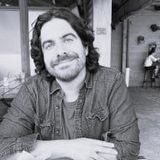
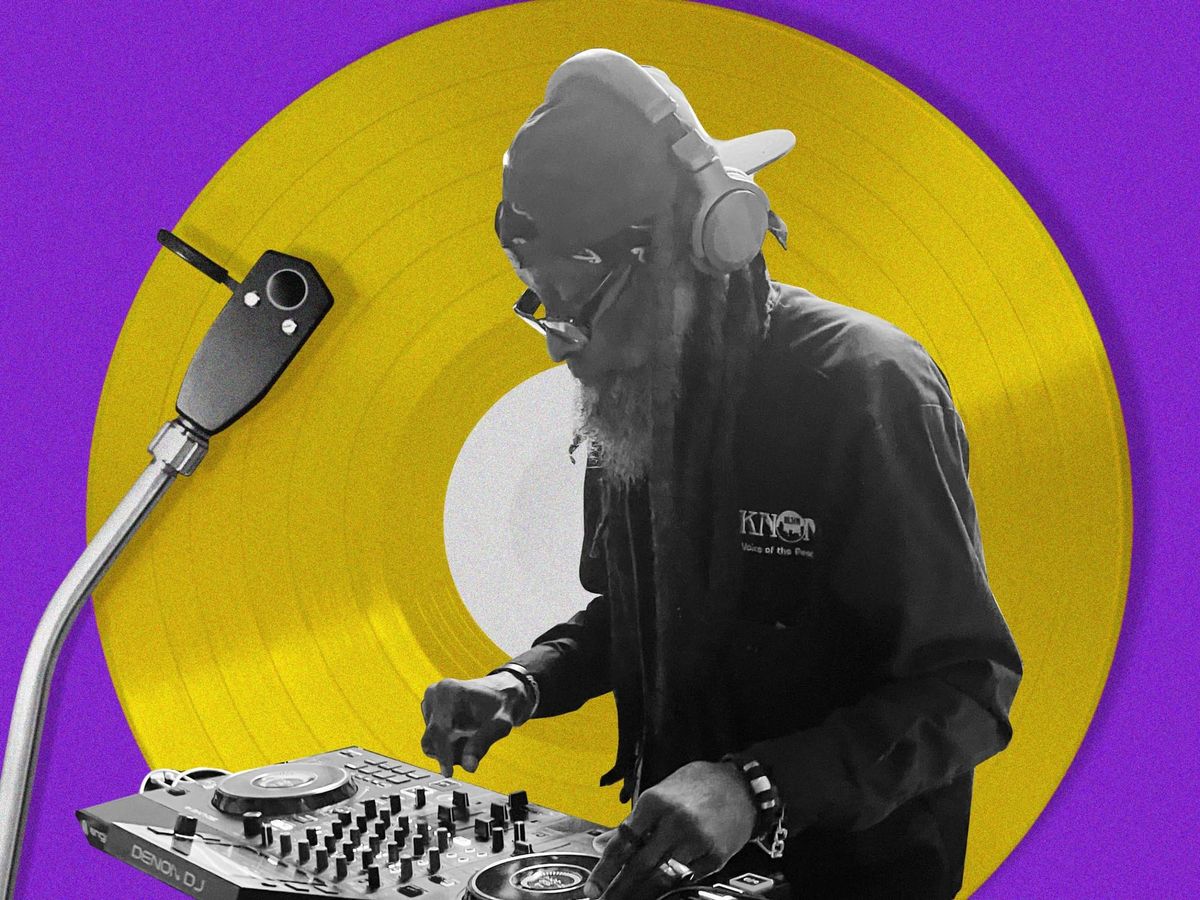
If you want to understand the casual celebrity of EZ Eddie D, sit with him on a porch. Preferably on a Saturday evening, and preferably at the busiest intersection of the Bishop Arts District in the rapidly gentrified Oak Cliff neighborhood of Dallas.
Less than two minutes into my conversation with him on such a porch, on such a busy Saturday, a honk came from a passing SUV. “EDDIE!” a woman shouted from the open window.
“Hey, what up!” Eddie yelled back. “You’re back in town?”
“I’m here to see you. If I can find a place to park.”
Less than two hours later, EZ Eddie D — real name Eddie Murphy — was in the studio for his weekly radio show, “Knowledge Dropped, Lessons Taught” on KNON, Dallas’ popular, long standing community radio station. He has made the mix and operated the boards for the exclusively hip hop show just about every week since 1987.
“Knowledge Dropped, Lessons Taught” might be the longest-running hip hop radio show in the world. It’s one of those claims that’s easier to disprove than to definitively prove, and I haven’t found evidence to confidently say it’s not true. “The Eclipse Show” on KGNU in Boulder, Colorado, predates Eddie’s show, but in those earlier years it started out playing R&B and Funk. Eddie has exclusively played hip hop since day one.Other shows have tenuous claims to being around since the ‘80s but were not continuous through the years or cycled through numerous hosts and formats.
Even if “Knowledge Dropped, Lessons Taught” isn’t the longest running hip hop show, its origins still land much closer to hip hop’s official birth year than to 2025.
Up until an hour before the show, you can catch Eddie, 64, at Dude Sweet Chocolate, an artisanal chocolate shop that’s become Dallas’ go-to for trendy, giftable snacks. He is the manager there, seemingly trusted for his people skills more than his culinary expertise.
Sitting on the front porch swing of the business, which is in a converted house, Eddie’s dreads hang down to his chest, concealed at head-level by a bandana under a backwards hat with “Oak Cliff” written in Old English. His beard has collected about as much grey as he has collected memories – that is to say, a lot.
“I’d love to be at my funeral,” he says, after I comment on all the times we’d been interrupted by passersby, who he gives a cheerful “peace” to.
A 1998 Dallas Observer story by the late culture writer Zac Crain describes Eddie as the “godfather” of the Dallas hip hop scene. Twenty-seven years later, “grandfather” might be more apt — and these days most of the kids have moved away.
That same Observer story states, “Dallas has enough talented hip-hop groups to make Eddie D's show one of the best on any station in the city.” Now, he says he doesn’t play nearly as much local music as he did in the early years, largely because far less is sent to him.
Later that night during the show, while a recorded ad break plays, he tells me that a few decades ago the studio would be packed with local artists who’d show up hoping to get him to play their song or even make time for a coveted interview. It was the city’s best — often the city’s only — hip hop showcase for homegrown talent. On this night, it was only me in the studio with him. If you drove by the station, you might think it was just another office building, closed for the night.
Eddie tries to conceal some internalized resentment about so many artists who he helped get recognition who didn’t continue to support the show financially or with their own platforms. If they paid his generosity forward, they certainly didn’t pay it back.
“It bothers me on some levels, just because, you know, if I would have been that way, none of this would be going on now,” he says, gesturing vaguely to the lively Oak Cliff intersection where street vendors are playing Tupac’s “Ambitionz Az A Ridah” and where a busking drum circle kitty corner to us had just yelled his name and thrown up a fist in support.
https://soundcloud.com/shorttx-1/01-edz-wav?utm_source=clipboard&utm_medium=text&utm_campaign=social_sharing
By the time Eddie arrived in Oak Cliff in 1984 from Cincinnati, he was primed for what would become his life calling. As a teen, he had his mind blown hearing Kraftwerk’s “Trans-Europe Express” (the core sample used in Afrika Bambaataa’s foundational “Planet Rock”) for the first time. Earlier, he’d clocked the way kids at roller discos reacted to the DJ playing One Nation Under A Groove records and thought, “Alright, I want that.”
He didn’t have much reason to stay in Dallas when he stopped in to visit his cousin, but when he heard a live radio broadcast of local tastemaker DJ Ushy doing a set at Club Pizzazz in Oak Cliff, he thought, “OK, I’m here. I’m home.”
The Dallas hip hop scene has taken plenty of twists and turns since Eddie arrived, often flirting with an identity or defined sound but rarely breaking through on a national level the way Houston hip hop did in the ‘90s and early 2000s.
That’s not to say Dallas hasn’t left its mark. In the mid-80s, Eddie credits the group Nemesis, who debuted with the single “Oak Cliff” as the first from the city to achieve state-level success. In those years, Eddie had his own hip hop group, The Fresh Ones, signed to the local Black Lion Records and managed by a man who went by Mr. Williams. Also managed by Mr. Williams was a 16-year-old female MC named Apples, who would later sell millions of records as Erykah Badu. In 1986, a 45-inch record was put out with The Fresh Ones on one side and Apples on the other side.
Eddie didn’t know Badu sang until the first single for her multi-platinum debut album Baduizm came out a decade later. During her initial transcendent rise, she came on “Lessons Taught, Knowledge Dropped” for an interview. Afterwards, she pledged $5,000 to the station in support of the show, which was the largest donation the show had received at that point.
Primarily known as the poster child for “neo soul,” Badu’s music is often overlooked for its large influence on hip hop. But collectives like Odd Future (primarily members Tyler the Creator and Frank Ocean) draw clear influences, consciously or not, from her albums.
Even more obfuscated in Dallas’ contributions to hip hop is D.O.C., especially the lyrics he wrote for others. D.O.C.began his career in Big D as part of the Fila Fresh Crew, before moving to Los Angeles where he struck up a friendship with Dr. Dre in the mid-eighties. He ghost wrote significant portions of N.W.A.’s debut album, Straight Outta Compton, and wrote a healthy portion of Dr. Dre’s lyrics for his iconic debut album, The Chronic. D.O.C.’s 1993 debut album, No One Can Do It Better, was met with critical and commercial success, but weeks after its release, he was in a major car accident that left his vocal chords severely damaged, haltinghis performing career in its tracks.
D.O.C.’s affiliations with Dr. Dre, N.W.A., and Snoop Dogg, as well as the way he dressed, (he wears a Los Angeles Kings hat on his debut album cover), led most fans to associate him with the West Coast. Few in Texas even knew he had come from Dallas.
More scattershot examples of Dallas culture touch hip hop history. Dallas Boogie was a movement that arose from about 2006 to about 2011, stemming from artists such as Tum Tum, the GS Boyz, and Dorrough. Songs that came out of Dallas Boogie typically had original dances associated with them. The massive hit “Teach Me How To Dougie” by the Cali Swag District is often credited to the West Coast, which fails to note that it derived from “My Dougie” a smaller but still national hit (with an accompanying dance) by Dallas rapper Lil Wil. If the Dallas Boogie movement didn’t directly lead to the dance-centric stylings of TikTok, then it certainly predicted it.
Kal Banx, a current in-house producer for Top Dawg Entertainment, the record label that birthed Kendrick Lamar, grew up in Dallas and cites Dallas Boogie as an influence in the beats he makes for artists like Doechii.
Realistically, Dallas’ most known hip hop exports have been two white rappers: Vanilla Ice and Post Malone, both of whom have been criticized for the outsized space they have taken up in the culture. These days, though, Dallas hip hop is at something of a high swing with a number of prominent rappers coming out of the city, none bigger than the multi-platinum BigXthaPlug, who initially broke through in 2022 with his anthemic single “Texas.”
Being from Dallas Texas, or even Dallas, doesn’t guarantee you anything when it comes to play on EZ Eddie D’s show. He is something of a purist, always leaning toward music that came out of the “golden era of hip-hop” when groups like KRS-ONE’s Boogie Down Productions mixed swagger with conscious lyrics.
You won’t hear music that degrades women on “Knowledge Dropped, Lessons Taught.” You are unlikely to hear a lot of materialistic music. At one point, as we spoke outside Dude Sweet Chocolate, a lifted pickup truck with giant rims drove by slowly, blaring current Atlanta sensation Playboy Carti out four open windows. “I don’t fuck with that,” Eddie says of the sound. “Just something about it. I graduated from fourth grade a long time ago. That’s remedial.”
He admits that he might mix in lyrics that touch on “gun play every now and then because that's the world we live in,” but claims he won’t play anything that glorifies violence. Locally, violence in hip hop has spilled off of the mic and into reality, like in 2020 when M03, perhaps the biggest Dallas rapper at the time, was killed in a drive-by shooting on I-35. Earlier this year, Dallas police charged Yella Breezy, who was feuding with M03 and perhaps his biggest competition on the scene at the time, with organizing and paying for the murder.
Perhaps more than his taste, though, Eddie’s show is defined by his skills. Using a digital turntable, he blends records with precision, an ability he says took him about a year to learn how to do. It’s rare for a modern radio DJ to blend records (essentially overlaying songs on top of each other to create seamless transitions), and Eddie’s techniques have been refined for decades.
Eddie describes himself as something of a Luddite when it comes to technology, but to see him blend records in person — navigating between the turntables, a laptop, and the sound levels on the radio — is like watching an air traffic controller in a flow state. It’s a level of talent that can actually be under-appreciated when listening on the radio; at one point he blended four songs at once so crisply, it convincingly sounded like just one song to the casual ear. He wasn’t going linearly; beats were phasing out and coming back later, meshing with the lyrics. That a healthy portion of his music is deep cuts by largely unknown artists (“I used to say we’re so underground, we’re looking up at the underground”) adds to the illusion that you’re hearing only one song at a time. Your phone’s Shazam app does not stand a chance during Eddie’s show.
Insisting on top tier lyricscism from the artists he plays, his blending adds an additional musicality, keeping the show a party regardless of the heaviness or levity of the lyrical themes. “It’s got to be funky,” he says. “It’s got to be danceable.”
In Eddie’s case, what’s danceable hasn’t changed over the years. People have approached Eddie and told him that they listened to his show as teenagers and now have kids who have graduated high school. It’s a passion for the genre that keeps him coming back, hunting for new songs to play. “I think about hip hop 24/7,” he says. He roughly divides the songs into two categories: old school (the classic songs of hip hop legends) and true school (new music, often underground, that he believes meets the standards set by the former category).
As noteworthy as his longevity is the fact that Eddie has never made a dollar from his radio show. KNON is a community radio station, kept afloat entirely by listener support. Radio hosts, even legendary ones, must meet listener pledge goals every quarter to stay on the air. From that perspective, the amount of money that Eddie has raised over 40 years is staggering to consider.
On the other hand, community radio doesn’t have to answer to anyone but the FCC. The same goes for its DJs. “I get to say what I want, and I get to play what I want,” Eddie tells me. “You can’t put a dollar on that.” In any given episode, he might talk about racism taking over the country or he might congratulate a Dallas high school soccer team for winning their recent game.
When Eddie plays the Ultramagnetic MCs (the group that launched the career of rap legend Kool Keith), he seems to be winding down his blending and mixing as the show itself winds down to the final few minutes. He finishes with Kraftwerk’s “Trans-Europe Express” and mostly lets it play on its own, almost like he is showing the backbone of the entire mix’s core. A song ahead of its time meant to sound like the future, the German group’s hit record feels like a stripped down acoustic subtlety in the aftermath of the past hour and 55 minutes of Eddie’s work.
With no mixing to be done, he has a moment to talk. I ask him how much longer he wants to do the show, and he dodges the question. Instead he cops to wanting something more than just showing up every week and hoping the listeners are tuning in. He would like to be in the Hip Hop Hall of Fame.
Twenty-five years ago, Eddie and his show were vital parts of the growth of a local scene and a worldwide genre. Now, he’s more of a historian, showing that hip hop’s vibrancy was always more than the sum of its songs. It will go on without him, continuing to branch in directions he might not care for, but to deny him his contribution would be to undermine the entire movement.