Texas Is a Lot More Queer Than You Think. I Am Too.
I think I need to start at the beginning, because I’ve never talked about this publicly.
During freshman orientation at McGill University, I ended up on a pedestrian-only stone street strung with pink decorations: The Gay Village in Montreal, Canada.
There’s a Saint-Pierre-Apôtre Church with a Chapel of Hope dedicated to AIDS victims. Rainbows. Murals. When I was last there, more than 10 years ago, there were cute boutiques and hair salons, tattoo parlors, and a McDonalds for post-dancing McFlurries. It’s where I saw my first-ever drag performance, and it’s where I shared my first kiss with another woman in 2009.
I was barely 18, and I realized one day that I had a massive, ridiculous, world-ending crush on an older girl in my (you guessed it) Introduction to Women’s Studies class. And also a bespectacled brunette editor on the school paper. And this girl in the waiting room of my counselor’s office. And one who lived in the all-girls dormitory with me. And this — anyway, you get it.
I wore increasing amounts of plaid from Urban Outfitters. I got my ear cartilage pierced. I saw Tegan & Sara perform live. I had a lot of questions, so I spent hours on AfterEllen.com. I watched “The L Word” and “Queer as Folk,” and then I texted with friends who’d come out to me years earlier. It was the first real secret I ever told my brother.
This one night, after dancing to Lady Gaga at a gay club that charged a cover, my date and I experienced a rite of passage. We were in a post-dancing haze walking back toward the dorm at McGill, when we stopped and kissed at a street light. Two dudes yelled “dyke!” from across the otherwise empty street. It paled in comparison to what I’ve experienced in my life since, but I felt shamed — like we hadn’t been careful enough, despite the fact that gay marriage had been legalized in Canada more than four years earlier. (For what it’s worth, Facebook tells me that she and her wife just had a baby boy this past summer.)
I came out as bisexual to the neighbors on my dorm room floor using glitter-covered postcards. I had a serious boyfriend in college, too, which is probably why in November 2011, I reported a feature on bisexuality, biphobia, and its place in the queer world for The McGill Daily. Please be forewarned, it’s like a parody of itself. And today feels dated, which is a real relief.
When I graduated, I took the first opportunity I was offered: an internship covering the Texas Capitol in Austin. I grew up in Texas, but I had never heard that “Cowboys are frequently secretly fond of each other,” which is, of course, a song written by Lubbock musician Ned Sublette in 1981 and covered by Willie Nelson in 2006.
I wasn’t sure what I was in for, how comfortable I would be expressing this newly discovered part of my identity, or whether that brief street harassment I experienced as a freshman might look bigger and scarier in a place like Texas.
Even after moving back, I was woefully ignorant about how queer Texas is.
As it turns out, Texas is one of the queerest states in the country. Only California has more LGBTQ+ identifying residents. Texas is home to more queer people than all the queer people in Canada. And more than double the number of queer New Yorkers. I had a Brooklyn roommate — a fabulous Italian cook, now a phenomenally talented drag queen — who used to enter my room with the greeting, “Hey, sweaty!”
Now multiply that energy by 1.8 million.
Texas is home to vibrant gay, lesbian, and drag scenes. And not just in Austin, Houston, and Dallas, but in many, many smaller areas. Gay and trans mayors run cities — Annise Parker was one of the first openly gay mayors of a U.S. city when she was elected in Houston in 2009 — but a lot of queer people in small towns have not come out to their constituencies.
When I graduated and moved back to Austin at 21, I spent my nights drinking Redbull-vodka slushies while dancing to Robyn during “Tuesgays” at Barbarella’s on Red River. The night a drag queen at Oilcan Harry’s looked at my outfit and told me I “better work, bitch” was a formative experience. It was 2013, so naturally I was dating a segue tour guide who performed stand-up jokes about me. She’s the first woman I ever said “I love you” to romantically. I handled it poorly, which is a generous way of putting it.
Of course, when I moved to Waco for work, I didn’t stop being queer. I dated a bartender whom I would literally pick up and spin around at her workplace — the way people do on “The Bachelor.” She was funny, clever, and kind. She kept me company when I was sick. Like a lot of failed lesbian relationships, we’re still good friends.
A queer colleague at The Waco Tribune-Herald was the first person to introduce me to the question, “Are you family?”
Then, on the morning of June 26, 2015, I was about to head to the office with my police scanner when the U.S. Supreme Court ruled in Obergefell v. Hodges, legalizing same-sex marriage nationwide.
At the time, I was a local crime reporter — but this story was big, and we had only a handful of full-time staff. So I was assigned to cover it.
McLennan County was one of 16 counties out of 254 in Texas to issue marriage licenses that day. It was one of the profound joys of my life to witness 10 couples commit to each other in the county clerk’s office.
Unlike covering a pride protest or a march, this was the first time I was interviewing queer Texans who were not part of a demonstration of any kind. Just regular Texans from small towns who loved their partners.
Subscribe to the Big & Bright 🌈⭐👏 newsletter, where we’ll be covering the good, the bad, and the joyful aspects of queer life in Texas
When the news broke, 32-year-old Jessica Preciado and her fiancée, 31-year-old Jaclyn Owens, were at an OB-GYN appointment checking on the health of their baby girl, whom Jaclyn was carrying. The baby was due in three months, they told me. They’d been together eight years, and they had a commitment ceremony in Las Vegas four years earlier. But they didn’t know how long they’d have to wait to get legally married where they lived, in Hewitt.
“I just really wanted it to happen before the baby comes,” Jaclyn told me that day. They were worried about the cost and logistics of having a baby — and being in the hospital — while not being married.
By 11 a.m., they had a marriage license, beginning the 72-hour mandatory waiting period before a Texas wedding. They were the third same-sex couple to ever receive a marriage license in Waco.
“Now we can do it like everyone else,” Jessica told me about becoming a parent.
An hour later, I watched Sylvia Ramirez, 44, and Rachel Segers, 35, who lived in Mart, get their license too.
“We’re going to get married now before they change their minds,” Rachel told me.
Another woman, Mary, said she had a fear that we’d wake up the next day and Texas would find a way to prevent her and her soon-to-be-wife Tammy from getting married. She wasn’t willing to provide her last name for the newspaper, out of fear of discrimination at work.
“I never thought it would happen in my lifetime,” said Tammy.
To my delight, and because we had great photographers, one of the couples I interviewed appeared on the cover of The New York Times the next morning. Forty-seven-year-old Michael Crow wore a burnt orange University of Texas baseball cap. His soon-to-be-husband, 44-year-old Robert Woodcock, was wearing a hat too, along with a SpaceX t-shirt. Both men wore cargo shorts and beards. On our front page, both men were beaming with joy. In the Times, they were kissing on the lips.
Robert saw the news of the ruling online around 9 a.m. from his desk at his office.
“I started crying right there at work and called Michael,” he told me that day.
They received their marriage license in front of my eyes, around 1 p.m., standing right between framed Texas and American flags. They told me they were planning their wedding for July 4.
Before the news broke, Robert told me he worried he’d never be able to legally marry his partner of two years. Then, in an instant, that all changed.
It meant everything, he said.
“To be able to stand and say, ‘I love this guy with everything that’s in my heart,’” Robert said. “It doesn’t matter what other people might think.”
He turned to his soon-to-be husband and said: “I love you and will always love you.”
You Already Know How Hard It Is
Of course, there’s the bad too. A few months ago, we wrapped up the 2025 legislative session(s) and, as has become a cruel habit of Texas politicians, lawmakers have once again made the lives of LGBTQ+ Texans materially harder.
In 2020, the Supreme Court ruled that employers cannot discriminate against LGBTQ+ Texans on the basis of their sexuality or gender identity. But, in 2022, after Texas Attorney General Ken Paxton made our state a plaintiff in a suit against the federal government, a Trump-appointed judge ruled that Texas employers can fire you on the basis of how you dress, your pronouns, or the bathroom you use.
That same year, the state’s department of health removed resources for LGBTQ youths from its suicide prevention webpage — sending a stunning signal about its apparent apathy for the death of queer children. “We’re talking about a group of young people who are more than four times as likely to attempt suicide compared to their peers,” a director of advocacy and government affairs at The Trevor Project told NBC at the time.
To be queer in Texas is to be enraged, joyful, desperately frustrated, emboldened by solidarity, sometimes scared for yourself and your friends, and other times grateful for a thoughtful, sparkling community. In Texas, and in America at large, I know this personally, and I have witnessed it professionally. I’ve edited or reported on the full gamut. Marriage proposals on the Texas House floor. The erasure of Pride crosswalks. Bomb threats at drag shows. Threats of violence at schools. HIV diagnoses. Trans Texans killed by violence. The Pulse nightclub shooting. And so many other hate incidents.
In July 2024, Joshua Ybarra was harassed with anti-gay slurs while he was beaten so severely by three men that he went unconscious after leaving a gay club in Austin. In March 2025, Travis County declined to prosecute the case. In 2023, Akira Ross was gunned down in Cedar Park by a man yelling homophobic slurs in a violent attack that was caught on video. “It was a hate crime,” her father told the Austin American-Statesman. Ross’s alleged shooter was arrested on murder charges, with a bail set at $1,000,000.
Chaya Raichik, better known as “Libs of TikTok,” was tied to 10 hate incidents in Texas between June 2022 and June 2024, including bomb threats at four Planet Fitness locations, after she highlighted their trans-inclusive locker room policies. A Fort Worth middle school also faced bomb threats in March after a post by Raichik. Then, in June, another bomb threat forced the temporary cancellation of a drag show in Austin. As our contributor Kit O’Connell reported in the Texas Observer, a Midland drag show scheduled to take place in January was canceled over threats. In September, Austin police issued arrest warrants for two men who were accused of a transphobic Barton Springs assault.
Queer people have always lived here. According to historians, on the 19th-century Western frontier, men lived in a primarily homosocial society — and sometimes, men turned to each other for physical intimacy.
Unfortunately, as long as there have been queer Texans, they have faced discrimination.
There’s only one time in its history that the Texas Senate has officially investigated anyone for sexual harassment — and it wasn’t Charlie Wilson or any of the men you’ve read headlines about. It was in 2001, when three women were accused of “lesbian recruitment,” then fired, in a case that The Austin Chronicle called “The Senate’s Witch Burning.”
“In my heart of hearts I think (she) got fired because she was gay,” one of the women’s’ friend and lawyer, Karl Bayer, told us when we were reporting for Texas Monthly, “and the whole thing could have exposed, ‘Oh my god, the Senate has hired gay people.’ ”
Big & Bright 🌈⭐️👏
There’s a reason that I’ve only really hinted online about my bisexuality until now. I know Texans can be conservative. I’m from here. My extended family lives here. I’ve been trying to avoid giving my aging grandparents a heart attack. And I have always been vaguely afraid of the lack of job protections for queer Texans. (See: the Texas Senate.)
Mostly it’s been about fear and privilege.
There’s privilege in the fact that I appear straight, and I’m bisexual — which means anytime I have dated men, I’ve been sort of invisibly queer. For a long time there was fear of discrimination at work, but now I’m very lucky to work somewhere that isn’t an issue.
But frankly, I’m starting to get sick of this narrative of disenfranchisement, hate crimes, discrimination, and threats being the only one.
With how we talk about it, it’s easy to feel Texans — not just Texas politicians — are more conservative than they are. In 2023, Texas Politics Project asked more than 1,000 registered voters whether they thought same-sex marriage should be legal and found an almost even split on the issue. (Nationally, about 71% of Americans support same-sex marriage, a fact I hope we all remember if Obergefell ever gets struck down.)
“Public opinion in Texas supports the passage of non-discrimination protections for LGBT people,” according to an employment discrimination study published by UCLA in 2015. “In response to a national poll conducted in 2011, 73% of those polled in Texas said that Congress should pass a federal law to prohibit employment discrimination based on sexual orientation and gender identity.”
That means there are more queer Texans and queer allies in Texas than conservative lawmakers and commentators want you to think.
At The Barbed Wire, we believe in mischief, joke-making, and the importance of the fourth estate. Embracing the truth, even when it isn’t convenient. And acknowledging our viewpoint instead of pretending not to have one. My fulfillment of that ethos, which is essential to my understanding of ethical storytelling, has been incomplete until now.
I’m a millennial woman journalist with no husband, no children, and a small dog who might as well be a cat. If you’ve been paying any attention, you know that basically makes me Vice President JD Vance’s worst nightmare.
Now that Libs of TikTok convinced Gov. Greg Abbott to threaten every city’s funding if they don’t erase rainbow crosswalks, I feel an imperative to remind us all that there are a lot of us. We’re everywhere.
Luckily, we’ve got help on that score. The Kind Clinic and Texas Health Action are underwriting queer coverage from The Barbed Wire in what will be our first sponsored vertical. It’s called Big & Bright, and it’ll include a newsletter delivered right to your inboxes every two weeks with original reporting and curation of queer Texas culture and news. All essays, reporting, and analysis will be editorially independent.
We’ll be writing about the good, the bad, the joyful. Queer people in Texas aren’t always the victims of a tragedy. Sometimes we’re the artist, the hero, the performer, the jokester, the observer — or the leader of a digital newsroom, in my case.
It’s important to me that I’m transparent in this moment, because I’m not just an ally, as I have often portrayed myself online. I’m family. And because I’m about to ask queer people in Texas to tell us their stories, I want to be absolutely clear that I’m in it with you — alongside rockstars, politicians, and celebrities that surprised me, frankly.
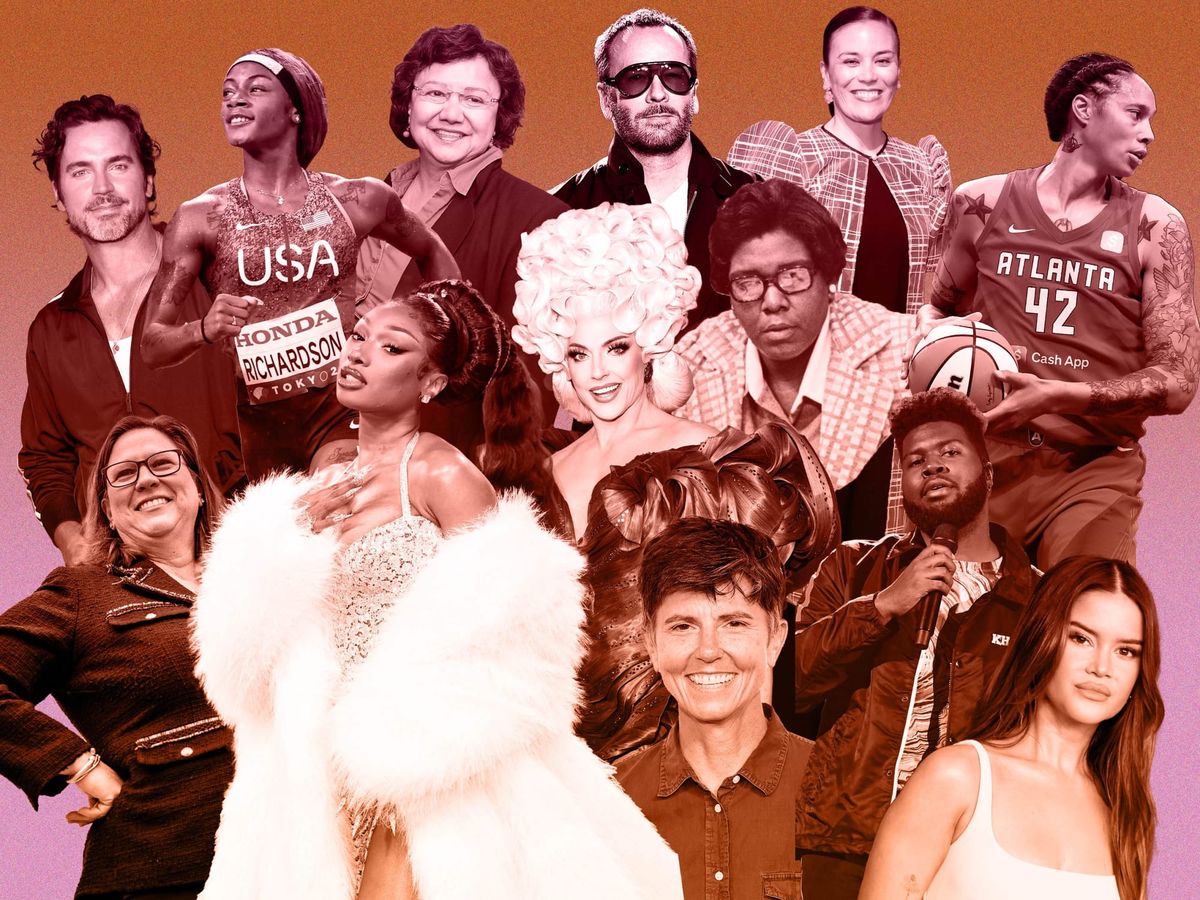
I read Tig Notaro’s books and listen to her podcasts. I’ve watched Sha’Carri Richardson race. If you’re a fan of St. Vincent, Demi Lovato, or Maren Morris, they too are queer Texans. There are historical figures like Congresswoman Barbara Jordan, but also gubernatorial candidate Sheriff Lupe Valdez, and Congresswoman Julie Johnson, along with several out, gay state representatives currently serving in the state legislature. Also San Antonio’s current mayor, Gina Ortiz Jones.
Maybe you knew Alyssa Edwards, the famous drag queen, lived in Dallas. But did you realize that “Queer Eye”’s Bobby Berk and Karamo Brown are both from Texas? And that Jonathan Van Ness moved to Austin after filming a season here? That means at one point a majority of the “Queer Eye” guys were Texans.
As Eric Webb once wrote for us, “Is Beyoncé gay? No, but also, yes.” Same goes for San Antonio’s Joan Crawford.
We’ll be cooking up in-the-moment cultural coverage of what’s happening both online and irl — like reviewing Khalid’s new album when it dropped earlier this month. There’s a whole history of gay cowboys, if you know where to look.
There’s queer line-dancing, and there are gay rodeos. Adult summer camps. Churches. Roller derby leagues. Queer fight clubs.
Filmmakers. Scientists. Academics. Police officers. Pastors. Ballroom dancers. Candle makers.
Two bearded guys in cargo shorts getting marriage licenses in Waco on a random weekday.
These are the normies.
The people in the Capitol who are obsessed with which bathrooms we use, what we do in our own homes, and what kind of art we make? The feds who want to strip away retirement benefits from trans Air Force veterans being forcibly removed from their positions?
Those are the weirdos.
They’re invested in erasing our stories, our presence, and our lives because it makes them look like they’re winning a culture war — and that is how they’re maintaining power.
But that’s villain shit. And not the camp kind.
So, if you’ve made it this far, please subscribe to our free newsletter, buy our pride merch, and send us your absolute gayest Texas stories.
Welcome to a new Big & Bright era in Texas.
I bet they’ll hate it.